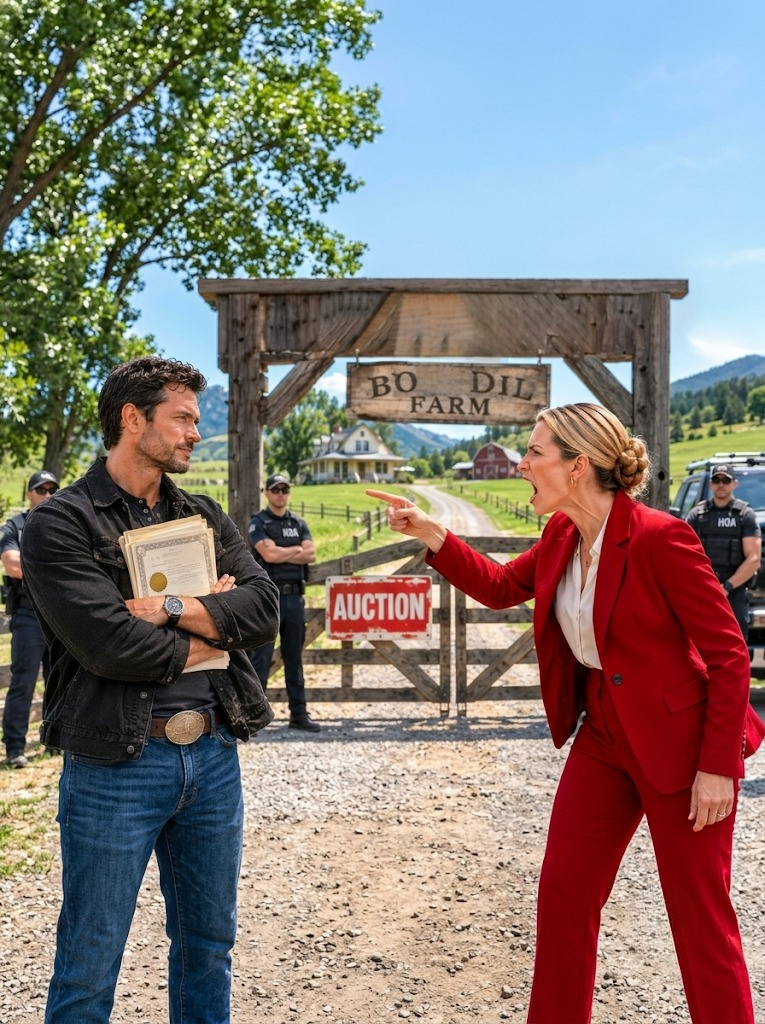
The first wall of my family’s mill came down at 6:17 on a Monday morning.
I was thirty feet away when the excavator bucket hit it.
Stone exploded into the yard.
A timber brace snapped somewhere inside.
And across the road, the president of Hawthorne Ridge Estates stood beneath a red umbrella filming the whole thing on her phone.
“Stop the machine!”
I ran toward the excavator.
Two private security guards stepped in front of me.
One put a hand against my chest.
“Property is under emergency demolition order.”
“My property?”
He pointed toward the woman with the umbrella.
Her name was Claudia Vale.
Fifty-eight years old.
HOA president.
Retired corporate attorney.
And apparently the woman who had decided my mill needed to disappear before breakfast.
My name is Evan Mercer. I was forty-seven, a restoration carpenter, and Mercer Mill had been in my family since 1894.
My great-grandfather built it beside Red Creek in western Pennsylvania.
My grandfather kept it operating until the late seventies.
My father spent half his retirement preventing the roof from collapsing.
And for the previous six years, I had been restoring it board by board.
The water wheel turned again.
The original grain elevator worked.
I had rebuilt the headrace with local stone.
It wasn’t a museum.
It wasn’t a business.
It was simply the oldest thing my family had ever managed not to lose.
Claudia crossed the road.
Behind her hung a white banner:
HAWTHORNE RIDGE — PHASE FOUR — 52 LUXURY HOMES
The proposed entrance road on the rendering ran exactly where my mill stood.
She held out a document.
“County declared the structure unsafe.”
I read it.
Red seal.
Emergency condemnation.
Signature of county inspector Martin Dale.
It looked official.
Almost.
The road name was wrong.
The form called it Old Ferry Road.
The county had renamed it Mercer Hollow Road twenty-six years earlier.
And Martin Dale had inspected my mill only four months ago.
His signature on that report did not look like this one.
“Where did you get this?”
“From the county.”
“Who served it?”
“You were notified.”
“No.”
She smiled.
“You’ve ignored every attempt to resolve this.”
I pulled out my phone.
Photographed the order.
The excavator.
The security vehicles.
The license plates.
Claudia’s smile disappeared.
“What are you doing?”
“Making sure I remember the morning.”
The excavator operator raised the bucket again.
Then the damaged wall shifted.
Several stones rolled away from the foundation.
Something brass flashed beneath them.
I stepped closer.
Embedded in the old masonry was a round survey monument.
Stamped into it:
PWC 1941 — BM 217
I had worked around that wall for years.
I had never seen it.
Claudia did.
For the first time that morning, she stopped looking confident.
“Take the rest down,” she snapped at the operator.
That frightened me more than the demolition order.
“Stop!”
I called the sheriff.
Then the county building office.
The excavator struck again before anyone arrived.
By the time Deputy Samuel Price pulled into the lane, nearly a quarter of the west wall was rubble.
Claudia met him first.
She gave him the order.
She told him I was obstructing lawful demolition of a hazardous building.
I gave him my deed.
My restoration permits.
My last structural report.
And Martin Dale’s phone number.
Samuel called him.
Twenty-two minutes later, Martin arrived personally.
He read the demolition order once.
Then again.
“I didn’t issue this.”
Claudia folded her arms.
“There must be some administrative mistake.”
Martin pointed to the seal.
“This isn’t our current county seal.”
Then the signature.
“And that’s copied from an inspection form.”
The excavator shut down.
The silence afterward almost hurt.
Martin issued an immediate stop-work order.
Samuel photographed everything.
Claudia’s private security guards suddenly became very interested in leaving.
But before Claudia walked away, she pointed toward the broken wall.
“Look at it, Evan. It’s unstable now.”
“Because your machine hit it.”
“Either way, it’s dangerous.”
That was when I understood her plan.
Damage the mill.
Call the damage proof.
Finish demolition.
I hired a structural engineer before noon.
By sunset, temporary shoring held the roof.
Then I called attorney Natalie Brooks.
She came to the mill that evening.
I showed her the fake order.
The development plan.
The brass marker.
She studied the marker longer than anything else.
“What does PWC mean?”
“I don’t know.”
We found out the next morning.
Pennsylvania Water Commission.
The marker belonged to a state survey network created during flood-control mapping in the 1940s.
One marker proved nothing by itself.
But Natalie hired retired surveyor Franklin Ross to compare it with the original county plats.
Three days later, Franklin spread four maps across my kitchen table.
The Hawthorne Ridge development map.
The 1998 subdivision plat.
My family deed.
And a 1941 water-commission survey.



