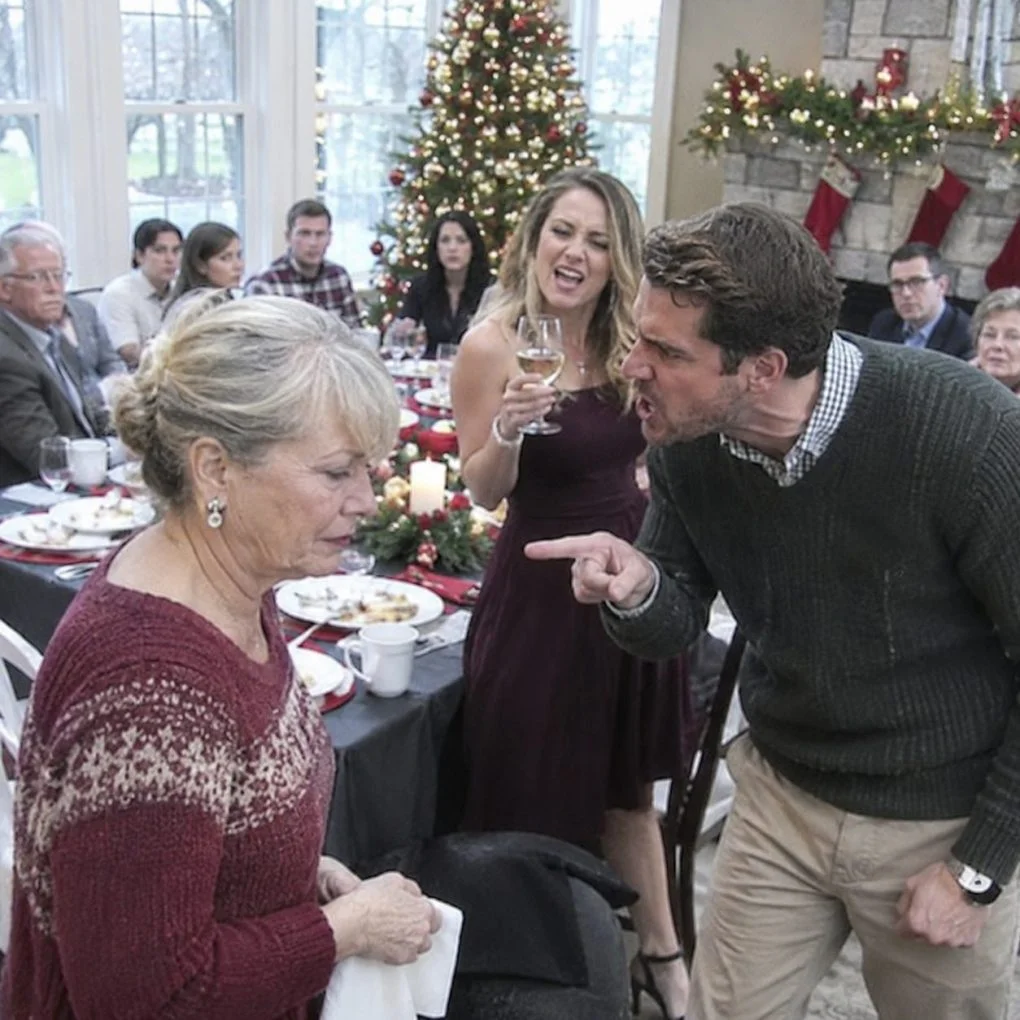
“Pay rent or disappear!”
My son Thomas said it so loudly that the conversation stopped around our Christmas table. Twenty-two relatives were crowded into his dining room, and I was still holding the spoon I’d used to serve his youngest child mashed potatoes when his wife, Lauren, lifted her wineglass.
“To a house without freeloaders,” she said, smiling. A few guests gave uncertain laughs; my sister Ruth lowered her eyes to her plate, and my eight-year-old granddaughter Emma asked why Grandma was being called a freeloader.
Thomas didn’t answer her. He looked at me, waiting for the apology he had grown accustomed to receiving whenever I made his life inconvenient. “Starting January, it’s fifteen hundred a month, Mom. You’re not living here for free anymore.”
My name is Evelyn Mercer. I’m sixty-six, a retired elementary-school secretary in Columbus, Ohio, and I moved into my son’s guest bedroom nineteen months earlier because he and Lauren begged me to help when their childcare arrangements collapsed. I never sold my small townhouse across town; I simply turned down the heat, left my husband’s winter coat hanging in the hall closet, and promised myself I’d go home when they were steady again.
Every month, I transferred $1,250 toward their household expenses. I also bought most of the groceries, got Emma and her brother Noah to school, and spent afternoons finding missing mittens and helping with homework while their parents worked. Thomas used to kiss the top of my head and call me the reason they could keep going.
After his father died, I had been grateful to have people to care for. I’d spent enough nights alone listening to the refrigerator hum in my old kitchen, reaching across a bed that no longer had anyone in it. I hadn’t noticed when being needed began to feel like being owned.
“I’m already contributing,” I told him quietly.
Lauren set down her glass. “Groceries and babysitting aren’t rent, Evelyn. Let’s see how you survive without us.”
I folded my napkin, carried my plate to the sink, and washed it beneath the running water because I couldn’t trust my hands to stay still at the table. Before sunrise the morning after Christmas, I packed one suitcase, kissed both sleeping children, and drove back to my townhouse.
At noon, I had seventeen missed calls. The last voicemail wasn’t from Thomas.
It was from a lending officer asking me to confirm the $90,000 loan my son said I’d agreed to take against my townhouse.
I had never agreed to borrow a penny.…Keep reading to uncover the rest here.
The woman at the lending office sounded embarrassed when I returned her call. Thomas had requested an appointment to discuss a home-equity loan using my townhouse as collateral, she explained, but no application or credit inquiry had been submitted because they needed to speak directly with me first. I told her there would be no appointment.
Then I sat in the little kitchen I’d left nineteen months earlier, watching winter light fall across the scratches on the table my husband, Henry, had repaired with his own hands. The house smelled faintly of cedar and radiator heat. I remembered Thomas, ten years old, leaving paper snowflakes on that windowsill because his father was working Christmas Eve.
Thomas called again. “Mom, you can’t just vanish,” he said when I answered. “We’re supposed to leave tomorrow, and who’s going to watch the kids?”
“You told me to disappear,” I replied. He went quiet long enough for me to hear one of the children asking for cereal before answering. “Lauren didn’t mean it like that. You know we’ve been under pressure.”
I asked about the loan, and he stopped talking. Finally he admitted Lauren’s beauty studio was behind on rent and they wanted money to expand into a cheaper, shared location before the landlord ended her lease. He’d been telling the lender I was willing to use my equity to cover the studio’s back rent and a move to a less expensive space, although he hadn’t asked me.
“You’ve always helped us,” he said. “I thought once you understood—” I asked him why he’d demanded more rent in front of everyone.
He sighed. “Lauren thought if you paid something official, her family would stop saying we supported you.”
For a moment I saw him at seventeen, standing over the sink washing dishes after his father’s first heart attack, insisting I should sit down. I had loved that boy with an uncomplicated certainty. It hurt to realize the grown man could let his wife humiliate me so strangers wouldn’t think he needed my help.
When Noah’s fever reached 103, I sat with him in urgent care for four hours, his socked feet curled across my knees. Thomas texted asking me to bring milk home, and I did.



