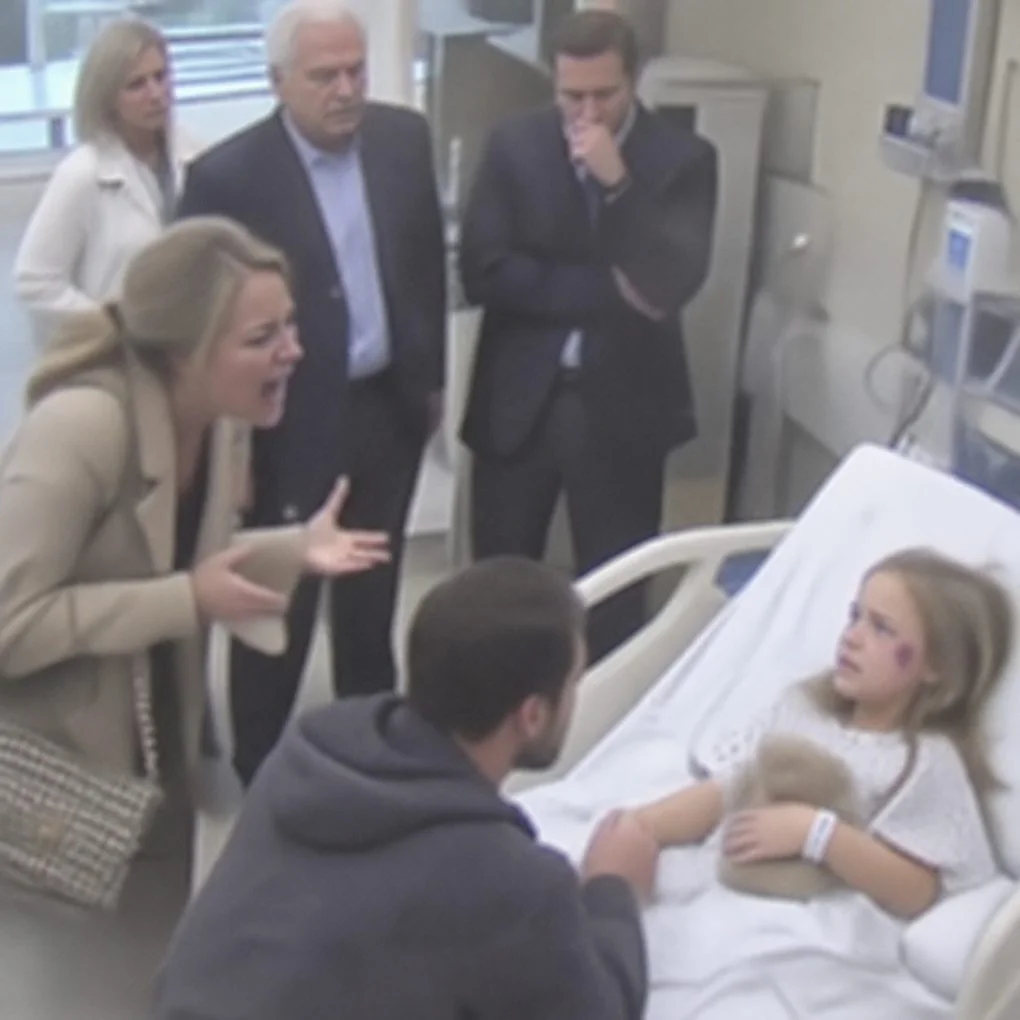
“Please don’t tell Mom I called you,” my nine-year-old daughter whispered from the hospital. “She closed the curtain while they were beating me.” I felt my hands go cold. Her mother’s family had money, lawyers, and powerful connections. They had no idea what the hospital had preserved…
“Daddy, Mom closed the curtain while they were hitting me.”
My nine-year-old daughter whispered those words into a hospital telephone at 9:18 on a Saturday night. I was standing in the break room at the Charlotte maintenance depot where I worked, still holding a vending-machine sandwich. “Lily,” I said, “where are you?” She told me a nurse had helped her call because her mother wouldn’t give her back her own phone.
Forty minutes later, I found Lily in a pediatric room with a splint on her wrist and bruises along one arm. She was wearing the blue party dress she’d chosen for her grandfather’s birthday, its little pearl buttons fastened crookedly. When I approached, she pulled the blanket over her shoulder before recognizing my shoes.
My wife, Claire, told the doctor Lily had fallen down the staircase at her parents’ estate. Her father, Charles Whitmore, owned commercial property across North Carolina; her brother Grant ran part of the business, and their family treated questions like insults. Two attorneys had already called Claire while I drove to the hospital.
But Lily had never mentioned stairs.
She’d spilled a glass of cranberry punch near the dining room while the family entertained guests. Charles called her careless; Grant dragged her into the sunroom to “teach her manners.” Claire followed them. Through the glass doors, guests might have seen what happened, so my wife pulled the heavy curtain across.
“Mom heard me asking her to stop them,” Lily whispered. “She was right there.”
I wanted to drive straight to the Whitmore house and shout until someone answered. Instead, I stayed beside my daughter while a nurse documented what Lily had said and explained that the hospital had contacted child protective services. I asked for the doctor, gave my own statement, and waited until Lily had fallen asleep.
Before I left, she caught my sleeve. “Daddy, did you bring home my yellow backpack from Mom’s car?”
“I can get it.”
“Look in the little zipper pocket,” she said. “The one with the broken star.”
I knew the pocket. I’d bought Lily a palm-sized voice recorder so she could practice stories for school, and she kept it there when she wasn’t using it. That afternoon, she’d promised to record the poem she’d written for her grandfather.
Before driving home, I used our spare car key to retrieve the backpack from Claire’s car in the hospital garage. On our mudroom bench, I found the recorder beneath a crumpled party napkin and pressed play.
First came Lily’s small, hopeful voice: “Grandpa, this poem is for you.”
Then a man’s voice snapped, “Claire, shut that curtain. Nobody needs to see this.”…The next part of the story is here.
I stood in the mudroom with the recorder in my hand, listening to the familiar scrape of Lily’s sneakers against a floor. There were angry voices, her frightened attempts to apologize for the spilled drink, and the unmistakable sound of adults striking her. I stopped the playback before the end because my stomach had begun to heave.
Then I made myself listen again, not for the violence, but for what the adults said afterward. Claire’s voice was clear: “Tell the hospital she fell. Grant, put the glass away.” My wife hadn’t simply watched. She had helped prepare the lie that followed.
I called the hospital social worker before calling anyone in my wife’s family. She advised me to preserve the original recording and tell the investigating officer about it, rather than sending copies around to relatives. I put the device in a clean envelope, noted where I’d found it, and drove back to Lily.
When I got there, Claire was standing outside the room with a man in a dark suit. He introduced himself as her family’s attorney and suggested we “keep a private childhood accident from becoming a public misunderstanding.” He had no authority over Lily’s medical care or the investigation, but he spoke as if his business card settled both.
“I’ve spoken to the hospital staff,” I told him. “They know what Lily said.”
Claire caught my elbow. “Nathan, Dad is seventy-one. Do you really want to ruin his life over a family discipline issue?”
I remembered the first day Lily learned to ride a bicycle, when Claire ran behind her until her sandals slipped off and both of them fell laughing into the grass. For years I’d believed the woman who loved our daughter that fiercely could never stand by while someone hurt her. I pulled my arm away without answering.



