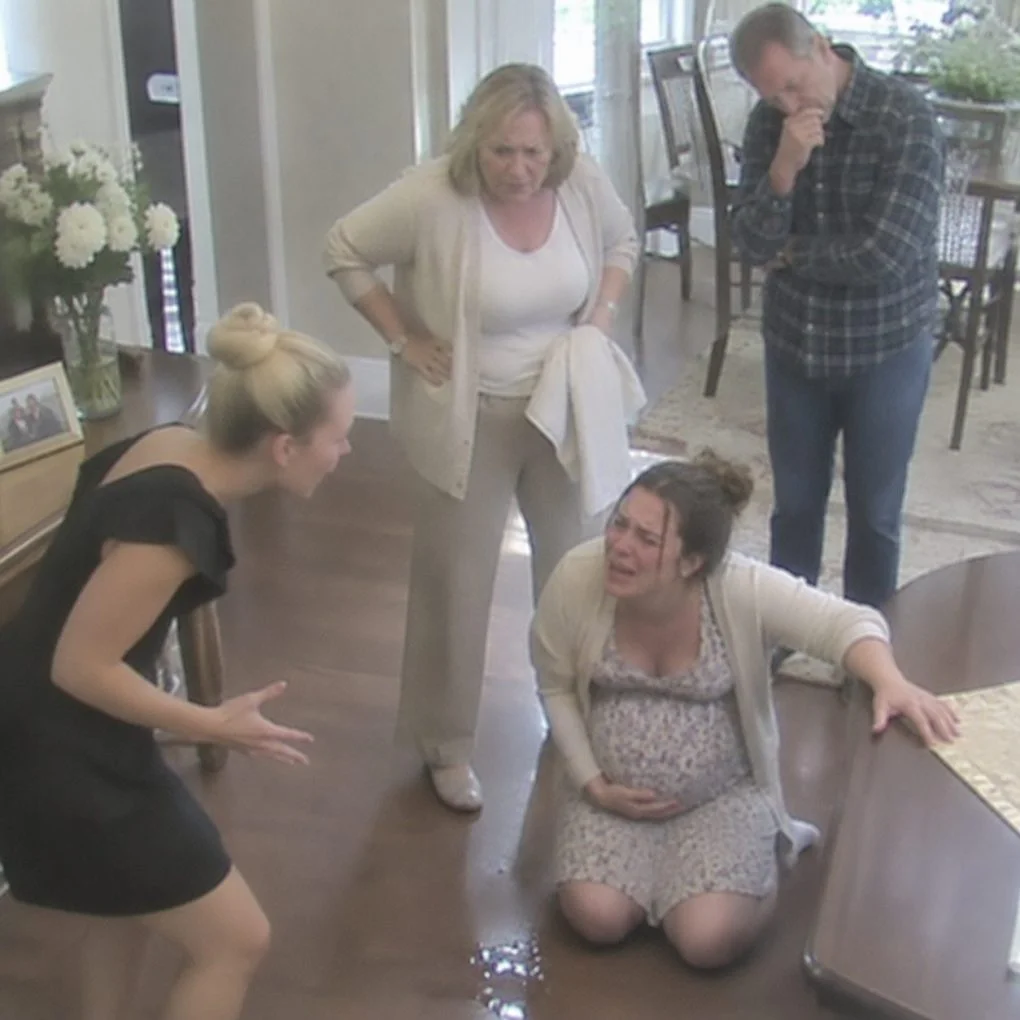
“Your husband is dead. Stop using that baby to get sympathy!” my younger sister shouted as I doubled over in pain. My mother watched my water break on her dining-room floor and handed me a towel. Nobody called for help. But three days earlier, I’d signed documents that would change everything they thought they owned…
“That baby isn’t even Andrew’s,” my younger sister said as I gripped the edge of our parents’ dining table. “Stop using a dead man to make everyone feel sorry for you.”
A contraction tightened across my stomach so sharply that I couldn’t answer. I was eight months pregnant, my husband had been dead for five months, and my mother’s Sunday roast was still sitting untouched in front of me when my water broke onto her polished hardwood floor.
“Mom, please call an ambulance,” I whispered. “Something’s happening too early.”
She stared at the puddle beside my shoes, then pulled a dish towel from the drawer. “You can at least clean that up, Emily. I just had these floors refinished.”
My father studied his plate. He’d once helped me build a science-fair volcano, but now he wouldn’t lift his head.
At thirty-three, I never imagined fearing labor at my parents’ table in Columbus, Ohio. Andrew had been the gentle man who warmed my side of the bed with a heating pad and kept our first ultrasound photograph tucked behind his driver’s license.
He founded Bluebird Patient Transport, a small company that drove older patients to dialysis and medical appointments. I’d helped build it from our kitchen table, and our ownership papers made me his equal partner; after his death, his remaining shares had passed to me through his estate.
Dad managed daily operations, and my sister, Brooke, handled bookkeeping. I kept them employed because I thought Andrew would have wanted his business—and our family—to survive his death.
Then unpaid fuel bills arrived for vans that were supposedly profitable. When I asked Brooke about the missing money, she said grief had made me forgetful, and Mom told me a pregnant widow shouldn’t be questioning the people keeping her afloat.
Three days earlier, I’d met privately with an attorney and an outside accountant. I signed documents that would change who controlled the company, but I still came to dinner hoping my parents might remember I was their daughter before I became an inconvenience.
Another contraction bent me against the chair. I dialed 911 myself while Mom held out the towel and Brooke muttered, “Such a performance.”
As the dispatcher asked how far apart the pains were, Dad’s phone vibrated beside his plate. He read the screen, went pale, and finally looked directly at me.
“Why is an auditor asking for our bank records?” he demanded.
I held the phone against my ear and said, “You have no idea what I signed on Friday.”
Then Brooke leaned toward him, forgetting I could hear her.
“Dad, did you close the account in Andrew’s name?”…Explore the full story here.
I barely heard the dispatcher telling me to breathe. Andrew had been dead since April, and whatever bank account Brooke was talking about had never appeared in the monthly statements my father sent me.
“Which account?” I asked. Dad pushed his chair back so hard it struck the wall, and Mom told me I was upsetting everyone when I should be thinking about the baby.
The dispatcher stayed on the line until paramedics arrived. One wrapped a blanket around my shoulders while the other checked my contractions; neither asked me to wipe the floor before helping me onto the stretcher.
My husband’s older sister, Rachel, met us at the hospital after I called from the ambulance. She’d brought groceries after Andrew’s funeral and sat in my kitchen without demanding conversation, while my parents kept asking when I’d sign the business over to Dad.
I told Rachel what Brooke had said about the baby. She opened a photograph Andrew had sent her after our ultrasound: his hand holding two tiny yellow socks, with the message, “My daughter is going to have the warmest feet in Ohio.” He’d been arguing over nursery paint colors the week before he died, and I hated that my sister had made even those memories feel like something I needed to defend.
At thirty-five weeks and five days, my labor was early enough that the team monitored us closely. Between contractions I kept looking at the empty chair beside my bed, remembering how Andrew rubbed my wrist when I was anxious; I hadn’t realized how much I’d miss that ordinary touch.
Rachel squeezed my hand when I asked. “He would have been so proud of you,” she whispered, and I turned my face toward the window.



