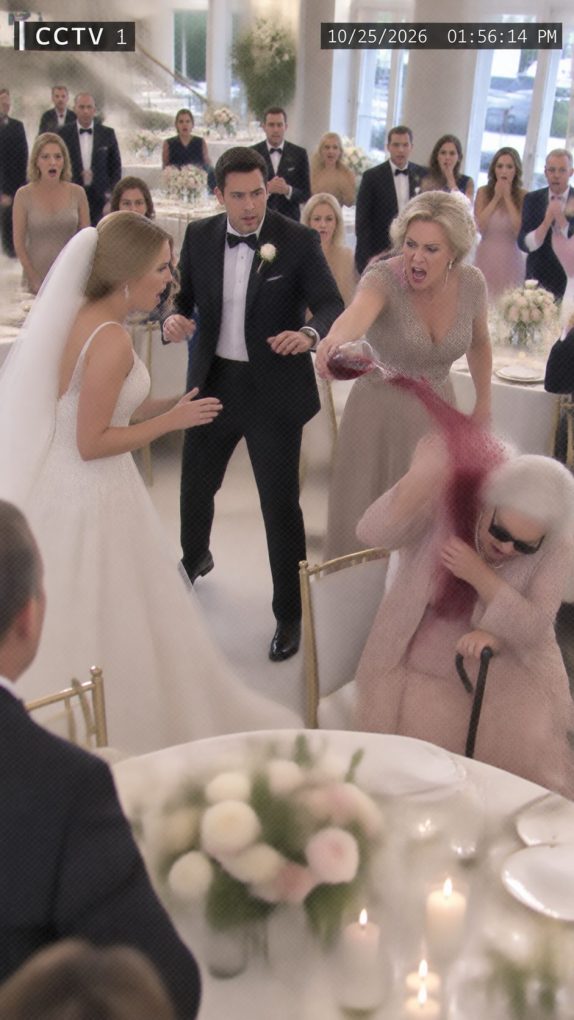
The red wine hit my mother’s white dress before anyone understood what Caroline Whitmore had done.
Mom stood beside the engagement-party table with one hand resting lightly on my arm, her white cane folded beneath the chair behind her. She had lost most of her sight five years earlier after a retinal disease progressed faster than doctors expected. She hated pity, refused help unless she needed it, and had spent the entire evening smiling politely while my future mother-in-law made comments about “limitations,” “appearances,” and whether my parents would be comfortable at a wedding attended by “important people.”
Then Mom accidentally reached for Caroline’s water instead of her own.
Caroline snatched the glass away.
“A family like yours will embarrass us,” she said.
Mom went still.
I thought that was the worst of it.
Then Caroline picked up her wine and threw it across Mom’s chest.
Twenty-three guests fell silent.
I looked at Nathan, the man I was supposed to marry in six weeks.
For three years, he had promised that eventually he would stop letting his mother decide everything—where we spent holidays, which neighborhood we should live in, what kind of wedding we should have, even whether Mom’s cane should appear in the photographs.
This was the moment.
Surely.
“Nathan,” I said.
He looked at his mother.
Then at me.
And sighed.
“Claire, please don’t make this bigger than it is.”
I stared at him.
“Your mother just threw wine at mine.”
“Mom was frustrated.”
Caroline folded her arms.
Nathan lowered his voice.
“Just apologize for overreacting, and we can finish the evening.”
Something inside me became perfectly calm.
I removed my engagement ring.
Placed it beside his champagne glass.
And said, “There won’t be a wedding.”
Nathan actually laughed.
“You’re ending three years over a glass of wine?”
“No.”
I looked at my mother’s stained dress.
“I’m ending it because I finally understand who you become when choosing me costs you something.”
My father had watched the entire exchange from the far end of the room.
Thomas Bennett was sixty-seven, soft-spoken, usually dressed like a man who might be coming home from a hardware store. Nathan’s family knew he owned “some manufacturing businesses.” They had never cared enough to learn more.
Dad walked Mom to the restroom, helped her find a clean shawl, then came back and asked me one question.
“Are you certain?”
“Yes.”
He nodded.
No speech.
No threat.
He simply took out his phone.
By midnight, Nathan called me seventeen times.
I answered the eighteenth.
His voice sounded nothing like it had at dinner.
“What did your father do?”
“I don’t know.”
“My parents’ attorney says the financing commitment disappeared.”
Then Nathan’s father grabbed the phone.
“Tell Thomas to reverse it. We close Monday.”
That was when Dad stepped into my apartment carrying Mom’s ruined dress in a garment bag.
He heard the shouting.
And calmly said, “There is nothing to reverse. I never signed.”
Nathan went silent.
Dad looked at me.
Then added, “Their hotel expansion depended on a twelve-million-dollar bridge guarantee from my holding company.”
I stared at him.
“You were financing them?”
“I was going to.”
He placed the garment bag on a chair.
“Because I thought they were going to be your family.”
Then his expression hardened.
“Tonight they made it clear they never intended to treat yours like one.”
The next morning, Dad’s attorney explained exactly what had happened. Whitmore Hospitality was trying to acquire and renovate a historic hotel outside Boston. Their lender required additional support before releasing the final construction financing because costs had increased and two investors had withdrawn. Dad’s holding company had issued a nonbinding term sheet indicating it was willing to consider a limited guarantee.
Nothing had been finalized. No guarantee agreement had been executed, no collateral had been pledged, and no lender had the right to force Dad’s company to proceed. Whitmore Hospitality had simply begun behaving as though the closing was inevitable because weeks of negotiations had gone well.
That confidence explained Nathan’s panic. His father, Richard, had already signed contracts with architects, ordered imported fixtures, and publicly announced the redevelopment timeline. Losing Dad’s support did not automatically bankrupt the company, but it created an immediate financing gap they now had to solve themselves.
Nathan arrived at my apartment before noon. He brought flowers for Mom and an apology that lasted almost seven minutes. Most of it concerned the financing. He said Caroline had been under pressure, the wine was “an emotional mistake,” and my father was punishing hundreds of employees for one family argument.
I asked him whether he believed I should have apologized the night before. He looked away. That was the only answer I needed.



