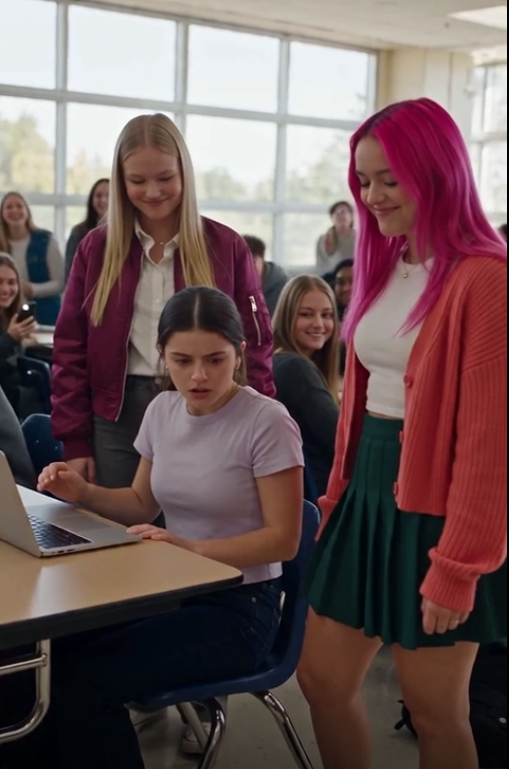
My lunch hit the floor before Madison Blake finished saying I didn’t belong at Westbridge High. Chocolate milk ran down my white shirt. A hundred people turned. Half of them laughed.
“Oops,” Madison said, holding the empty carton. “Guess the poor girl needs another free lunch.”
My name is Emma Carter. I was seventeen, and I’d spent three years learning how to disappear in a crowded room. I knew which stairs Madison’s friends used and which bathrooms had locks that worked. I knew nobody stepped between her and somebody she wanted to hurt.
That morning I’d made a different decision.
“You done?” I asked.
Madison blinked. Behind her, Riley Shaw lifted a phone to record my humiliation. “Excuse me?”
“I asked if you’re done.”
She shoved my shoulder. “What are you gonna do, cry?”
“No.” My hands shook, but I kept them at my sides. “I’m done being scared of you.”
She raised her hand. I caught her wrist before it reached my face. I didn’t twist it or shove her back. I just stopped her.
The laughter broke into whispers.
I released her and pressed PLAY on my phone.
Madison’s voice came through the speaker, clear and cheerful: “Tessa’s such an easy target. I took the Winter Wish cash, and everybody thinks she did it. Dad says it’ll disappear before the audit.”
Riley’s phone dropped toward her chest. Madison’s mouth opened without a sound.
“Turn it off!” she screamed, lunging for me.
I stepped aside. Principal Price appeared at the cafeteria doors, followed by two teachers.
“Madison. My office. Now.”
“She recorded me without permission!”
“And you just tried to hit her,” the principal replied.
For once, the room wasn’t looking at my stained shirt. It was looking at Madison.
By the final bell, the missing cash had been returned, Tessa Nguyen’s accusation had been withdrawn in writing, and Madison had been suspended pending an investigation. People called it a victory.
Then my phone buzzed with an unknown number.
Tessa met me outside the principal’s office with both hands buried in the sleeves of her oversized sweater.
“They said I’m cleared,” she whispered. “They said they made a mistake.”
“That’s good, right?”
“My scholarship interviewer already heard I stole from the fundraiser, Emma. They can’t unhear that.”
I didn’t have an answer. Tessa had spent every lunch break helping organize Winter Wish, a drive for coats and grocery cards. When $6,400 vanished from the collection box, someone conveniently found a spare key in her backpack. She hadn’t been allowed to lead a club since.
Inside, Dr. Price sat across from Madison’s father, Daniel Blake, who chaired the school foundation. His expensive watch flashed when he reached for a folder.
“Emma,” he said, “you’ve made your point. Let the adults handle the rest.”
My mother stood beside me in her work scrubs. She’d left a double shift at the nursing home after the principal called.
“My daughter was assaulted and publicly humiliated,” Mom said. “You can start by speaking to her like a person.”
Daniel smiled without warmth. “Nobody disputes the cafeteria incident. The missing funds were located and restored. Let’s not make accusations we can’t prove.”
“Madison made them for me,” I said.
Dr. Price set a document on the desk: a receipt showing the cash had been redeposited that afternoon. I recognized the foundation’s stamp.
“It’s over,” she said.
“Then why does the total look wrong?” I asked.
She glanced up. “What total?”
“Winter Wish raised more than cash. Sponsors gave checks.”
Daniel closed his folder. “You don’t have access to our accounts.”
“I know. That’s why I’m asking.”
Outside, Mom took my face in her hands and checked where Madison’s nails had scratched my wrist. “You shouldn’t have to do this alone.”
I showed her the anonymous message. She read it twice.
Then she pointed at the phone. “Whoever sent this knows the cash wasn’t the whole story.”
Another text appeared before she finished speaking.
Tessa lived above her father’s laundromat, where dryers rattled against the walls and the air smelled like detergent. Her dad was folding towels when we arrived.
“I heard they finally apologized,” he said.
Tessa stared at the floor. “They sent an email.”
He put the towels down. “That’s not the same thing.”
Three weeks earlier, he’d driven her to a scholarship interview at a local college. The woman interviewing her had asked about the missing donation money. Tessa had come home crying and told nobody but me.
“I’m sorry I waited,” I said. “I should’ve played that recording sooner.”
“You took it to the counselor first,” Tessa reminded me. “Remember what happened?”



