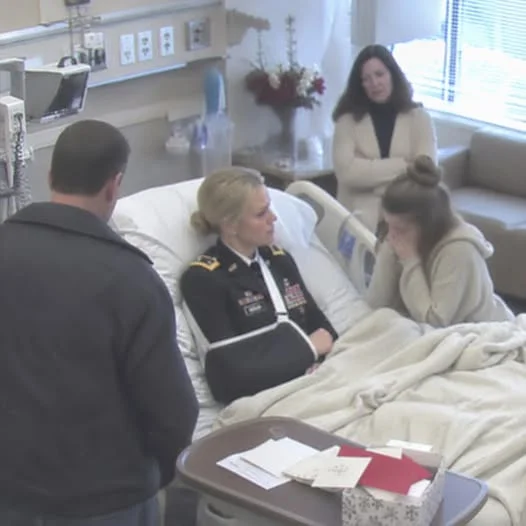
“Don’t come for Christmas, Mom. Dad’s wife needs to feel like she belongs.” My daughter couldn’t meet my eyes when she said it. I packed my uniform and went back to base without arguing. Just after midnight, my ex-husband received a call from the Pentagon. Then my daughter called me…
“Could you please not come for Christmas, Mom? Dad’s wife will be there, and we want her to feel like she’s really part of the family.”
My daughter, Kate, was twenty, but her voice sounded twelve again when she asked. I stood in my Arlington apartment holding a tin of cinnamon rolls I’d baked that morning, my thumb pressed into the warm metal until it left a mark.
“Okay, sweetheart,” I told her. “I understand.”
I didn’t. For seventeen Christmases I’d made those rolls, sometimes with my suitcase still unpacked. When Kate was little, she’d pull the smallest one from the pan and insist it was mine, because mothers always got the last piece.
My ex-husband, Mark, had remarried two years earlier. Vanessa liked matching-pajama photographs about fresh beginnings; lately, there was room for everyone except me.
I am Colonel Rebecca Morgan, forty-six, assigned to a Joint Staff office at the Pentagon. My title meant little to Kate, and that was deliberate; I wanted her to know me as the person who remembered her science fairs, not a rank on a uniform.
I took the rolls to the young soldier downstairs whose wife was overseas, then returned to Joint Base Myer to volunteer for the Christmas Eve duty watch. The captain scheduled to work had a newborn at home, and I told him to go spend the night holding her.
At 9:40 that evening, the watch supervisor asked me to deliver a set of signed papers to the duty office across the installation. Rain glazed the road, turning the white lines into reflections; at an intersection, a pickup slid through a red light and struck the driver’s side of my car.
I remember the airbag, the metallic taste in my mouth, and trying to move my left arm. A military police officer crouched beside the door, telling me an ambulance was coming, while somewhere on the seat my phone kept playing Kate’s childhood ringtone.
I reached the hospital conscious, with broken ribs and a fractured shoulder, but the doctors wanted to monitor a possible concussion. The Pentagon duty officer tried Kate, whose phone was on silent, then called Mark, still listed as my alternate emergency contact.
At 12:03 a.m., my phone finally rang in my hand. Kate was crying so hard I could barely understand her.
“Mom, why did the Pentagon just call Dad—and why is he shaking?”
I told her I was hurt but safe. She lowered her voice. “Dad opened his desk to find your insurance papers, Mom. There are seven Christmas cards in there, all addressed to me.”
“Why did he never give them to me?”
Dad ended the call and looked at me as if he had been holding his breath for hours. Mom sat beside him, one hand around a mug of tea, the blue dress folded in a bag at her feet.
“You weren’t supposed to find out at a rehearsal dinner,” he said.
I knew my parents had sold their restoration company two years earlier, but they’d spent most of my childhood driving a ten-year-old truck and arguing over grocery coupons. Mom handled the books from our kitchen counter, then supervised its finances even after she lost her sight, using screen-reading software that spoke account figures aloud at a speed I could barely follow.
They had been considering a $4.2 million equity investment in Caldwell Hospitality’s waterfront hotel renovation. The money belonged to a family investment company Mom controlled; Dad helped with negotiations, but the decision was hers, and the final subscription agreement was not signed or funded.
“Their lender wanted proof of committed equity before refinancing the construction loan,” Dad explained. “We were supposed to close Monday, after your wedding.”
“Does Nathan know?” I asked.
“He attended the meetings.”
That hurt in a way the wine hadn’t. Nathan had watched my parents make financial commitments that might save his family’s project, and still he’d asked me to ignore the woman who threw a drink at my mother.
Mom put her cup down carefully. “I didn’t withdraw because I’m angry, Claire. I withdrew because I no longer trust these people to honor an agreement.”
The next morning Nathan called twelve times. When I finally answered, he said, “Mom was upset. She didn’t mean it like that. We can still have the wedding if you stop punishing everybody.”
“She threw wine at my mother.”
“It’s one bad moment. My family’s hotel employs sixty people, Claire. Your parents pulling out will put the whole project at risk.”



