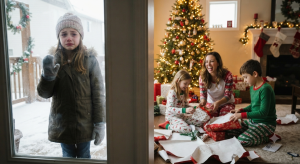
My wife locked my ten-year-old daughter out of our living room on Christmas morning while her own children opened presents behind the door. When I came home from a twelve-hour hospital shift, I found my little girl asleep on the stairs, clutching a gift she’d made for me. But what broke me wasn’t the locked door. It was what my daughter whispered when I woke her.
“Daddy, I was good. I didn’t even cry loudly.”
My name is Peter, and until December 25, 2024, I believed I had finally given my daughter the family she deserved.
We lived in Boulder, Colorado, in a two-story house with a mountain view, a fireplace that never drew properly, and a front porch that Ivy insisted looked magical when it snowed.
I was an emergency department physician. Working holidays was part of my life. So were missed birthdays, interrupted dinners, and twelve-hour shifts that sometimes became fourteen.
But I had one rule.
No matter how exhausted I was, I came home to my daughter.
Three years earlier, my first wife, Natalie, had died, leaving behind a seven-year-old girl who still believed that if she kept her mother’s favorite sweater underneath her pillow, she might dream about her.
I had never known how to explain death to a child.
So instead, I explained what I could.
I told Ivy that love didn’t disappear when someone died. It simply changed where it lived.
And every Christmas morning, no matter what shift I worked, Ivy and I shared two mugs of cocoa before we opened our presents.
It was a tradition Natalie had started.
One mug had a snowman with a crooked nose. The other had a red cardinal.
Natalie used to say the cardinal was a reminder that someone who loved us was always nearby.
After she died, Ivy claimed the cardinal mug for herself.
“Daddy gets the snowman because he’s funny-looking,” she announced one Christmas.
I laughed for the first time in what felt like months.
That tradition became our anchor.
Then Marlene entered our lives.
She was warm when we met, patient when Ivy was shy, and seemed to understand how difficult it was for a widower to rebuild a family.
Marlene had two children of her own, Coral, twelve, and Forrest, nine.
Their father lived in another state and wasn’t consistently involved.
I thought our families could give each other what we had lost.
For a while, I convinced myself they had.
We married eighteen months before that Christmas.
At first, the children got along reasonably well. There were arguments over television programs and bathroom schedules, but nothing that seemed unusual.
Marlene organized birthday parties, packed school lunches, and made a point of telling people that she loved all three children.
I wanted to believe her.
Looking back, I realize how much I wanted it.
Because when you have already watched one family fall apart through circumstances you cannot control, the possibility of losing another can make you ignore things you should never ignore.
The night before Christmas, I left for work at 7:15 p.m.
Ivy followed me into the hallway wearing green pajamas covered in tiny reindeer.
“Remember, Daddy. Cocoa first.”
“Always.”
“And nobody opens anything until you’re home.”
I looked at Marlene, who was standing in the kitchen.
“We’re still waiting until eight, right?”
Marlene smiled.
“Peter, we’ve discussed this three times. Yes. All three children open their gifts together at eight.”
I kissed Ivy on the forehead.
“See you in the morning, Bug.”
She hugged me tightly.
“Don’t let the hospital keep you forever.”
“Never.”
Those were the last words she said to me before I left.
At 7:40 the following morning, I pulled into our driveway.
Snow lined the edges of the sidewalk. Christmas lights glowed around the porch railing, and the windows were covered with the paper snowflakes Ivy had made at school.
I remember feeling relieved.
My shift had been brutal. We’d dealt with a highway collision, an elderly patient with respiratory failure, and a frightened little boy who needed stitches after falling against a coffee table.
All I wanted was a shower, a mug of cocoa, and the sight of my daughter smiling.
I opened the front door quietly.
“Ivy?”
No answer.
Usually, she heard my keys before I even stepped inside.
I took off my coat.
“Bug? Daddy’s home.”
Then I saw her.
She was curled on the fourth stair, her knees tucked against her chest.
Her Christmas pajamas were wrinkled. One sock had slipped halfway off her foot.
In her arms was a small brown-paper package tied with white string.
Her cheeks were blotchy, and her eyelashes were stuck together in the way they get after someone has cried themselves to sleep.
Something inside me tightened.
“Ivy?”
I knelt beside her.
“Sweetheart, wake up.”



