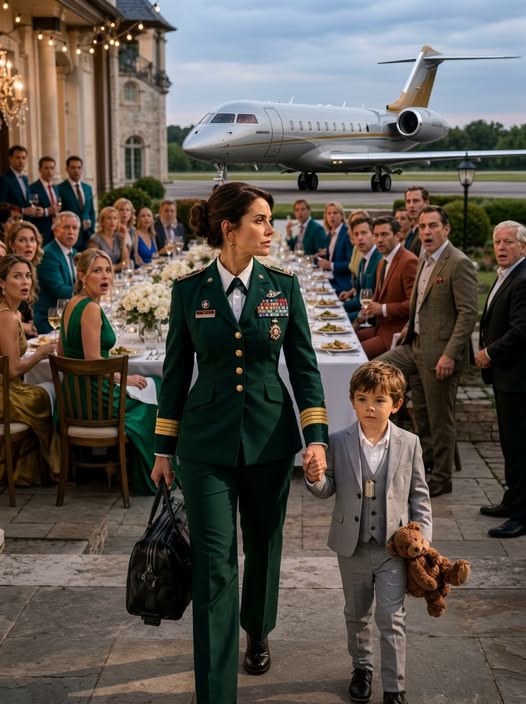
 The grey skies over Canadian Forces Base Trenton hung low, thick with the scent of pine and impending rain, as the CC-150 Polaris touched down with a dull, shuddering rumble.
Inside the passenger cabin, the atmosphere was dead silent except for the rhythmic, raspy breathing of three-year-old Leo. He was tucked beneath a heavy wool military blanket, his tiny cheek resting directly over my collarbone. His skin was still mottled with faint pink hives—the fading ghosts of a systemic histamine revolt that had nearly stopped his heart twelve hours earlier on a polished wooden deck in Michigan.
Captain Marc Tremblay, my adjutant for four years before I took my extended leave to pretend to be an ordinary American housewife, crouched quietly in the aisle beside my seat. He didn’t offer empty platitudes. He didn’t ask how my flight was. He simply extended a secure, encrypted tablet, his dark eyes steady and unblinking.
“Medical transport is idling on the tarmac, ma’am,” Marc said, his voice a low, gravelly baritone that had guided convoys through Kandahar and coordinated joint strike logistics across three continents. “Major Vance is heading the pediatric team at Ottawa General. They’ve reviewed the toxicology panels transmitted from the urgent care clinic in Petoskey. They’re ready.”
“Did you secure the chain of custody on the sample?” I asked. My voice didn’t sound like the voice of Elena Whitaker—the soft-spoken woman who had spent five years enduring holiday dinners where my potato salad was discreetly shoved to the edge of the buffet, or whose foreign accent was mimicked behind linen napkins. My voice was the instrument of Colonel Elena Morris, Director of Joint Intelligence and Threat Assessment for the Canadian Special Operations Forces Command. It was clipped, precise, and devoid of tremor.
“Secured,” Marc replied, sliding a finger across the glass screen. “Corporal Campbell entered the Whitaker lake house at zero-three-hundred under civilian cover while the local emergency services were still wrapping up their preliminary report. The ceramic ramekin containing the dipping sauce has been sealed, refrigerated, and transferred to the Royal Canadian Mounted Police forensic laboratory in London, Ontario. We also recovered the discarded wipes Brooke threw into the exterior trash bin.”
I closed my eyes for a fraction of a second.
Brooke. My sister-in-law. The woman who fancied herself a culinary artist, an arbiter of taste, and the golden child of the Whitaker dynasty.
*He needs to build tolerance eventually,* Patricia’s voice echoed in my skull, dripping with the faux-maternal condescension she had weaponized against me from the day Nathan brought me home to Grosse Pointe. *Mothers today make children weak because they’re terrified of everything.*
They hadn’t just been careless. Carelessness implied a momentary lapse, an oversight born of distraction or ignorance. What happened at the lake house was an execution of ideological arrogance. Brooke had intentionally incorporated peanut paste into the satay-style glaze, laughing when Leo dipped his grilled chicken tender into it, because she wanted to prove that my “neurotic rules” were nothing more than an elaborate bid for attention.
When Leo’s throat began to close—when the first violent, wet cough tore through his small chest and his lips took on the slate-blue tint of terminal cyanosis—Brooke hadn’t reached for the medical kit. She had rolled her eyes.
*He’s choking on a piece of gristle, Elena, stop screaming.*
And Nathan.
My husband. The man who had sworn an oath before God and two hundred guests to cherish and protect us. Nathan had stood frozen between the deck railing and the barbecue pit, a half-empty craft beer sweating in his hand, looking at his mother for permission to panic.
*Mom says give him some water first, Elena! Don’t stab him with that needle, you’ll traumatize him!*
I hadn’t waited. I had slammed the autoinjector into my son’s outer thigh through his denim shorts, packed him into my crossover before the ambulance could even navigate the winding, gated private road of the Whitaker compound, and driven through the night toward the international border.
“Colonel?” Marc’s voice brought me back to the cabin.
“We move now,” I said.
I stood up smoothly, shifting Leo’s weight so his head remained cradled in the hollow of my shoulder. My body moved with the familiar, muscle-memory efficiency that five years of domestic exile hadn’t eroded. Beneath my civilian trench coat, I was wearing plain black trousers and boots, but as I stepped through the hatch into the cold Ontario air, the two armed sentries at the base of the stairs snapped to crisp attention.
Their salutes cut through the damp wind. I didn’t return them with my hands full of my child, but I acknowledged them with a sharp nod of my head.



