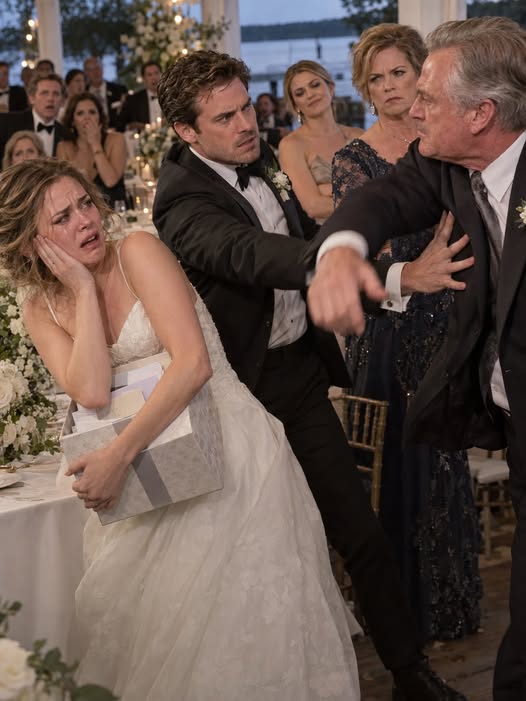
 The mechanical thunk-glide, thunk-glide of the gray aluminum walker against the tongue-and-groove oak floor was the only sound inside Harrow Lake Lodge.
The lodge was sixty years old, built with rough-hewn pine trusses that rose thirty feet into a dark ceiling, smelling perpetually of dry cedar, cold stone, and woodsmoke from the massive fieldstone hearth at the southern end. Through the tall picture windows, the frozen expanse of the lake sat like a plate of dull iron under a bruised March sky.
Ninety seconds earlier, one hundred and eighteen guests had been clinking fork tines against gold-rimmed china, finishing the last slices of almond-raspberry sponge cake, and laughing over lukewarm champagne.
Now, nobody breathed.
My left ear was ringing with a high, sustained electrical whine. The side of my face throbbed—not sharp like a cut, but deep, heavy, and hot, like someone had pressed a heated cast-iron skillet against my cheekbone. Beside me, Ellis stood like an iron post. He had his hands jammed into the pockets of his charcoal suit trousers, his broad shoulders squared, his gaze pinned to my father’s face. He didn’t drop his hands. He didn’t yell. In the three years I had known Ellis, I had learned that when he raised his voice, he was frustrated; when he fell entirely silent, he was measuring the timber to build a gallows.
My father, Vaughn Stark, stood three feet away. His fingers were still hooked into claws, frozen in the air where his open palm had rebounded off my cheek. He was fifty-eight, dressed in a rented three-piece tuxedo that pulled across his barrel chest, his neck mottled red with high blood pressure and three glasses of neat bourbon.
Across from him, my sister Bridget froze with her cocktail glass halfway to her mouth. Her mouth twitched. The neat, private little smirk she had worn when Dad reached for the walnut box was dissolving around the edges, sliding into the twitchy, petulant calculation she always wore when the script went off the rails.
Thunk-glide. Thunk-glide.
Grandma Marin stopped four feet from the edge of the head table.
At eighty-four, she was barely five feet tall, bent slightly by an old vertebral compression, but she wasn’t fragile. She wore her dark green wool cardigan buttoned to the collarbone, a pleated black skirt that reached her ankles, and sturdy orthopedic shoes with thick rubber treads. Beside her, Ivy Kesler, the thirty-year-old certified nursing assistant Ellis had hired through a private agency in Hastings, kept her hand loosely resting on the back of the walker. Ivy’s face was completely expressionless, the flat, professional mask of an emergency worker who had seen every variety of domestic ugliness and refused to be impressed by any of it.
“Vaughn,” Grandma said.
Her voice wasn’t weak. It was dry, thin, and clipped, carrying the distinct, nasal cadence of women who grew up in the farm hollows outside Cadillac during the war.
Dad didn’t look at her face. He looked at the floor between her rubber wheels, then at the open double doors behind her where the transport van was parked under the snowy porte-cochère.
“Ma,” Dad stammered, stepping sideways to place his bulk between her and the walnut box resting on the table behind Ellis. “You shouldn’t be on your feet. You know what the doctor said about the femoral pin. You’ve had a long ride from Hastings. You’re overstimulated.”
“I am eighty-four years old, Vaughn, not an infant in a pram,” Grandma said. Her gray eyes, magnified slightly behind thick bifocal lenses, shifted off him and locked onto my face.
She took in the red welt blooming across my left cheek. She took in the white silk bodice of my dress, the crushed tulle of my train tucked around my ankles, and the heavy walnut box Ellis was shielding with his right hip.
“Did you just strike your daughter, Vaughn?” she asked.
The room fell into an even deeper freeze.
My mother, Beverly, stepped forward from behind the table. Her voice had that breathy, theatrical tremor she always adopted when she was trying to rewrite reality in front of outside witnesses. She reached out with two manicured fingers, attempting to pat Grandma’s elbow.
“Marin, please,” Mom whispered, glancing nervously at Great-Aunt Loretta and the three tables of church members sitting twenty feet away. “Esther was being difficult about the cards. She was yelling at her father. You know how high-strung Esther gets when she’s tired. Vaughn was just trying to keep the situation from escalating. Let’s get you into the side room with some ginger ale.”



