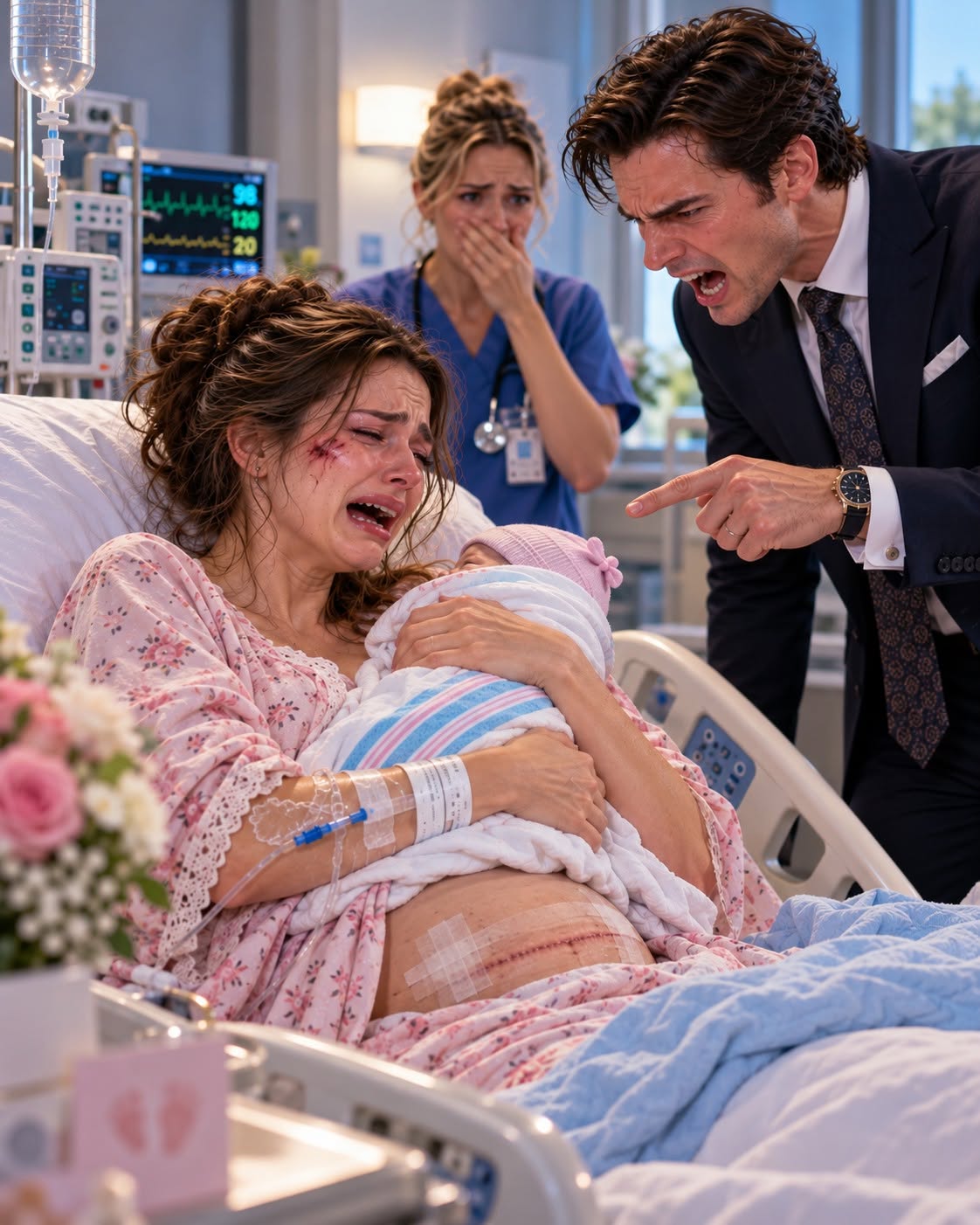
 The private maternity room was suffocatingly quiet, save for the low, rhythmic hum of the IV equipment and the soft flutter of white holiday lights coiled around a small Christmas tree by the window. Cool winter daylight poured through the glass, casting pale blue shadows across the floorboards. Evergreen garlands hung over the doorframe, their pine scent entirely mismatched with the clinical antiseptic that lingered in the air. Natalie sat propped up in the hospital bed, the stiff blue blanket pulled up to her waist, keeping her abdomen carefully covered. Her early-thirties face was pale, her brown hair pulled back into a loose, messy bun with stray strands framing her tear-streaked cheeks.
Her hand trembled slightly as she gripped her smartphone tightly against her ear. Her other hand rested flat and heavy over her covered pregnant belly, a protective instinct that refused to release even when the reality had already changed everything.
“Our baby’s gone,” Natalie whispered into the speaker, her voice hollow and fractured. “Please come.”
Across the line, there was a deafening pause. Through the tiny speaker, the faint, muffled sound of wedding-rehearsal music drifted—a cheerful string quartet playing a classical melody—followed immediately by the distant, echoing laughter of family members clinking champagne glasses.
Natalie waited, barely breathing, her eyes fixed on the empty visitor’s chair across the room. The contrast between her frozen world and the celebration happening miles away felt like a physical blow.
Owen’s voice finally came through the phone, flat, distracted, and rushed by the timeline of an event he refused to miss.
“The rehearsal’s starting,” Owen said, his tone carrying the weight of an inconvenience.
Natalie’s breath hitched. She didn’t scream. She didn’t shatter the phone against the wall. Grief, in its purest and most devastating form, was quiet, heavy, and paralyzing.
The call disconnected with a soft click, leaving only the dial tone buzzing in Natalie’s ear like a dying insect. She slowly lowered the phone, her fingers sliding down the glass screen until her hand rested limply on the blue blanket. The silence of the room rushed back in, heavier than before, suffocating the festive glow of the warm holiday lights blinking mockingly on the miniature tree.
The door clicked open softly. The nurse, a woman in her early thirties with blonde hair pulled back in a practical bun and an identification badge hanging from her blue scrubs, stepped quietly into the room. She didn’t speak. She didn’t offer empty platitudes or corporate sympathy. She simply walked over to the bedside, pulled up the empty visitor’s chair, and sat down. Without a word of warning, she reached out and took Natalie’s cold, shaking hand in her own, applying a steady, grounding pressure.
“He’s at the rehearsal,” Natalie whispered, staring straight ahead at the IV pole dripping clear liquid into her vein.
“I know, sweetie,” the nurse said softly, her voice steady and warm. “You don’t have to be strong right now. You’re allowed to break.”
“I’m not strong,” Natalie murmured, her voice cracking as the first true sob tore through her throat, muffled and ragged. “I’m just empty.”
On the third day, the door swung open with a sharp, casual push that shattered the fragile stillness of the room.
Owen entered first, striding in with the confident air of a man accustomed to being the center of attention. He wore a dark navy suit that still looked impeccably pressed, a crisp white shirt, a patterned silk tie, a pristine white pocket square, and an expensive wristwatch that ticked away the seconds of a life Natalie no longer belonged to. Right behind him streamed Natalie’s parents and her adult sister, all dressed in formal wedding-rehearsal clothing—velvet dresses and tailored suits that looked absurdly out of place in a maternity ward.
At the center of the room, sitting propped up in the hospital bed, Natalie cradled a small, weighted bundle against her chest. Her stillborn daughter was fully wrapped in a striped hospital blanket, a tiny pink cap resting on her head. The baby’s face remained carefully concealed against Natalie’s heart, protected from the cold eyes of the people who had abandoned her mother when she needed them most.
Owen stopped at the foot of the bed, his expression a mix of hurried annoyance and forced familial duty. He didn’t look at the bundle in Natalie’s arms; instead, his eyes darted nervously toward the door, as if he had a tight schedule to maintain.
Natalie slowly lifted her head. Her eyes, bloodshot and hollow, locked onto her husband. She looked from Owen to her mother and father, then to her sister, who avoided her gaze, and finally down at the small bundle resting against her ribs. Her arms tightened instinctively, settling protectively around her daughter.
The words hung in the air, grotesque and unbelievable. Natalie stared at her husband, the man she had loved, trusted, and built a life with for five years. While she lay bleeding in a sterile hospital bed holding a child who would never take a breath, he had been drafting property settlements with corporate lawyers and worrying about a wedding reception.
“You’re standing in my hospital room, three days after our daughter died, asking me to sign paperwork for a party?” Natalie’s voice didn’t shake. It was terrifyingly calm, carved out of pure, unadulterated shock.
“Professionally,” Natalie repeated, the word tasting like poison on her tongue. Her gaze snapped to her sister, who shifted uncomfortably in her designer heels. “And where were you when I called? Where was any of you when I was screaming in this bed alone?”
“We were at the rehearsal dinner, Natalie! You know how many VIPs flew in for this!” her sister snapped defensively, her voice dripping with irritation. “We couldn’t just drop everything and run to the hospital for a false alarm!”
“A false alarm?” Natalie whispered, her chest heaving as the raw grief threatened to consume her. She looked back at Owen, who was shifting his weight impatiently from foot to foot, checking his wristwatch.



