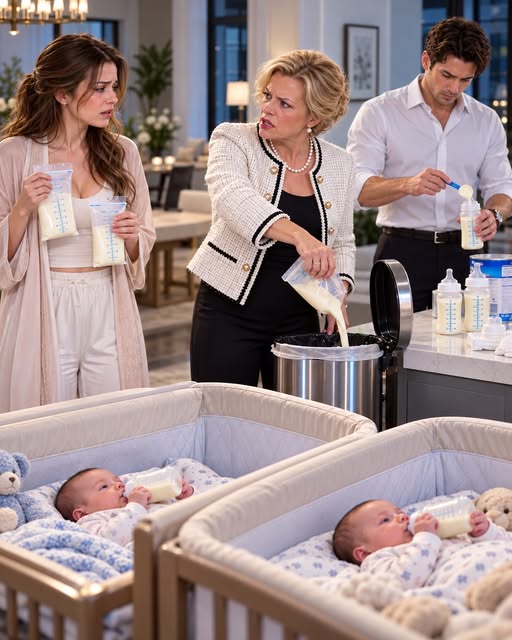
At 4:17 in the morning, I found my mother-in-law feeding my seven-week-old daughter the one formula her doctor had told us to avoid. My freshly pumped breast milk was in the trash. Before sunrise, my baby would be in an ambulance, and I would be wondering whether the husband I loved had helped make it happen.
My name is Megan Parker. Until that morning, I thought the worst part of having newborn twins was the exhaustion. I was wrong. The worst part was realizing that someone could look you in the eye, call her actions love, and knowingly put your child in danger.
I had come downstairs because the house was too quiet. That sounds ridiculous until you’ve spent seven weeks learning the thousand sounds two newborns make. Even from the bedroom, I could tell the difference between Sadie’s sleepy squeak and Molly’s short impatient cry. I could hear the refrigerator hum, the pump motor’s mechanical heartbeat, the floorboard that complained near the kitchen. But when I woke just after four, all I heard was the distant clink of glass.
I’d had an emergency C-section after Molly’s heartbeat dropped during labor. My incision still ached whenever I stood too fast. I’d pumped twice since midnight, feeding both girls, washing bottles, labeling milk, then crawling back into bed for what I hoped would be a glorious forty minutes of sleep. Two bottles were in the refrigerator: seven ounces, each labeled with the time. I knew because each ounce had cost me effort I could hardly explain to someone who’d never sat in the dark praying a pump would give them enough.
Donna sat in our living-room recliner with Molly against her chest. Sadie slept nearby in her cream-colored bassinet, one tiny fist tucked beneath her chin. Donna’s pearl necklace gleamed above her black blouse, her cream tweed jacket draped across the chair arm as though she were visiting a country club instead of helping her exhausted daughter-in-law.
A bottle was pressed to Molly’s mouth.
“What are you giving her?” I asked.
Donna looked up without flinching. “Breakfast.”
“That isn’t her milk.”
“No, Megan.”
I crossed the room so quickly that my hip struck the coffee table. On the side table lay a blue formula scoop. Beside it stood the blue-and-white can of standard cow’s-milk formula that Dr. Shah had specifically told us not to use for Molly.
“Tell me you didn’t give her that.”
Donna sighed, as though I were interrupting an ordinary morning routine. “You have got to stop acting like I’m poisoning your children.”
“Give her to me.”
“She just started eating.”
“Donna.”
Something in my voice finally made her surrender my baby. Molly was warm and heavy in that helpless newborn way. Her eyelids fluttered. I eased the bottle away and examined the label, desperately wishing I had misread it. I hadn’t.
Three weeks earlier, when our tiny girls had been home barely a month, I had tried that formula after a difficult night. Molly developed red spots around her mouth and neck. Then she vomited twice. Dr. Shah told us to discontinue standard cow’s-milk formula until we could investigate a possible milk-protein allergy. He wrote the warning on a sheet of paper, highlighted it, and asked both Derek and me to repeat the instructions back. Donna had seen that paper on our refrigerator. She had mocked it enough times that there was no chance she’d forgotten.
I carried Molly into the kitchen. An empty bottle sat in the sink. Another milk-storage bottle protruded from the trash beside the stainless-steel can. I could see my handwriting: 3:18 A.M. — LEFT. A small star next to it marked the side I’d finished pumping on.
“What did you do with my milk?”
“It looked thin.”
“You threw away my milk because it looked thin?”
“I didn’t know how old it was.”
“The time is written on it.”
Donna folded her arms. “Those babies have been hungry all week.”
“They’re seven weeks old. They cry.”
“Your milk isn’t filling them up. I raised three children, Megan. I’ve seen this before.”
“This isn’t about your opinion of my milk. It’s about a medical instruction.”
“She had one little rash.”
My knees seemed to lose their strength. “You knew she reacted to it.”
Donna hesitated just long enough to betray herself. Then she said, “Derek told me the doctor was being cautious.”
I looked toward the staircase. Derek was asleep upstairs. He’d come home late, kissed the top of my head, and promised that he had spoken to his mother about following our rules. I had believed him because I needed to believe that at least one other adult in this house was on my side.
“You talked to Derek about using the formula?”
“Lower your voice. You’ll wake everybody.”



