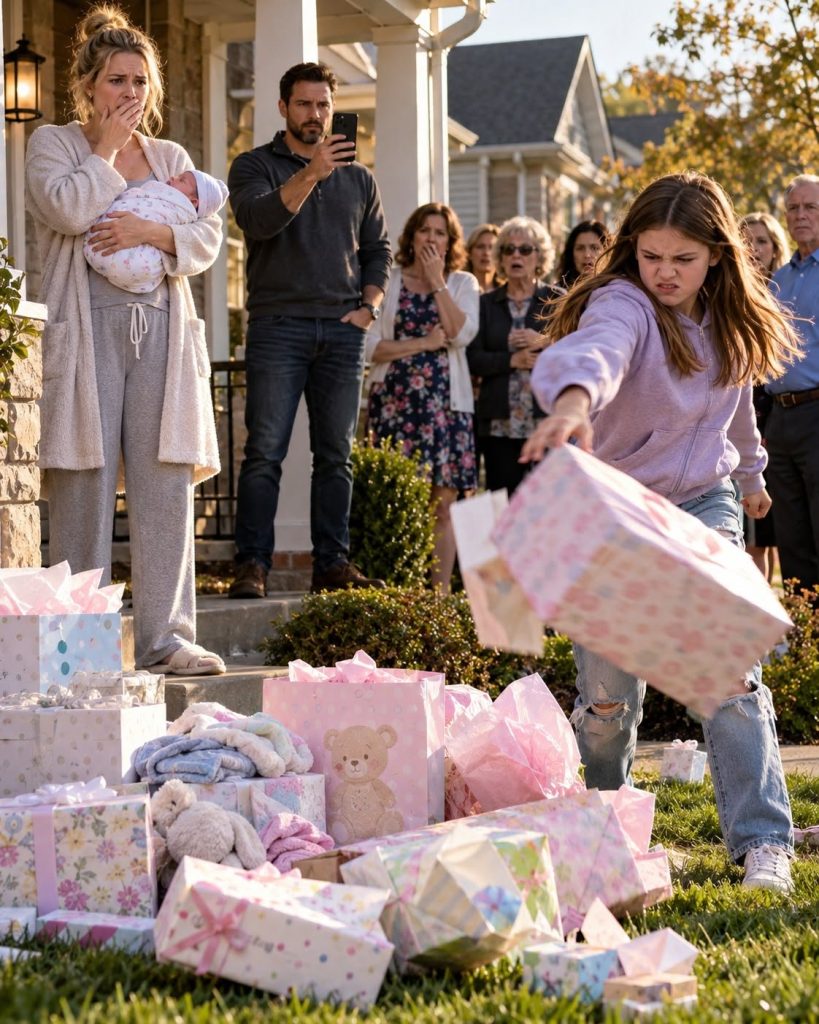
Chapter 1 – The Lawn of Broken Gifts
Eleven days after a major abdominal surgery, the human body is supposed to be resting, healing, and protected from sudden shocks. Instead, I found myself standing rigid on the front porch of our suburban home, my hands gripping the wrought-iron railing so hard my knuckles turned translucent. My knees threatened to buckle under the strain, a dull, throbbing ache radiating outward from the fresh C-section scar beneath my postpartum leggings.
Thirty guests stood scattered across our newly manicured lawn and the paved driveway, frozen in various states of awkward shock. Some held paper plates with half-eaten chicken sandwiches; others had champagne flutes hovering inches from their mouths. At the center of this surreal tableau stood my twelve-year-old stepdaughter, Sadie. Her cheeks were flushed a violent red, tears streaming down her face, her chest heaving as she shoved a violently crumpled bank statement directly into my line of sight.
“You spent seventy-four thousand dollars of my college money on your stupid baby!” she screamed, her voice cracking with a raw, terrifying hysteria that cut right through the warm afternoon air. “Dad showed me!”
My gaze flickered downward from her tear-streaked face to the offending piece of paper. The numbers stared back at me in bold, unforgiving black ink. I stared at the total, then slowly shifted my eyes to the name printed under the heading of Custodian.
It wasn’t mine.
It was her father’s.
My husband, Cole Price, stood just a few feet away. We had been married for nearly two years. When I first met Sadie, she was ten, grieving the loss of her mother, Allison, who had passed away when the girl was just seven. I had walked into their lives fully aware of the emotional minefield I was navigating. I never tried to replace Allison. I never forced Sadie to call me Mom. I let her set the pace.
For the first year, our dynamic was a delicate, fragile dance of mutual respect. I learned her quirks with the quiet, observant patience of someone who genuinely wanted to belong. I knew she liked her strawberry pancakes cut into precise triangles because the edges held the syrup better. I knew she couldn’t stand the chemical, cloying scent of lavender detergent because it triggered her migraines, so I immediately swapped out all our laundry supplies for unscented alternatives. I knew she was brave about school, about bullies, about everything except thunderstorms—whenever the lights flickered and died, she would seek out the nearest warm body, and I would hold her until the grid hummed back to life.
I learned all of that without demanding a single word of gratitude in return.
When the pregnancy test finally turned positive, bringing Lucy into our world, Sadie had seemed genuinely thrilled. She was the one who accompanied me to the paint store, running her fingers over hundred different sample cards before picking out a soothing, pale-green color for the nursery. She had looked up at me with bright, intelligent eyes and told me that pink was entirely overrated, insisting that newborns probably didn’t care what their walls looked like anyway, as long as they were safe.
In those quiet moments, holding paint swatches side by side in the fluorescent glow of the hardware store, I truly believed we were becoming a real family. A cohesive, unbreakable unit.
The cracks only began to appear two months before Lucy was born, spreading like invisible fractures through thin ice. Cole suddenly changed. He started answering Sadie’s questions for her, cutting off her voice before she could even form her thoughts. If I asked her if she wanted to come with us to a weekend matinee, Cole would instantly jump in, telling me she needed space. If I offered to sit at the kitchen table and help her navigate her pre-algebra homework, Cole would gently push me away, claiming she was old enough to handle her studies entirely on her own.
Whenever I tried to bring this up in the privacy of our bedroom—asking him why he was building walls between us—he would look at me with practiced disappointment and call me oversensitive. He’d sigh, run a hand through his hair, and tell me that pregnancy hormones were making me paranoid.
And then came Saturday.
I had explicitly told Cole what I wanted for Lucy’s homecoming: six close visitors, a few simple finger sandwiches, and an uninterrupted hour of quiet rest upstairs before I had to face the reality of motherhood. Instead, Cole took it upon himself to turn the event into what he grandly called a “proper welcome-home celebration.” He invited thirty people, filling our driveway with unfamiliar cars. There were neighbors I had barely exchanged nods with at the mailbox, and distant corporate coworkers of Cole’s who had never even laid eyes on me, let alone my newborn.



