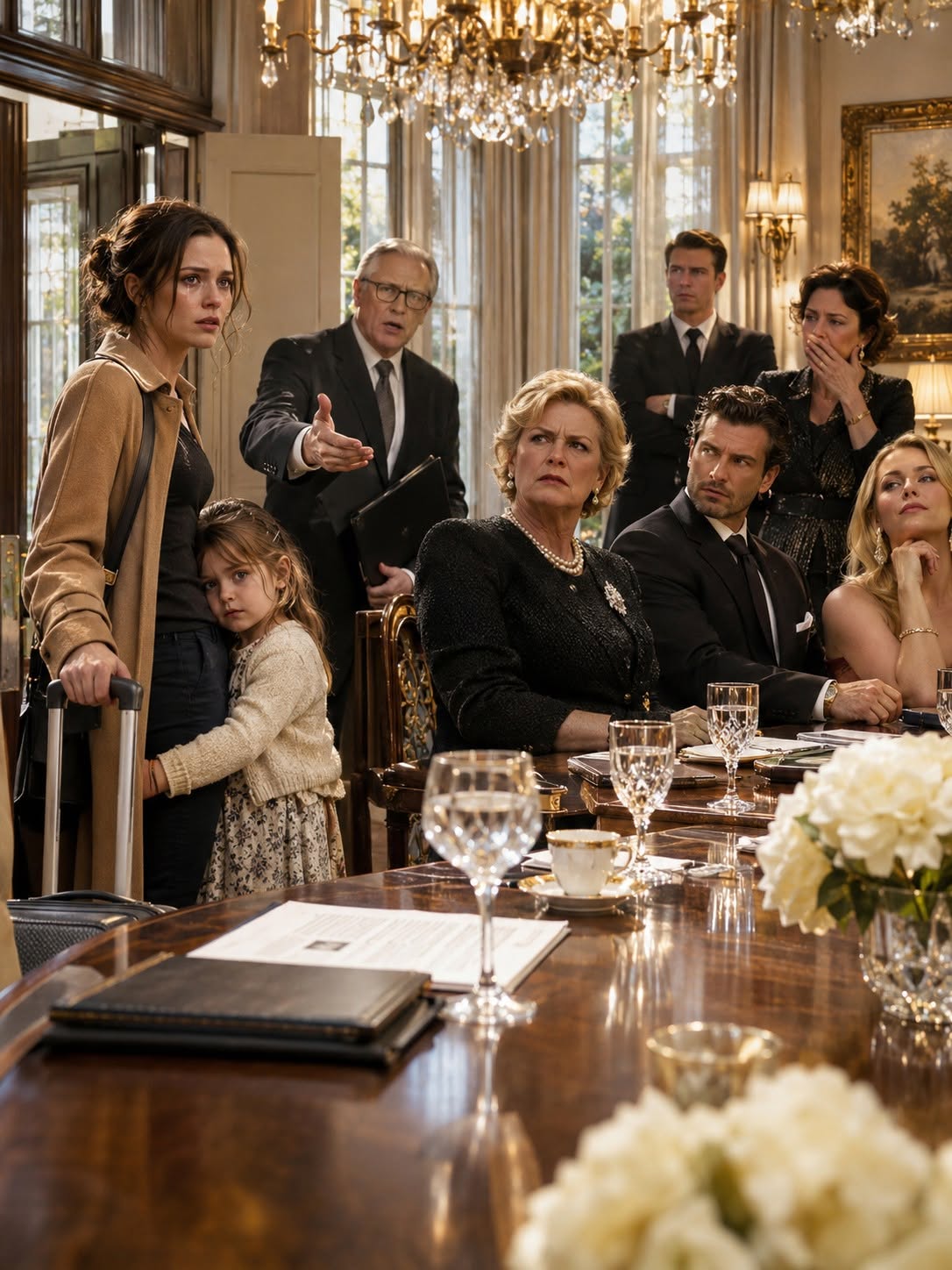
 The macaroni and cheese was still bubbling on the stove when my husband walked into our kitchen with another woman.
It was Thursday evening, two days after his father died. Our four-year-old daughter, Ruby, was watching cartoons in the living room, and I was trying to make something she’d actually eat after a difficult week. The house smelled faintly of burnt butter and the sweet, sugary musk of the vanilla candle I’d lit to keep the heavy air of grief from settling too deeply into the hallway.
Kevin came through the garage door at 7:15. Behind him was a blonde woman in a camel-colored coat, pulling a small suitcase across our kitchen tile. The wheels clicked against the linoleum with a sharp, rhythmic clatter that cut straight through the drone of the television.
I recognized her immediately.
Her name was Alexis. I’d met her twice at company gatherings, where Kevin had introduced her as a regional marketing contact. She had always been exceedingly polite, shaking my hand with a firm, professional grip and asking about my bookkeeping clients with the practiced interest of someone making small talk at a dentist’s office.
Apparently, their business relationship had evolved into something considerably more personal.
“Amanda, we need to talk,” Kevin said. His voice had that flat, controlled cadence he used when he was about to deliver bad news to a client and wanted to make sure he sounded entirely blameless.
I turned down the burner under the pot of pasta. The orange sauce hissed as it settled against the metal. I looked from Kevin’s face to the suitcase, then back to Kevin. He wasn’t wearing his wedding band. I hadn’t noticed until that second, but his left ring finger was bare, showing a pale band of skin where the gold had lived for eleven years.
“Your father’s funeral is Saturday,” I said, keeping my voice level, though my heart was beginning to hammer against my ribs like a trapped bird. “Whatever this is, can it wait forty-eight hours?”
“No, actually, it can’t.”
He reached into his jacket pocket and placed a thick manila envelope on the kitchen island, right beside the coffee mug I’d been using since breakfast. The mug had a chipped rim and a faded cartoon cat on the side that Ruby had painted at a ceramics store when she was two.
Alexis stood near our coat rack, looking around at the family photographs on the wall. She seemed particularly interested in the picture of Kevin, Ruby, and me at the pumpkin patch the previous October. In the photo, Kevin had his arm around my waist, and we were both laughing because Ruby had tried to wear a pumpkin stem like a unicorn horn. It felt like it belonged to a different century.
“What’s that?” I asked, pointing a wooden spoon at the envelope.
“Divorce papers.”
The word hung in the air between us, small and ugly, like a dropped dish.
I looked at him, waiting for some flicker of hesitation, some sign that he understood the absurdity, the sheer cruelty of the timing. Donald Murray had drawn his last breath in a hospice bed less than sixty hours ago. His body was currently resting in a climate-controlled room three miles away, waiting for a visitation that Kevin hadn’t even bothered to help me prepare for.
Instead of hesitation, Kevin smiled. It was a thin, tight movement of his lips that didn’t reach his eyes.
“I’m about to inherit millions,” he announced, as if he were reading a press release about a quarterly sales milestone. “Time to upgrade my life, starting with my wife.”
I remember the refrigerator humming behind me—a low, rhythmic vibration that suddenly felt deafening. I remember the smell of melted butter and the yellow dust of powdered cheese. And I remember thinking with absolute, chilling clarity that Donald Murray hadn’t even been buried yet, and his only son was already treating his life like an open house.
My name is Amanda Murray. I was thirty-eight years old, and I’d been married to Kevin for eleven years.
We lived in a modest, three-bedroom split-level house in Overland Park, Kansas, where we’d been raising Ruby and doing what I thought was the ordinary, grinding work of building a family. We drove a four-year-old Subaru with a dent in the rear bumper where I’d misjudged a concrete pillar at the grocery store. We shopped at Costco, saved for Ruby’s college fund five dollars at a time, and spent our Friday nights eating takeout pizza on the living room rug.
At least, I’d been doing that work.



