Her teeth were clean. No cavities. The hygienist had praised her brushing, but Annie hadn’t smiled once during the whole forty-minute visit. She had kept her eyes fixed on the ceiling tiles, her fingers tangled tightly in the hem of her denim jacket.
On my lap lay the folded lined sheet Barb had pressed into my palm by the cafeteria doors.
I smoothed the creases against my steering wheel. The handwriting was neat, slanted, written in blue ballpoint ink on standard legal pad paper. Twelve dates, beginning with Monday, August 31—the second week of the school term—and ending with today: Friday, October 16.
Beside each date was the exact same entry: *Purple unicorn box. Confiscated Rm 14. Billed hot.*
Twelve meals. At $4.35 per standard elementary hot lunch, twelve meals came out to exactly fifty-two dollars and twenty cents. Add the twenty-cent juice surcharge from the first week of September, and there it was.
$52.40.
The number hadn’t been an unpaid deficit from forgotten lunch money or a clerical lag on an old balance. It was an invoice for twelve confiscated lunches.
“Annie,” I said, keeping my voice as calm and level as water in a glass.
She stopped swinging her feet. “Yes, Mama?”
“Look at me for a second, sweet girl.”
She turned her face toward mine. She had my dark brown eyes and her father’s stubborn chin, but right now her shoulders were curled inward, trying to make herself small enough to disappear into the upholstery.
“You’re not in trouble,” I told her, reaching out to tuck a stray curl behind her ear. “Not one bit. You couldn’t be in trouble with me if you tried today. But I need you to tell me what happens in Ms. Vaughn’s room before lunchtime.”
Annie looked down at her neon ring. She turned the little plastic dolphin around and around on her knuckle. “The morning check.”
“The morning check?”
“After spelling,” she whispered. “Before we line up for the restroom. Ms. Vaughn gets the green binder from her shelf. She calls it the Hawk Plate Audit. We have to put our lunchboxes on the top right corner of our desks and open the zippers.”
My chest tightened. “She makes you open them?”
“She walks down the rows with the clipboard,” Annie said. Her voice was thin, barely louder than the hum of the heater fan. “If you have things with green stickers, you get a star on the board. Green is raw vegetables without dip, whole fruit that isn’t cut up in syrup, and water bottles with no flavor drops.”
“And if you don’t?”
“Yellow is bread that isn’t dark brown, or sandwich meat that has salt in it. But red…” Annie swallowed, her throat bobbing. “Red is junk.”
“Did she tell you my food was junk?”
Annie’s eyes welled up with immediate, burning tears. She pressed the heels of her hands against her eyes, fighting them back the way she’d seen me do late at night when the electric bill sat unopened on the kitchen counter.
“She said you were too busy to learn the pyramid,” Annie choked out. “She said parents who work long shifts sometimes don’t make good choices for their children’s fuel, and that the school had an obligation under the district grant to protect our developing brains. Today she picked up the Cheetos with two fingers, dropped them back in the box, and said, ‘This is empty inflammation, Annie. We don’t bring empty inflammation into a learning environment.'”
My fingers dug into the foam of the steering wheel until my knuckles turned white.
“And then?” I asked, breathing through my nose.
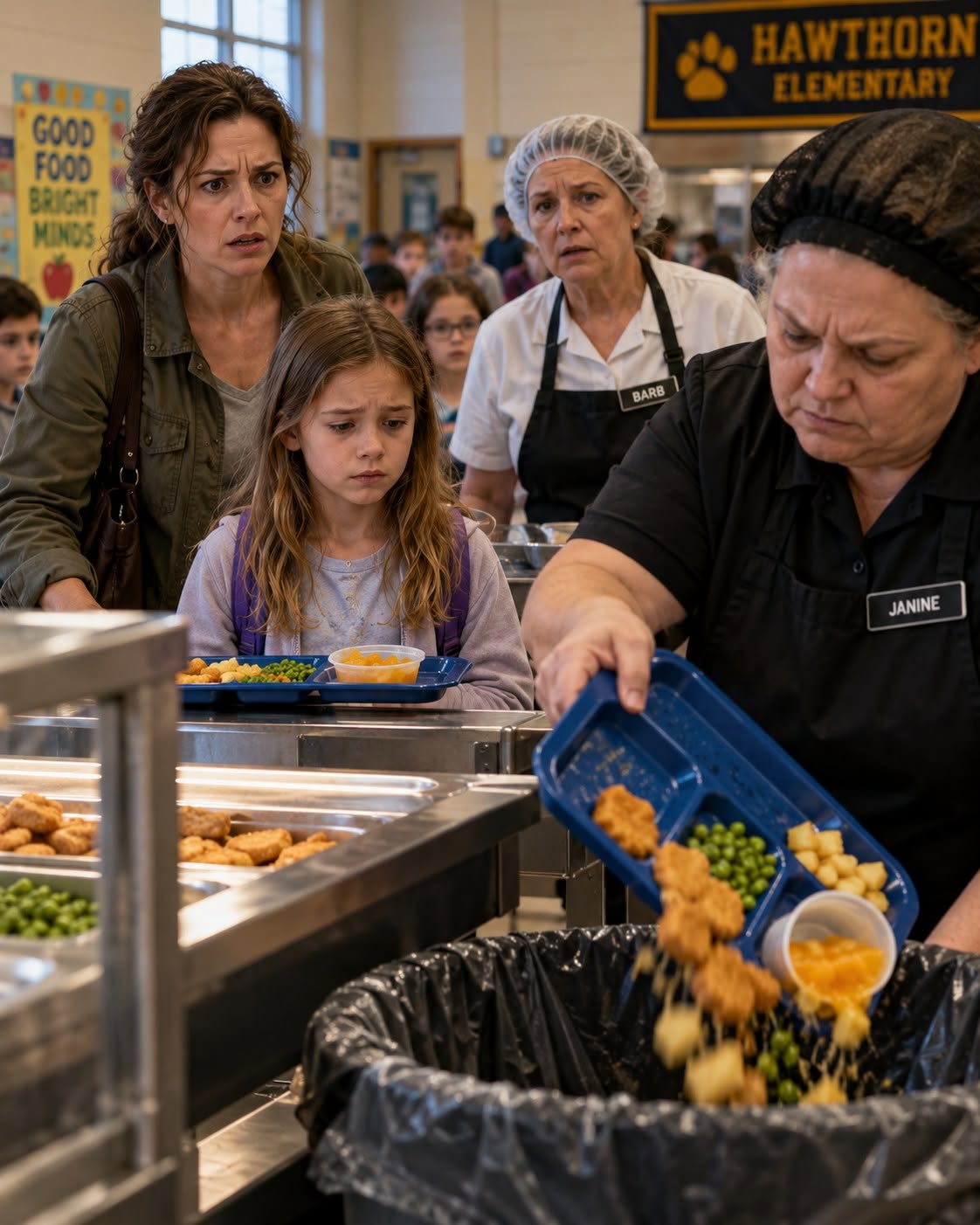
“She carried my purple box to the tall metal cabinet by her desk,” Annie said. “She turned the key. She told me to take my blue pass and go to the hot line. She said the district would provide a balanced tray so I wouldn’t fall behind in math.”
Twelve times.
Twelve separate mornings, my daughter had stood in front of twenty-two other children while a woman with a master’s degree held up her food, classified it as parental failure, and locked it behind sheet metal.
And twelve times, Annie had carried that blue pass to the cafeteria, too ashamed to tell me, because she thought she was protecting me from being scolded.
“Why didn’t you tell me, Annie?” I asked, my voice cracking slightly despite my best efforts. “Baby, why didn’t you say something the first time she did it?”



