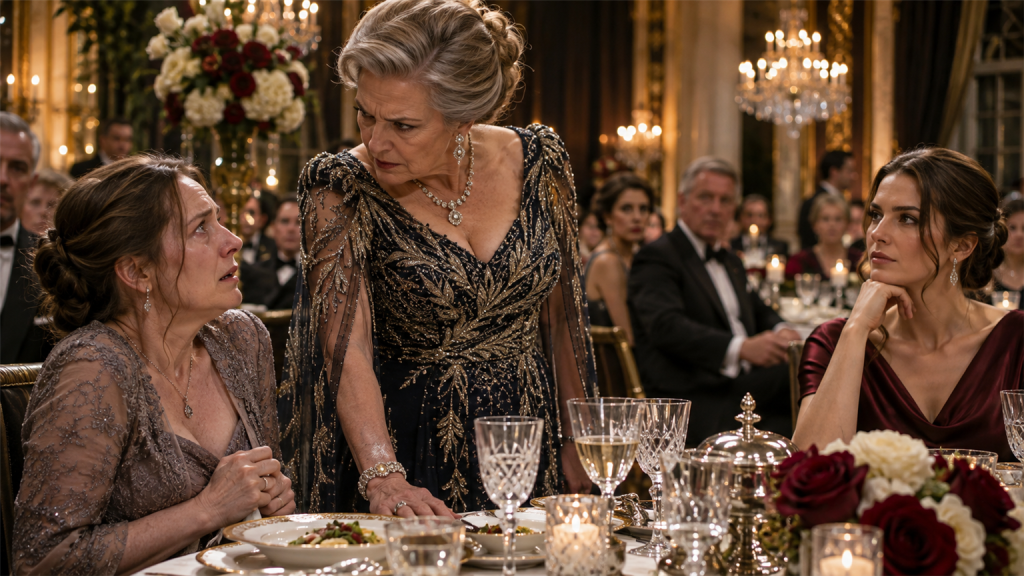
Twenty minutes before my mother introduced me to my sister’s future in-laws as “our other daughter” who did temp work when she could find it, I hadn’t even been thinking about the Harringtons. I was thirty-seven years old, wearing a navy wool dress that pinched slightly at the ribs when I leaned over, and trying to unlock the brakes on my grandmother’s wheelchair because the event planner had wedged her right against a PA speaker.
“Apparently surviving to seventy-nine qualifies me to hear the auctioneer twice,” Grandma Eleanor muttered, smoothing the glossy evening program over her knees.
I laughed, the sound swallowed by the warm tuning notes of a string quartet near the bar, and wheeled her four feet closer to our assigned white-linen table. The rubber casters stuck slightly on the hotel ballroom’s geometric carpet. Eleanor Quinn had been making that exact brand of dry, unsentimental joke since before I was old enough to realize humor could be a way of refusing to surrender.
She held the folded cardstock across her lap, one knotted knuckle resting on the name of the organization receiving the night’s proceeds. “They used the proper hyphenation,” she said, peering through the bottom half of her bifocals. “I checked.”
The cover read Second Start Employment Center. Below the silver-foil lettering sat an engagement photograph of my younger sister, Claire, leaning into the shoulder of her fiancé, Daniel Harrington. They looked tanned, rested, and entirely untroubled by logistics. Six weeks earlier, Claire and Daniel had announced they wanted guests at their pre-wedding dinner to make charitable contributions in lieu of engagement gifts. It was a generous, graceful idea. It had also become, over forty-two days of menu tastings and seating revisions, an opportunity for my mother to orchestrate her personal debut inside Chicago’s commercial real estate circle.
Grandma had volunteered at Second Start’s intake desk on Montrose Avenue for eighteen years. When Claire selected the charity—mostly because Daniel’s father sat on a municipal workforce board that occasionally crossed paths with their directors—Grandma had called my office directly to make sure I wasn’t skipping the dinner.
“I know how Helen gets when there are linen napkins involved,” Grandma had said over the phone while I was reviewing third-quarter freight variances. “Come anyway. And wear something with pockets so you can hold my reading glasses.” Then, quieter, she had added the line that made turning her down impossible: “I want you to hear what people in rooms like that say about the folks we help.”
Across the chandelier-lit ballroom, a catering captain handed a late-arriving volunteer a laminated name badge. The metal alligator clip snapped shut against the woman’s lapel, and for two seconds the smell of poached salmon and expensive lilies vanished. I was twenty-four again, standing outside a freezing Bolingbrook distribution warehouse in a borrowed wool coat with a green temporary placement badge clipped to my collar.
I had worked six weeks in third-shift dispatch right after college while sending out dozens of resumes for permanent operations roles. On my last Friday morning, a shift supervisor with coffee-stained teeth had apologized because the seasonal contract had been cut short by corporate. I’d thanked him, handed back the plastic clip, and sat in my rusted Honda Civic with the heater off, dividing my checking balance by the price of eggs and pasta so I wouldn’t have to touch next month’s rent.
“Avery,” Grandma said.
I blinked and looked down at her silver hair.
“You’re parking me, dear, not abandoning me at a bus stop.”
I set the wheelchair brakes with my shoe and kissed the crown of her head. She smelled like lavender soap and the peppermint lozenges she kept loose in her clutch.
Those six weeks in Bolingbrook had somehow become the only employment history my mother ever seemed capable of retaining. Not because I had kept my life a secret afterward. Thirteen years ago, when I signed my first independent consulting agreement in the front seat of that same Civic because the client’s lobby had already locked for the night, I drove straight to my parents’ house in Evanston to tell them. When I leased our first windowless suite near O’Hare, I sent photos. When I hired my fourth full-time project analyst, I brought a bottle of Pinot Noir to Sunday dinner.
Every single milestone met the exact same tilted head and patient, maternal sigh. That’s very encouraging, honey, but are you still putting in applications for something with benefits?
Eventually, you stop scheduling your good news around someone else’s calendar.
A young volunteer hurried past Table 4 carrying a stack of acrylic sponsor placards. The adhesive backing on the top card was peeling at the corner. Without thinking, I reached out as he paused by the service station and pressed my thumb along the edge until it caught.



