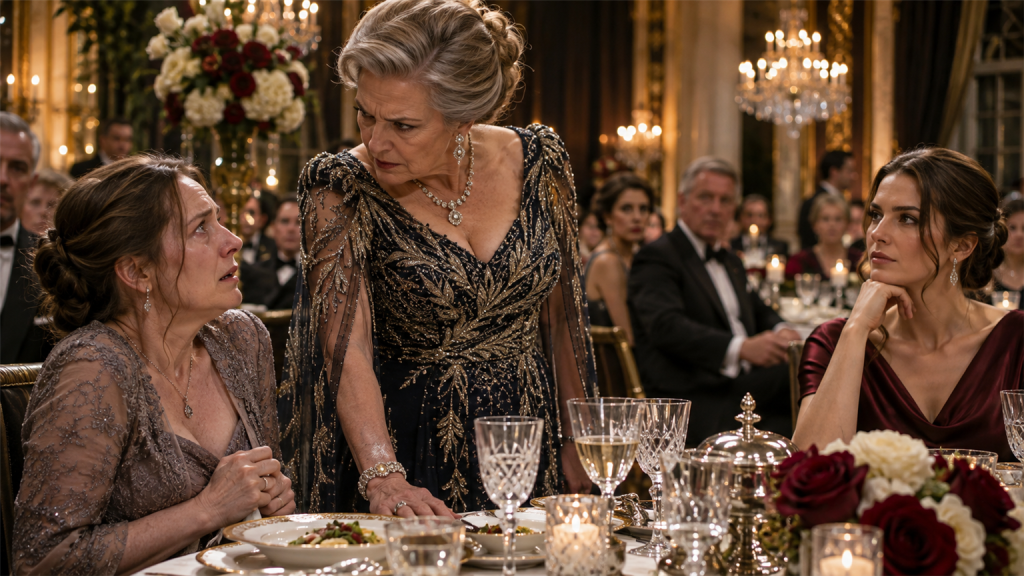
“Understood completely,” Carol said, her professional tone telling me she had already suspected as much after sitting three tables away from us at the gala. “We’ll keep all correspondence strictly through your Wacker Drive office.”
Four days later, the charity’s board secretary sent out the winter fundraising committee roster. Helen Quinn’s name was not on it.
At 4:50 PM that afternoon, my mother broke my thirty-day silence rule with a single text message:
You could have let me have this one thing. It wouldn’t have cost you a dime to let Carol think we coordinated it.
I looked at that message while standing by my office window, watching the commuter boats move down the Chicago River toward the lock. She still didn’t hear herself. Even after everything, I wasn’t a daughter with feelings or an executive with fiduciary rules; I was an inconvenient vending machine that was refusing to dispense the social currency she felt entitled to.
I broke my own silence just long enough to send six words back:
You cannot represent my company, Mom.
Then I blocked her number for the remainder of the month.
Around the same time, the smaller, quieter ripples started moving through our extended family. Chicago is a massive city, and nobody outside our immediate circle cared about a tense ten minutes at Table 4, which actually made the truth harder for my mother to outrun. When my cousin Lauren called me on a Thursday night, she sounded sheepish.
“Your mom told my mom that you had too much wine at the gala and started bragging about your salary to embarrass Claire,” Lauren said. “Then Aunt Sarah ran into Mrs. Patterson from the charity board at Mariano’s, and Mrs. Patterson mentioned that Vivian Harrington stood up at the table because your mother introduced you as an unemployed temp.”
“Vivian corrected an inaccurate introduction,” I told Lauren plainly. “And I had half a glass of sparkling water all night.”
“Yeah,” Lauren sighed. “I figured. I saw those texts your mom sent in the gala thread before dinner, Avery. I should have said something at three o’clock instead of just sending a thumbs-up on the flower schedule. I’m sorry.”
By the fifth week after the gala, the two aunts my mother usually drafted to call me and preach forgiveness had gone completely quiet. My mother hadn’t suffered some grand public exile; she had simply lost the automatic benefit of the doubt among the twelve relatives who used to take her stories at face value. For a woman like Helen Quinn, losing control of the room’s narrative was worse than a scandal.
On a freezing Tuesday evening in mid-November, five weeks after the dinner, my cell phone rang while I was locking up the office suite. It was Daniel Harrington.
I stood in the empty elevator lobby on the fourteenth floor and answered. “Hi, Daniel.”
“Hi, Avery. Have you got two minutes?” He sounded exhausted, with the hollow echo of an empty room behind his voice.
“Sure.”
“I just wanted to call you myself so you didn’t hear a distorted version through your parents,” he said. “Claire and I postponed the wedding indefinitely this afternoon. I’m packing my things out of the Streeterville condo tonight.”
I leaned my shoulder against the cool marble wall by the elevator bank. I felt no flash of triumph—just a heavy, sobering sadness at how thoroughly a four-month lie had hollowed out two people’s plans.
“I’m sorry you’re going through this, Daniel.”
“She finally showed me the phone on the Sunday after the gala,” he said quietly. “First she told me the June screenshot was an inside joke I wouldn’t understand. Then, when I asked why she’d spent the whole summer telling me you were struggling to pay rent, she cried and said your mother had bullied her into keeping your business quiet so Vivian wouldn’t judge the family. What broke it for me wasn’t even the gala, Avery. It was watching the story change every single time I asked a follow-up question over the last month.”
He paused, the sound of packing tape pulling off a roll echoing faintly on his end.
“I’m not calling to drag you into the middle of our breakup,” he added. “I just knew your family would try to lay this at your door, and I wanted you to hear from me that you didn’t cause this. Honestly, I wish I’d known which sister was which a year ago.”
“Take care of yourself, Daniel,” I said.
Two weeks after that—right before Thanksgiving, which I spent eating roasted chicken at Grandma’s bungalow while my parents and Claire stayed home in Evanston—Claire texted me that the engagement was officially over. They had forfeited the catering deposits at the Drake, untangled the joint lease in Streeterville, and begun the excruciating work of sending out cancellation cards to two hundred guests.



