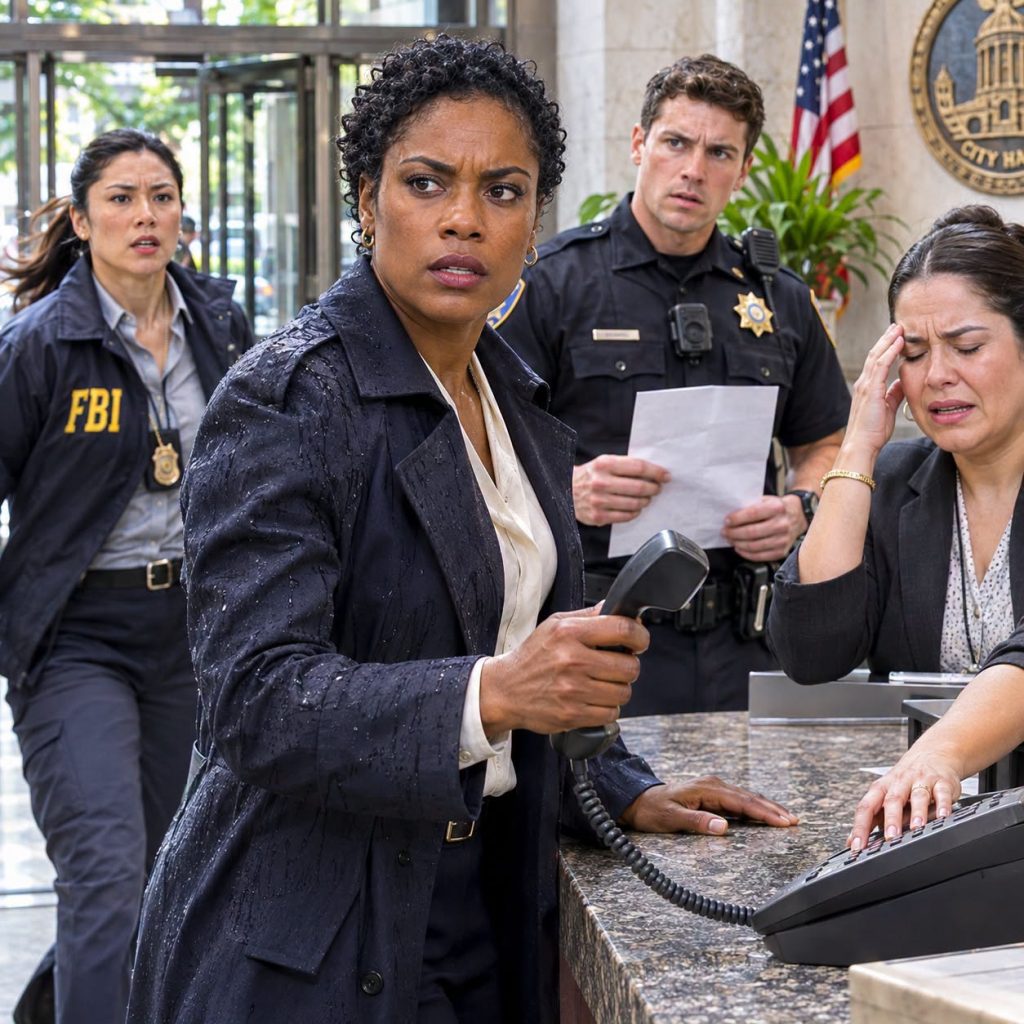
Part 1
“Get on your knees.”
I was halfway through giving the City Hall receptionist my name when Sergeant Calvin Puit grabbed my wrist. My umbrella hit the marble. Behind the desk, the receptionist stood so fast her chair rolled into a filing cabinet.
“Sergeant, she has an appointment.”
“Sit down, Gloria.”
I’m Immani Solain. I was forty-one that October morning, and it was my first day as the FBI special agent in charge in Harmon Falls. I’d come to City Hall to announce an investigation into the police department. In less than a minute, one of the officers we’d been investigating had my right hand pinned behind my back.
“My credentials are in my inside coat pocket,” I said. “I won’t reach for them. Call the mayor’s office.”
“You were told to go through secondary screening.”
“You told me after you grabbed me.”
His grip tightened. I went down on one knee because I could feel my shoulder about to give. The other knee struck the floor a second later. Somewhere behind me, a woman said, “Oh my God,” and I heard the unmistakable chime of a phone starting to record.
Puit looked over his shoulder. “Everybody back.”
A young officer came around the security desk. His nameplate read WHITLEY. His right hand hovered near his radio, and the red light on his body camera was blinking. Puit told him to bring the screening log. Whitley looked down at me, then at the open log on the desk.
“She came in through the public doors,” he said. “I saw her.”
“I asked you to bring me something.”
Whitley took a step toward the desk and stopped. “What am I supposed to put in it?”
Puit’s head turned slowly. I’d spent the previous evening reading summaries of eleven complaints against him. In three cases, a second officer had written that a person entered a restricted area. All three descriptions used the same phrase, past the marked boundary. There was no marked boundary on the floor where I knelt. There was a brass strip between the public lobby and the employee corridor, and I was a good ten feet from it.
“Gloria,” I said, “did you see where I was standing?”
“Yes. Right here at my desk.” She put both hands flat on the counter. “You were asking which elevator to take.”
Puit leaned close enough that only I could hear him. “You want to make this a bigger thing than it is?”
I looked at Gloria’s hands. She wore a grocery-store bandage around her thumb, and the tip was peeling up. I remember that because I was trying to keep my eyes on something ordinary. “It’s already as big as it is,” I said.
My phone began to vibrate inside my coat. I was due upstairs at nine. At eight fifty-five, an investigator on my team was supposed to call and confirm that a federal court order had been served on the city. We were seeking records from a retired dispatch system that the department claimed had been wiped. If the call was coming now, either my team had the records or something had gone wrong.
Puit keyed his radio. “I need transport at the east entrance. One adult female, refusing screening.”
“She hasn’t refused anything,” Whitley said.
“You can explain that to Deputy Chief Voss when he comes down.”
For the first time, Whitley looked genuinely frightened. His eyes went to his body camera. Then he looked at me. “Ma’am, did you say your name was Solain?”
Before I could answer, the elevator chimed. Mayor Constance Ferris stepped out with Maurice Halt, the FBI’s regional director. Puit straightened and started talking so quickly he tripped over the word procedure. Maurice walked right past him, lowered himself onto one knee, and held out his hand.
“Agent Solain,” he said. “I’m sorry we kept you waiting.”
Puit let go. My phone stopped vibrating. I took Maurice’s hand, but before he could help me to my feet, Whitley crossed the space between us.
“Agent Solain,” he said quietly, “the dispatch recorder is still running. It’s in the basement. Deputy Chief Voss sent someone down there five minutes ago.”
Pinned Comment
I thought the elevator doors opening meant I could finally get off that floor and ask some questions. Then I heard what Whitley said next, and I understood why he’d waited until someone from outside the department was close enough to hear him. The rest of the story is below 👇
Part 2
“He gave me the work order to sign,” Whitley said. “It says the recorder’s already been removed. I checked it myself at seven this morning.”
Maurice helped me up. I could move my fingers, though my thumb felt as if it belonged to someone else. The mayor looked from my hand to Puit. “Sergeant, you’re relieved of duty. Take your hands off your belt. Officer Whitley, secure his badge and duty weapon.”



