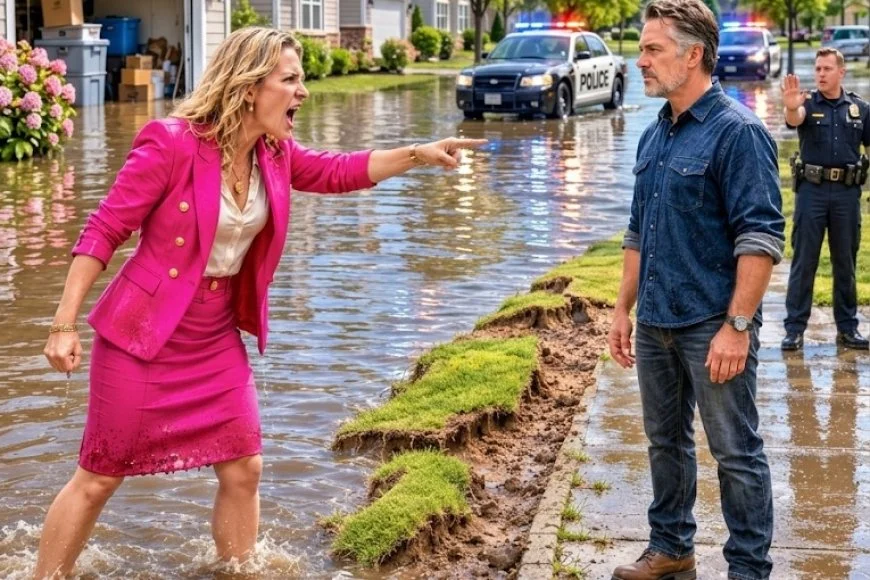
“Your mud pit stinks up the whole block. I’m having it filled Monday.”
Deirdre Nolan stood in my driveway holding a vanilla latte in one hand and an HOA work order in the other.
I stared at her.
“That ditch drains the entire street.”
“I don’t care what it drains.”
“It’s on my property line.”
“The board approved the work.”
“You need my permission.”
She smiled.
“Nobody on Birchwood Lane asked your permission, Mr. Dawson.”
Then she turned and walked away.
Four days later, two dump trucks arrived at sunrise.
By noon, fourteen loads of dirt had buried three hundred feet of drainage channel.
Three weeks after that, Deirdre stood ankle-deep in floodwater watching pieces of her brand-new sod float down the street.
But to understand why, you need to understand the ditch.
My name is Fletcher Dawson. I’m fifty-six years old, and I’ve been a plumber for twenty-six years.
Water has paid my mortgage most of my adult life.
And if working around water teaches you anything, it’s this:
Water doesn’t care about opinions.
Give it a path and it behaves.
Block the path and eventually it comes through your garage.
My wife Colleen and I bought our house on Birchwood Lane because it was cheap enough to leave us breathing room.
Three bedrooms.
Two bathrooms, if you were generous about the second one.
Garage door that screamed every morning.
We didn’t care.
Our kids were grown. Colleen worked night shifts at the county hospital. I wanted a place where I could fix what was broken and eventually stop fixing everything else.
The first thing I noticed during the inspection was a drainage ditch along the front edge of the property.
Three feet wide.
About two feet deep.
Ugly as sin.
It ran past most of the homes on the downhill side of the street and carried stormwater toward a drain near the end of the cul-de-sac.
I liked it immediately.
Not because it was pretty.
Because it worked.
After rain, thousands of gallons moved through that channel instead of across driveways and into garages.
So I kept it clear.
Leaves.
Trash.
Branches.
Once a tennis ball.
Colleen called it my “canal maintenance program.”
Then Deirdre Nolan decided it was an eyesore.
She had been HOA president for three terms because almost nobody wanted to run against her.
Deirdre sold real estate part-time and spoke about property values as if she personally controlled the Federal Reserve.
Four months after we moved in, I received a yellow envelope.
Violation:
UNPERMITTED STANDING WATER FEATURE.
Fine:
$150 per day.
I actually laughed.
Then I called her.
“It’s a stormwater ditch.”
“It looks terrible.”
“It’s supposed to carry water.”
“It lowers curb appeal.”
“The ditch was here before I was.”
“Then you inherited the problem.”
I appealed.
The board voted four to one against me.
So I did something I should have done before answering the first letter.
I read the covenants.
Every page.
No rule prohibited a drainage ditch.
No section number appeared on my violation notice.
No article.
No paragraph.
Just Deirdre’s opinion printed on HOA stationery.
I saved everything.
That turned out to matter.
The fines climbed past five thousand dollars.
Then came a lawyer’s letter threatening a lien.
I drove to the county stormwater office.
A clerk found the original 1994 grading plan.
The ditch appeared clearly on it.
But the county records were incomplete enough that she wouldn’t tell me who officially maintained it.
“Gray area,” she called it.
Deirdre heard only the part she wanted.
She started knocking on doors, telling neighbors my “swamp” was hurting home values.
Eighteen homeowners signed her petition.
So I hired a licensed geotechnical engineer.
It cost me $850.
He measured the channel, studied the slope, calculated runoff, and produced a stamped report.
His conclusion was simple.
During a moderate rain, the ditch handled roughly twelve thousand gallons.
Fill it, and water would sheet across Birchwood Lane and threaten at least nine garages.
I handed copies to every board member.
Deirdre glanced at the report.
“So you paid eight hundred fifty dollars for someone to tell you a ditch gets wet.”
Four board members laughed.
Then they voted to continue the fines.
Two months later, Deirdre narrowed the channel with decorative river rock.
The next rain sent water across my driveway.
Then Earl Crawford’s garage flooded for the first time in twenty-two years.
Earl came to my kitchen carrying a notebook and a six-pack.
He read the engineering report from beginning to end.
Then he looked up.
“If we’re going to war,” he said, “we need records.”
So we started keeping them.
Rainfall totals.
Photos.
Videos.
Water depths.
Dates.
Times.
By January, our evidence folder was thick enough to hurt somebody if you dropped it.
That was when Deirdre announced Phase Two of the Birchwood Beautification Initiative.



