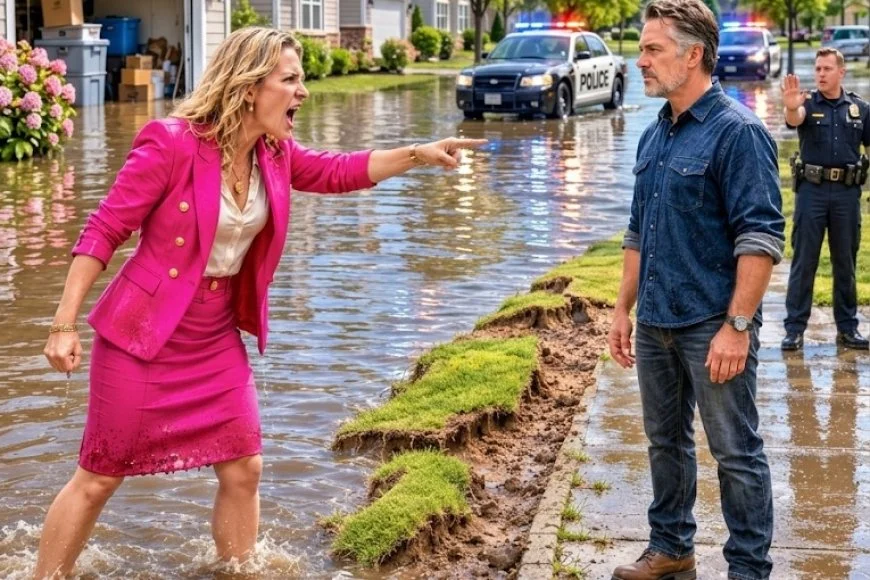
She stood at the front in a blazer and pressed slacks.
Her vanilla latte sat beside the laptop.
“Thank you all for coming,” she began. “The recent rainfall caused some unexpected water issues—”
Earl interrupted.
“Unexpected?”
He did not stand.
“My garage stayed dry for twenty-two years. You buried the ditch. Three weeks later I had three inches of water.”
Deirdre tightened her jaw.
“The board approved the project through proper procedures.”
Bev stood.
She held one page.
“Let’s discuss those procedures.”
Teacher voice.
Clear.
Unhurried.
“Eight thousand five hundred dollars to bury the ditch. The county estimates twenty-two to twenty-eight thousand dollars to restore it. Nine insurance claims have been filed. Does anyone on the board know the current estimated property damage?”
Nobody answered.
Bev looked down.
“Preliminary total is more than sixty thousand dollars.”
A murmur rolled through the room.
Deirdre raised one hand.
“Those numbers are not verified.”
“Neither was your ten-percent property-value increase,” Bev replied.
A few people laughed.
Not kindly.
I stood.
I had carried the original plat inside a cardboard tube.
I walked to the front and unrolled it beside Deirdre’s laptop.
The paper crackled.
“This is the original Birchwood Lane subdivision plat recorded in 1994.”
People leaned forward.
I pointed to the line.
“Stormwater drainage easement.”
Then to the note.
“County maintenance jurisdiction.”
I pulled five green certified-mail receipts from my folder.
“Three weeks before the flood, I sent every board member written notice that this easement existed.”
I placed the receipts down one at a time.
“All five signed for it.”
One.
Two.
Three.
Four.
Five.
Then I placed Deirdre’s email beside them.
“This was the response.”
I read it aloud.
“Our attorney has reviewed all aspects of the Birchwood Beautification Project. We are in full compliance.”
The room became silent.
Then the man in the gray suit stood.
“That statement is inaccurate.”
Heads turned.
Deirdre’s face changed before he said another word.
The attorney buttoned his jacket.
“My firm has represented the Birchwood Lane association on property matters for approximately eighteen months.”
He glanced toward Deirdre.
“In January, before the fill project was approved, Mrs. Nolan asked me to review county records relating to the ditch.”
Nobody moved.
“I identified the recorded drainage easement.”
Deirdre started to speak.
He continued.
“I advised the board president in writing that filling the drainage corridor without county authorization could violate the easement and expose the association to substantial liability.”
Earl whispered beside me.
“Well, hell.”
The attorney removed a printed email.
“I also received a response.”
Deirdre’s voice sharpened.
“That communication is privileged.”
He looked at her.
“I represent the association, Mrs. Nolan.”
Not her.
The association.
The distinction landed hard.
He read from the email.
“The board doesn’t need to hear about a thirty-year-old piece of paper. Just approve the project and send me the invoice.”
Nobody said anything for several seconds.
Then Jolene spoke from the back.
“My son’s schoolwork is destroyed.”
Her hands trembled.
“My landlord won’t answer me. My garage smells like sewage and mud.”
She stared at Deirdre.
“Who pays for that?”
Deirdre looked around the room.
“I was trying to improve the neighborhood.”
“You were warned,” someone said.
Another voice:
“You knew?”
Then another:
“You knew before the vote?”
One board member, Lynn Parker, covered her mouth.
“I never saw that email.”
Neither had the others.
The attorney confirmed it.
Deirdre had never shared his warning.
The county drainage inspector finally stood.
“The violation order remains active.”
He did not sound angry.
Government officials rarely need to when the paperwork is on their side.
“The association must restore the recorded drainage easement by April second. If restoration is not completed, the county may undertake corrective work and bill the responsible party.”
“How much?” someone asked.
“Current estimate is between twenty-two and twenty-eight thousand dollars.”
Another murmur.
Deirdre tried one last time.
“You’re all forgetting why we did this. That ditch was hurting the street.”
Earl stood now.
“No.”
He pointed toward the photographs Bev had brought.
Nine flooded garages.
Floating sod.
Water across the road.
“That ditch was protecting the street.”
The first board member resigned two minutes later.
Lynn.
She stood near her chair.
“I voted for the project.”
Her voice broke slightly.
“I didn’t know about the easement, but I should have asked.”
She looked around the room.
“I’m sorry.”
Two others resigned after her.
Then someone moved to remove Deirdre as president.
The bylaws required a member vote.
Ballots were distributed.
Nineteen voted to remove her.
Three voted against.
Motion carried.
Deirdre sat completely still.
Someone immediately nominated me to serve on the interim board.
I shook my head.
“Give it to Bev.”
Bev stared at me.
“She’s smarter than I am,” I said.
Earl added, “Meaner too.”
That got the first real laugh of the morning.



