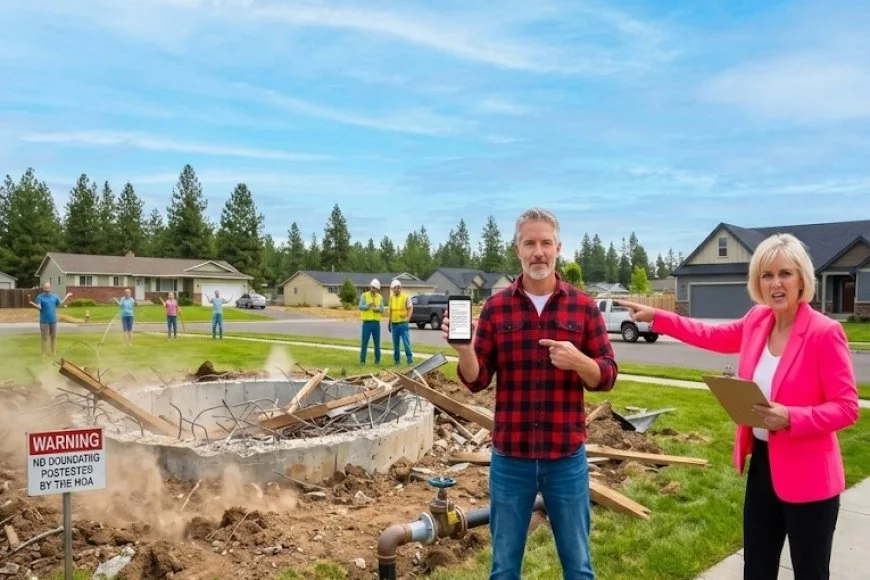
I came home after eight months overseas and found a concrete slab where my grandfather’s water tower had stood for sixty-three years.
No call.
No warning.
No hearing.
Just four sawed-off timber posts buried beneath fresh concrete and a laminated sign wired to my fence.
STRUCTURE FAILED CODE COMPLIANCE.
DEMOLISHED PURSUANT TO SECTION 4.7.
THANK YOU FOR YOUR COOPERATION.
Cooperation.
I had been halfway around the world.
My name is Garrett Thorn. I’m fifty-eight, a veteran and third-generation landowner in Elkhorn County, Colorado.
My grandfather Eldon built that tower in 1961.
Hand-welded steel tank.
Timber frame.
Barn-red paint.
It fed our irrigation lines, kept the fire-suppression tank full, and backed up the house whenever summer pressure dropped.
But calling it infrastructure only explains half of it.
Grandpa painted that tower every spring until his knees stopped letting him climb.
My father maintained it after him.
When Dad died, I inherited both the property and the responsibility.
Then I left for eight months doing civilian infrastructure work in East Africa.
My neighbor Walt Duvall checked the place twice a week.
His updates were usually useless.
Grass long.
Deer back.
Fence okay.
Then I came home.
And the tower was gone.
I photographed everything before touching a thing.
Cut posts.
Anchor bolts buried under new concrete.
Demolition permit taped to the fence.
Date stamp.
Contractor name.
Then I called Walt.
“Tell me exactly what happened.”
He went quiet.
“It was there Tuesday.”
“And?”
“Wednesday morning a crew showed up. Had it down before lunch.”
“Who authorized them?”
“County said it was permitted.”
“How long did the permit take?”
Another pause.
“Three days.”
That was impossible.
I knew enough about county review to know structural demolition did not move that fast.
Then I called Renata Solis, a Denver property-rights attorney who had once helped me settle a fence dispute without either neighbor threatening murder.
She listened.
Then asked:
“Original survey?”
“Yes.”
“County registration for the tower?”
“Yes.”
“Certified response to the HOA notice?”
“Yes.”
She exhaled.
“Then somebody made an expensive mistake.”
The HOA was Ridgecrest Commons.
Four years earlier, developer Prescott Hargrove had built a sixty-four-home subdivision beside the older ridge properties and inserted a so-called community integration clause into the development paperwork.
Most of us had barely noticed it.
That was our mistake.
Then Claudette Voss became HOA president.
Claudette had opinions about fences, mailboxes, driveway gravel, barns, sheds, and anything else visible from the road.
My tower offended her most.
Six weeks before I left for Africa, she sent one letter claiming it might violate a new aesthetic standard.
I replied by certified mail.
The tower predated the HOA.
It was a registered agricultural fixture.
I did not consent to inspection, alteration, or removal.
Then I left.
Claudette waited until I was gone.
Renata pulled the permit.
Deputy Inspector Fowler had approved it in under forty-eight hours.
Standard review took ten business days.
There had been no proper hearing.
No cure period.
No emergency declaration.
No structural failure report.
Just an expedited permit and a demolished tower.
I wanted to sue immediately.
Renata stopped me.
“Wait.”
“Why?”
“She’s going to send you the demolition bill.”
I laughed.
“She destroyed my property.”
“Yes.”
“And she’ll bill me?”
“Yes.”
Eleven days later, Ridgecrest Commons mailed me an invoice for $6,200.
STRUCTURAL REMEDIATION.
COMMUNITY AESTHETIC RESTORATION.
The cover letter was signed by Claudette personally.
We hope this closes the matter and allows us all to move forward as a community.
I made two copies.
Then framed the original.
After that, I started reading county records.
Everything.
Subdivision approvals.
Drainage permits.
Utility agreements.
Development covenants.
Three hours into the archive, I found something Claudette clearly had not considered.
Ridgecrest Commons had been approved on the condition that it maintain a shared stormwater agreement with surrounding ridge properties.
Including mine.
The agreement referenced the area where the tower had stood as part of the original drainage-control framework.
By removing a registered structure tied to that recorded plan, Ridgecrest had potentially disrupted one of the anchor references used in its own stormwater compliance documents.
Then I found something even better.
Or worse, depending on which side of the paperwork you were standing.
The subdivision’s water service crossed my land.
A shared lateral line ran along my western boundary under an easement granted in 2003.
The easement had a twenty-year term.
Renewable only by mutual consent.
It expired in 2023.
Nobody renewed it.
Not the developer.
Not the property-management company.
Not the HOA.
Not the county utility office.
Sixty-four homes were receiving water through a pipe crossing my property under an expired easement.
I stared at the document for a long time.
Then called Renata.
She started laughing.
“I’m not shutting off anyone’s water.”
“I know.”
“I mean it.”
“I know.”
“So what does this give us?”
“A negotiation.”



