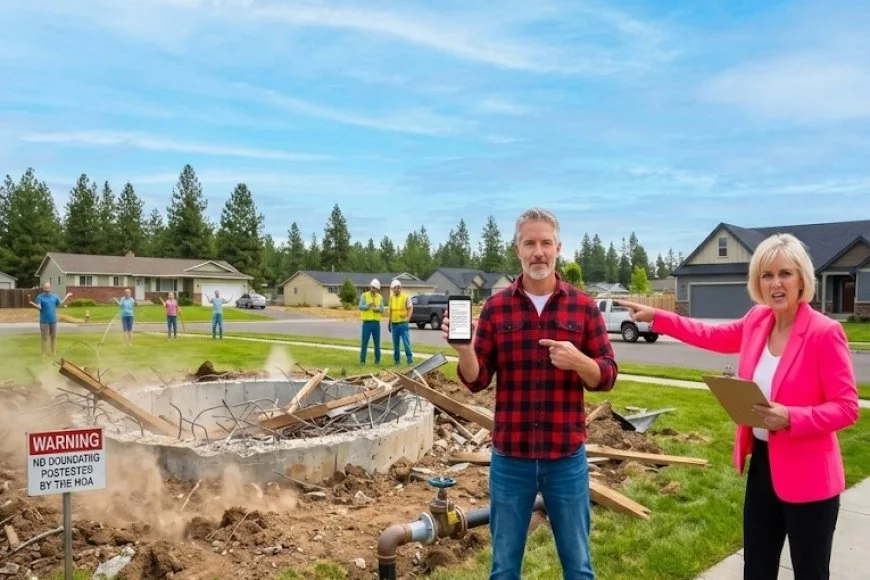
Then came consequences.
The county investigation into Deputy Inspector Fowler found three other permits he had expedited improperly over four years.
All involved projects connected to development around Ridgecrest.
Fowler resigned before the review finished.
Several projects were reopened for examination.
The state’s HOA regulators ordered an independent financial audit.
The audit found roughly $31,000 in homeowner overcharges and unsupported assessments accumulated over two years.
Residents received refunds or account credits according to the corrective plan.
The HOA was also fined and required to adopt stronger financial controls.
Claudette did not face the dramatic criminal prosecution some neighbors expected.
The evidence supported serious governance and financial misconduct concerns, but not every bad decision becomes a felony.
That disappointed some people.
Not me.
I wanted accurate consequences.
Not theatrical ones.
My civil claim moved separately.
The successor development company, Pinnacle Ridge Holdings, inherited much of the mess Prescott Hargrove had left behind.
Its lawyers initially argued that the HOA alone had caused the demolition.
Renata responded with development documents.
The community integration clause.
Stormwater agreements.
Management contracts.
Permit communications.
Then came the expired water easement.
That changed everyone’s incentives.
The sixty-four homes needed continued service.
I was willing to grant it.
But the new agreement would be real.
Written.
Compensated.
Renewable under clear terms.
And separated completely from the fight over the tower.
Nobody’s water was shut off.
Nobody’s family was used as leverage.
Instead, the county utility board, Pinnacle Ridge, and I negotiated.
The new lateral easement included annual compensation.
Inspection rights.
Defined maintenance obligations.
A renewal schedule.
Emergency access procedures.
Mutual-consent language.
All the things the old agreement should have had before somebody forgot it existed.
Then we resolved the stormwater problem.
The county acknowledged that demolition of the tower structure had interfered with documentation attached to the shared drainage framework.
New survey references were installed.
The drainage agreement was updated so nobody could later claim a demolished structure had erased a boundary or easement.
Boring work.
Important work.
My civil case settled four months after the recall.
$85,000.
Enough to cover the tower’s documented value, legal expenses, professional reports, and part of the agricultural losses associated with losing the water storage system.
More importantly, the settlement included a written acknowledgment:
The demolition had not been properly authorized.
I read that sentence several times.
Then filed it away.
The money rebuilt steel.
The acknowledgment repaired something else.
In March, a crane came up my ridge.
Walt stood beside me.
So did his nephew Cody, a licensed plumber who had helped design the new water connections.
The replacement tower did not look like Grandpa’s.
I decided not to pretend it could.
Modern steel frame.
Improved fire connection.
Better access ladder.
Updated tank.
New foundation.
We painted it pale silver-blue.
Cody stepped back.
“Never seen a water tower this color.”
“My grandfather had a name for mornings like this.”
“What?”
“Colorado morning.”
The sun caught the tank.
For a second, it almost disappeared into the sky.
I liked that.
The old tower belonged to Grandpa.
This one belonged to what came after.
Prue became interim HOA president.
Her first meeting lasted fifty-one minutes.
Walt considered that revolutionary.
Monthly financial statements were posted publicly to members.
Dues changes required actual votes.
Vendor relationships were disclosed.
Reserve transfers required multiple signatures.
The clubhouse HVAC unit was brought into compliance.
That made me laugh harder than anything else in the story.
Doyle left the board but continued helping with parking and event setup.
It turned out he was excellent when given authority over exactly fourteen painted spaces and nothing more.
Birdie Oaks became the most powerful person in Ridgecrest without ever holding an office.
She did not want one.
Instead, she proposed using part of the recovered funds to establish an annual community scholarship.
Two thousand five hundred dollars.
Local graduating senior.
Environmental stewardship or community service.
The first winner was a young woman planning to study environmental engineering.
The ceremony happened inside the same clubhouse where Claudette had been recalled.
Birdie gave a short speech.
“Community is a verb.”
That was all.
Walt cried.
He blamed allergies.
Nobody believed him.
Afterward, I walked home instead of driving.
The new tower was visible above the ridge.
Silver-blue against the evening.
The concrete slab from Grandpa’s original tower was still there.
I had not decided what to do with it.
At first, I wanted it gone.
Every time I looked at it, I remembered coming home exhausted after eight months overseas and seeing nothing where sixty-three years of family history should have been.
Then I changed my mind.
I built a bench beside it.
Nothing fancy.
Timber.
Steel brackets.
Facing west.
Walt helped.
Birdie brought lemonade and supervised despite nobody asking.
One evening, my granddaughter sat there with me.
She asked why I kept the slab.



