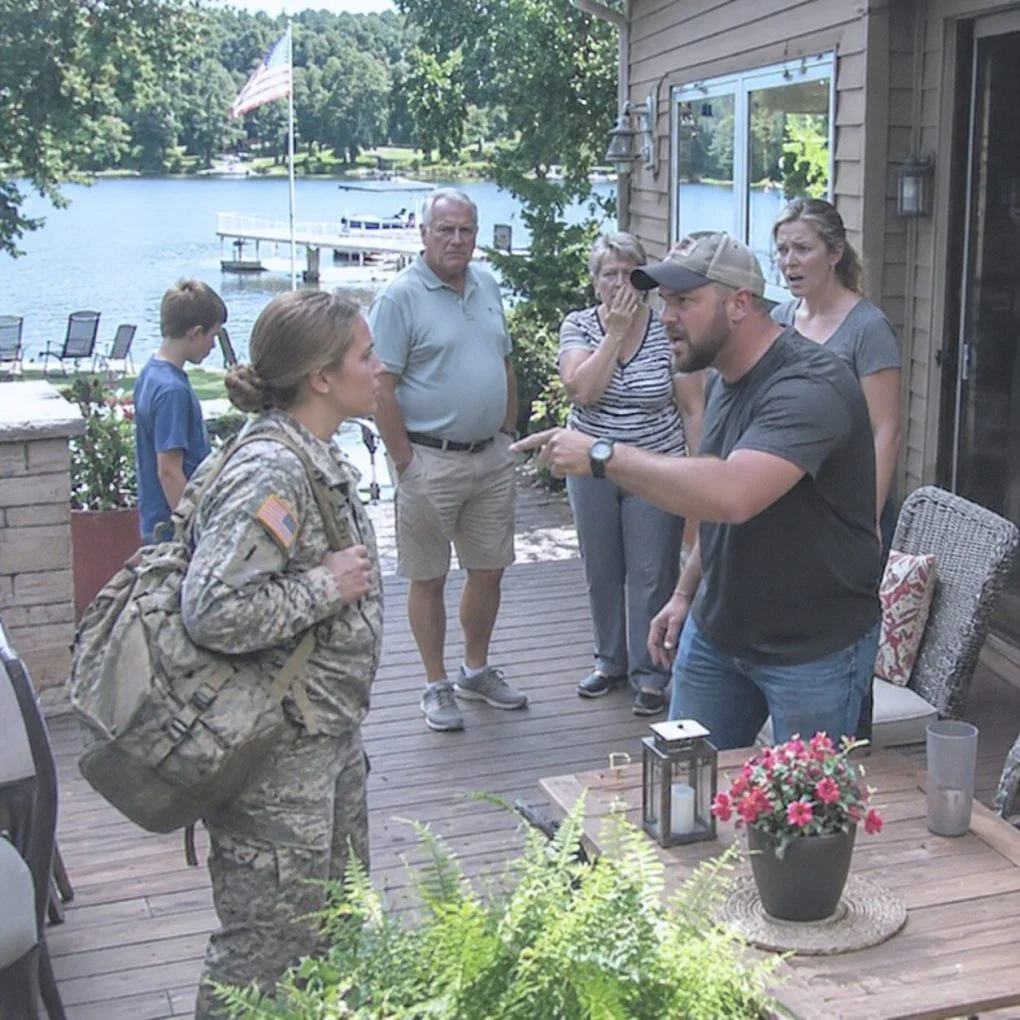
“Who let this freeloader in? Get out of my house!”
My brother-in-law, Travis Walsh, was standing on my porch with a beer in his hand when he said it. Behind him, his parents were eating lunch at the table my father had built, and two children were racing barefoot across the living room I had locked before leaving for duty.
I had driven seven hours for forty-eight hours of leave. My Army duffel sat at my feet, my hair was still bent from its tight bun, and I was wearing the faded gray sweatshirt Dad used to steal from me on fishing trips. All I had wanted was one quiet night beside the lake before reporting back.
“Travis,” I said, “where’s Jenna?”
He looked at my sneakers and laughed. “Of course you’re here looking for a free vacation. Jenna’s been too generous with her family. Take your bag and go.”
My sister appeared behind him, holding a damp dish towel. She wouldn’t meet my eyes, and I noticed that the little brass wind chime Dad had hung by the door was missing.
The house wasn’t a family vacation rental. I had bought it seven years earlier with years of Army savings and a mortgage in my name, then paid Jenna $300 a month to check the heating and pipes whenever I was away. Dad had helped me repair the porch before he died, staining one board darker than the rest because he had spilled his coffee.
“Jenna,” I asked, “did you tell him he could live here?”
“Claire, not in front of everyone,” she whispered.
Travis stepped between us. “My wife doesn’t answer to you. I told you to leave.”
I could have shown him the deed on my phone. Instead, I saw his mother lift the hand-carved wooden fish Dad had made me, using it to prop open the screen door, and suddenly I couldn’t trust my voice.
“Okay,” I said.
I walked to my car and called Mara Levin, the attorney who had handled my purchase. She told me not to force my way inside or change locks while people were living there. I sent her a photograph of the cars in my driveway, then called our neighbor to ask whether he’d seen anything unusual.
He sent back a link.
My house was advertised online as a luxury lake retreat, available for $950 a night. The listing displayed photographs of my bedroom, my father’s porch bench, and a calendar of upcoming reservations.
Under HOST AND PROPERTY MANAGER, it said Jenna Walsh.
And the very first photograph showed something that made my breath catch: the locked cabinet containing Dad’s letters was standing open.
I spent that night in a roadside motel fifteen minutes from the lake. It had a humming air conditioner and a window overlooking a gas station, and every time a truck passed, I imagined its headlights moving across the water at my house.
Mara sent a written notice to Jenna and Travis confirming my ownership and demanding that they stop advertising the property and preserve every rental record. She also contacted the local management company named on the listing; after seeing the recorded deed, its manager suspended new bookings and agreed to investigate who had authorized the rentals.
By Saturday morning, Mara had the documents I needed. The company had received a signed letter appointing Jenna to manage the house in my name, with a copy of my driver’s license attached. My signature looked convincing from a distance, but its final stroke was identical to the signature on an old insurance form I’d left in a file drawer for emergencies.
I hadn’t signed a rental authorization. I hadn’t given anyone permission to copy my license, either.
The company had paid Jenna nearly $19,000 for stays booked during my last deployment, plus deposits on several future visits. She had arranged cleaners, collected guest reviews, and apparently told her husband that I had transferred the house to her after Dad died.
When I called Jenna, she didn’t deny it. “Travis thought it was mine,” she said, her voice thin. “He told his parents we finally had a place big enough for everybody.”
“You knew I was coming home Friday.”
“I was going to ask you to stay somewhere else. Just until they left.”
I remembered her calling me last winter to complain about how hard things were financially. I’d offered to cover the children’s school supplies; she’d thanked me, then asked whether I would still pay her for checking the house because she needed the money. I hadn’t imagined she was earning rent from strangers at the same time.
“Where are Dad’s letters?” I asked.
There was a silence. “Travis wanted the cabinet for his fishing gear. I put the papers in the shed.”



