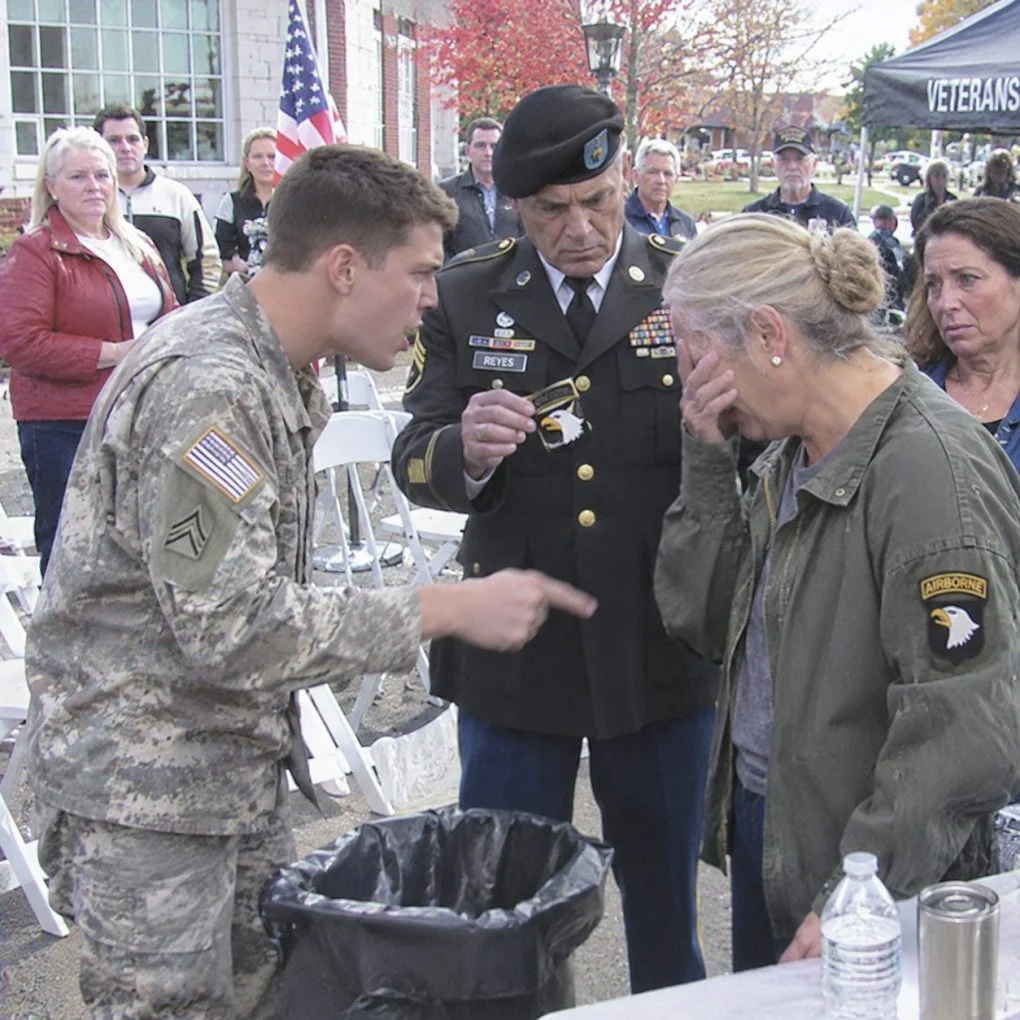
I was accused of faking my military service in front of a crowd. A young corporal tore the Screaming Eagle patch from my sleeve as if it meant nothing. But when his sergeant major noticed the inscription hidden on the back, he stopped the corporal with four words…
“Tell us another war story, lady!” the corporal shouted, and his fingers caught the Screaming Eagle patch on my sleeve. The stitches snapped against my skin, and he tossed the patch beside a trash can as the Veterans Day crowd stared.
I didn’t bend to pick it up. I saw my husband David at our kitchen table, squinting through his glasses as he stitched that patch onto my blue jacket. His hands trembled after months of cancer treatment, but he’d used blue thread because he couldn’t find black, then pressed the patch flat with his thumb as though he were handling something precious.
I had been waiting to check in, my driver’s license in my hand, when he asked which soldier I’d stolen the patch from. I told him I had served there; he laughed at once.
“That’s not yours to wear,” the corporal said. He looked barely older than my daughter had been when she left for college, his uniform immaculate, his certainty absolute. “Real soldiers don’t need costumes.”
My name is Nora Ellis, and I’m fifty-eight, a former Army nurse who served with the 101st Airborne Division in Afghanistan. I had driven to a veterans’ gathering in Clarksville, Tennessee, carrying a photograph for the mother of a soldier I couldn’t save. I hadn’t come for applause, or to defend the nights I spent treating men who cried for their mothers.
“Corporal, please give that back,” I said. My voice barely carried beyond the registration tent.
He laughed and nudged the patch farther from my shoes with his boot. A teenager lifted her phone; an older veteran stepped forward, but I shook my head.
David had sewn six words onto the back of the patch, where only I could see them. During his illness, I’d kept counting the dead and forgetting the survivors. David wanted me to touch those words when the memories became unbearable.
He died nineteen months ago; I’d worn the jacket almost daily since. Every time I slipped it over my shoulders, I remembered him sitting at that kitchen table, making something ordinary feel worth keeping.
A voice behind the corporal cut through the murmuring. “Take two steps back. Now.”
A command sergeant major approached, his expression controlled as he crouched to retrieve the patch. He turned it over and read the words: For the ones you brought home.
His hand went still. He looked up at my face, then at the scar crossing my wrist.
“Captain Ellis?” he asked softly. I recognized his eyes before I remembered his name: Daniel Reyes, once a young sergeant on the worst night of my deployment.
He straightened toward the corporal. “You just threw away the patch of the woman who saved my life.” Then he spoke another name—one I had spent seventeen years trying not to hear….Discover what happens next here.
“Private Eli Moreno,” Sergeant Major Reyes said. “His mother is here today.”
The name hurt more than the cold. Seventeen years earlier, an explosion struck a convoy in Afghanistan, and casualties overwhelmed our aid station; Reyes was bleeding badly, and Eli was brought in beside him. I worked until my hands cramped inside my gloves, and although Reyes survived, Eli died before the evacuation aircraft arrived.
I’d written to Eli’s mother twice after his funeral. Teresa Moreno answered both letters with kindness I wasn’t ready to accept, and we exchanged Christmas cards for years. Last month she asked me to come to a remembrance service in Clarksville, promising I wouldn’t have to speak.
The corporal glanced between us. “Sergeant Major, I thought she was faking it. There’ve been people pretending to be veterans around here.”
“Did you ask her name?” Reyes said. “Did you check with the organizers before laying your hands on her?”
The corporal had no answer. Reyes instructed him to stand aside, called the event’s military liaison, and asked two witnesses to stay; he did not announce a punishment, because that decision belonged to the soldier’s commander after the incident was documented. The teenager offered video of him ripping the patch from my sleeve.
Reyes handed it to me with both palms open. The edge was torn, and a scratch on my arm had begun to bleed. I touched the six small words instead of looking at the wound.
David had stitched them after another dream in which seven stretchers came in but only six voices answered. He had sat beside me until morning that night, saying very little because he knew there wasn’t anything he could say to make the memory disappear.



