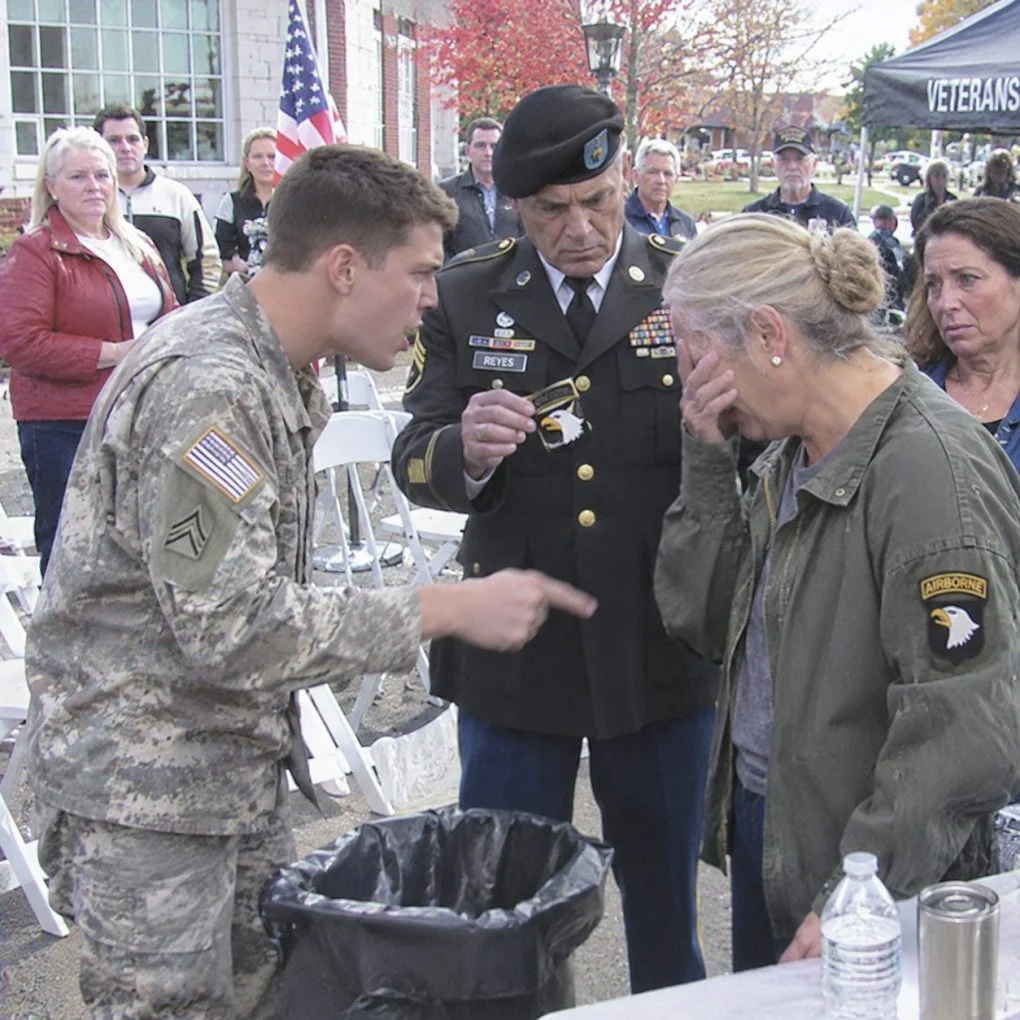
“You remember what you did that night?” Reyes asked. “You kept pressure on my wound and refused to leave until the helicopter crew took me. You were already exhausted, but you spoke to every one of us as if we had somewhere important to be.”
“I remember Eli,” I said. My voice came out thin, and I hated that the corporal could hear it. “I remember telling him his mother was waiting, when I couldn’t promise he’d make it home.”
Reyes looked toward the memorial tent. “He spent his last conscious minutes asking you to check on the other men, Nora. I wrote that in my statement; I don’t know whether anyone ever showed it to you.”
No one had. I’d believed Eli died frightened and abandoned while I treated another patient, a thought that followed me through David’s illness, his funeral, and every quiet morning afterward. Reyes didn’t claim those words erased what happened; he only told me that Eli had thought about other people even then.
The event coordinator, a retired major named Denise Walker, came over with a first-aid kit and asked whether I wanted to file a civilian complaint. I said yes, and Reyes promised his command would preserve witness accounts and address the corporal’s conduct through proper channels. I didn’t want his life destroyed, but I wouldn’t let anyone call the assault a misunderstanding.
Then the microphone crackled from the remembrance tent, where Gold Star families were gathering. I saw Teresa standing by the first row, one hand wrapped around the folded flag case she’d brought for the display, watching the patch in my hand.
She walked toward us without looking at the corporal. Her eyes were wet, but her voice was steady when she said, “Nora, I have something to tell you about my son, and I want him to hear it too.”
Teresa took my hand and led me toward the chairs beneath the remembrance tent. The corporal stayed where Reyes had told him to wait, while the military liaison took witness statements. The torn edge pressed into my palm, and I missed David’s steady hand at my elbow.
Before Teresa approached the microphone, I gave her the photograph I’d carried from home: Eli beside our aid-station tent, laughing with his whole face. At the microphone, she didn’t name the corporal. She spoke about Eli, who had been nineteen when he died, who hated tomatoes and called his little sister every Sunday.
Then she looked toward me and said, “The Army told me Captain Ellis stayed with my boy until help came, even though other wounded men needed her.” I lowered my head, remembering how many times I had wondered whether Eli’s family blamed me for the boy they never got to welcome home.
For seventeen years I’d replayed my mistakes; hearing Teresa describe my presence as kindness was almost unbearable. She continued, “Nora wrote me afterward. She didn’t tell me how brave she was; she told me Eli had asked about the others. Those letters were the first honest words I received about his final hours.”
Teresa faced the crowd that had watched him throw my patch away. “My son didn’t come home,” she said, “but his service is not a costume, and neither is hers.” Nobody applauded immediately; the silence felt like an answer.
Reyes stepped forward. He identified himself as one of the soldiers treated by my team and explained that service was not something a stranger could judge from the age of a face or the clothes someone wore. With my permission, he described the torn patch and asked the crowd to show veterans the dignity they’d want for their own families.
The corporal stood at the back beside his supervisor, his face drained of its earlier amusement. After the ceremony, he tried defending his actions, then noticed Teresa beside me. “I was wrong,” he said. “I had no right to touch you, ma’am.”
“You had no reason to assume I was lying,” I answered. “And if I hadn’t known your sergeant major, you would have left that patch in the dirt.”
He looked down. I didn’t demand a salute or public performance; I asked that his statement accurately describe what he’d done. He needed to remember when nobody was watching.
The video, witness accounts, and my complaint went to his chain of command. After an investigation, his commander removed him from public-facing ceremonial assignments, issued a formal reprimand, and arranged reimbursement for the jacket’s repair; those actions took weeks, not seconds. Reyes called to tell me the complaint had been substantiated, without claiming he’d decided the outcome.
A veteran tailor offered to repair the sleeve. I asked her to preserve David’s crooked blue stitches, and she worked the patch back into place around them. The six words remained against the lining.



