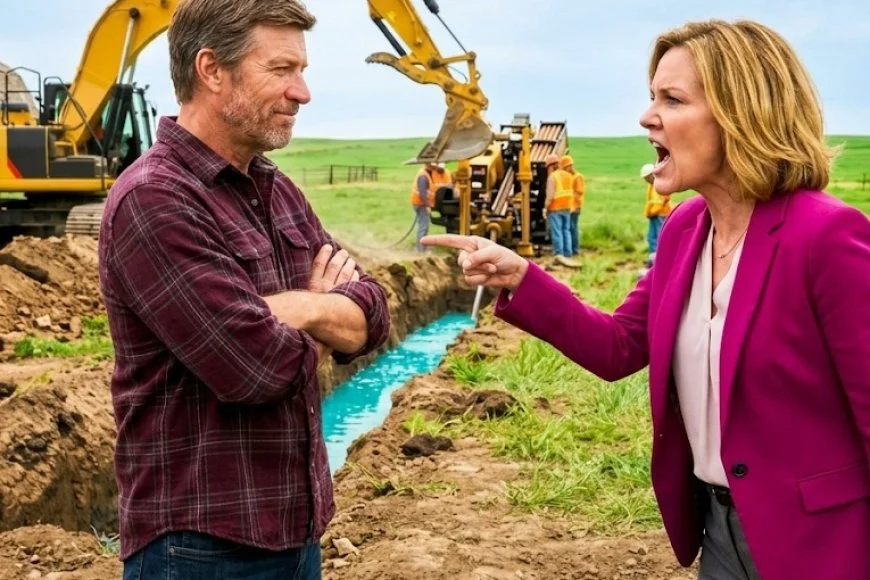
“You are trespassing on association property.”
The woman stood at the edge of the ridge in a navy blazer and sunglasses, pointing her phone at me like she was documenting a crime.
Behind her, a drilling rig was grinding through limestone on land my family had owned since 1889.
Diesel rattled through the morning air.
Core barrels lay beside the rig.
Fresh rock dust covered the grass.
And the woman had absolutely no idea where she was standing.
“This drilling activity will continue,” she said, “and if you interfere, the association will pursue legal remedies.”
I looked down at the gravel beneath her shoes.
“My family built this road.”
She smiled.
“Sir, this is Ridgeline Estates common property.”
“No.”
Her smile faded slightly.
“It’s really not.”
My name is Caleb Brennan. I’m sixty-four, and I inherited Brennan Ranch from my father in 1996.
Three hundred forty acres once belonged to my great-grandfather Josiah Brennan, who bought the land in 1889 for twelve hundred dollars and two mules.
Most of the ranch survived intact.
But in 1978, my grandfather Solomon sold roughly a hundred acres to a developer.
That became Ridgeline Estates.
He kept one strange piece.
A twelve-acre strip running along the southern ridge.
He also kept ownership of the old access road leading to it.
The development received an easement over that road.
That meant residents could use it.
It didn’t mean they owned it.
For decades, nobody cared.
People drove across.
I paid the taxes.
The HOA maintained its fences and mailboxes.
Everybody stayed in their lane.
Then the HOA decided to drill.
The woman introduced herself as Karen Doyle, the association’s property committee chair.
Ten minutes later, a white SUV arrived.
Richard Callaway, HOA president, stepped out wearing a gray suit that looked expensive enough to make the dirt uncomfortable.
He didn’t shake my hand.
“The association retained mineral exploration rights on all common property,” he said.
“Did you check the boundary?”
“Our counsel reviewed the relevant documents.”
“That’s not what I asked.”
He hesitated.
Then recovered.
“The survey is on file.”
“Did you personally look at it?”
He stared at me.
The rig kept drilling.
Finally, I nodded.
“Thank you.”
“For what?”
“For answering the question.”
I walked back to my house.
No shouting.
No sheriff.
No dramatic threats.
Just three phone calls.
The first was to Gerald Moss, the attorney who had handled my father’s estate.
“I need a certified survey of the southern strip.”
“Problem?”
“There’s a drill rig sitting on it.”
Silence.
Then:
“I’ll have somebody there Monday.”
My second call was to the county recorder.
I requested the Ridgeline Estates plat, HOA covenants, easements, and every recorded mineral-rights instrument attached to the development.
My third call went to Vincent Harrell.
Vincent specialized in mineral and surface-rights disputes.
He listened while I explained everything.
Then he asked:
“Did they remove core samples?”
“Yes.”
“Did you authorize it?”
“No.”
“Do they have a lease?”
“Not from me.”
He was quiet.
Then:
“Don’t discuss money with them. Don’t sign anything. Find out exactly where they drilled and what they found.”
The survey crew spent three days on the ridge.
Wednesday afternoon, the crew chief handed me the preliminary map.
The drill site sat forty-two feet inside my property line.
Not close.
Not ambiguous.
Inside.
Thursday, the county documents arrived.
I spread them across the same kitchen table where Solomon had signed the 1978 sale.
The plat showed the road as an access easement.
The HOA could use it for ingress and egress.
Nothing more.
The twelve-acre strip wasn’t HOA common property.
Neither was the ridge.
The HOA covenants did contain language claiming mineral rights over association-owned common areas.
But that was the problem.
They didn’t own this one.
I called Vincent.
“They drilled on your property without a mineral lease,” he said. “Now we find out why.”
The rig was gone when I returned to the site.
One worker remained, loading equipment.
I introduced myself.
“What were you drilling for?”
He studied me.
“Natural gas.”
“How many cores?”
“Six.”
“Where’d they go?”
“Lab in Midland.”
I nodded toward the ridge.
“You know this isn’t HOA property?”
His expression changed.
“They told us it was.”
“It isn’t.”
He slowly removed his gloves.
“Then somebody has a problem.”
Richard called that evening.
His tone was different.
Careful.
Measured.
“There appears to have been a misunderstanding.”
“About twelve acres?”
“We relied on a site map.”
“Which one?”
He ignored that.
“The association is prepared to compensate you for the inconvenience.”
“How much?”
“Five thousand dollars.”
I almost laughed.
Then I remembered Vincent’s warning.
“I’ll consider your offer after I see the laboratory report.”
A pause.
“That’s proprietary.”
“The rock came out of my land.”
Another pause.
“I’ll have counsel contact you.”
The letter arrived four days later.



