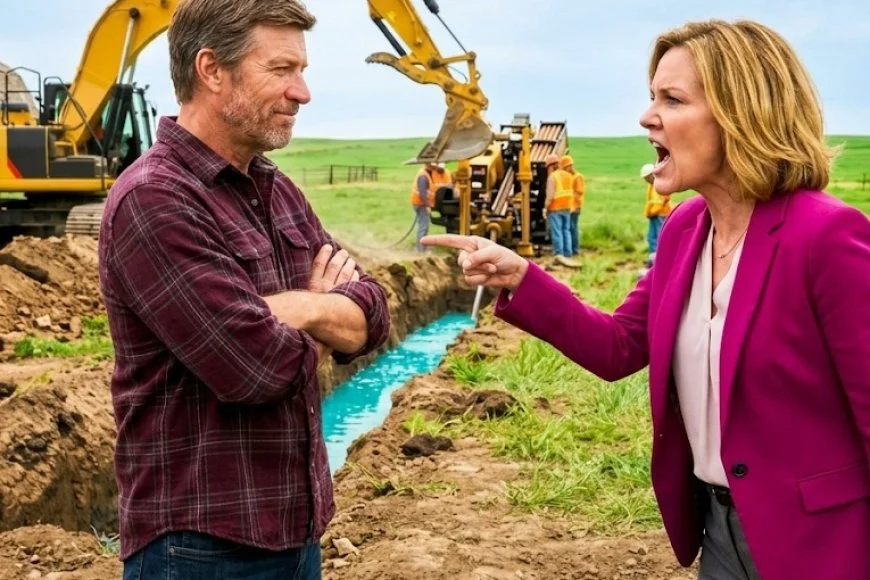
It apologized for a “boundary discrepancy.”
Repeated the $5,000 offer.
Then buried one sentence on page three.
The preliminary analysis had identified commercially significant hydrocarbon indicators.
I read it twice.
Then called Vincent.
He read the sentence aloud.
“Commercially significant.”
“That’s what it says.”
“Caleb, they didn’t offer you five thousand dollars because they scratched your pasture.”
“What are you thinking?”
“I’m thinking they found something.”
He paused.
“And I’m thinking they hoped you would sign a release before you understood what it was.”
Two days later, we filed for an injunction and demanded the drilling records.
The HOA fought disclosure.
Then the court ordered production.
A week later, Vincent and I sat in his office with the lab report open between us.
The estimate wasn’t seventy million dollars.
It wasn’t a guaranteed fortune.
It wasn’t even a producing well.
But the geologists had identified a potentially valuable gas-bearing formation beneath the ridge, enough to justify further exploration.
And attached to the report was something even more important.
A map.
One showing a proposed horizontal well path.
The line began on HOA property.
Then curved beneath my twelve-acre strip.
I stared at it.
“They weren’t just testing my land.”
Vincent shook his head.
“No.”
He tapped the map.
“They were planning to drill under it.”
Then he turned the page.
At the bottom was an internal HOA email chain discussing a future mineral lease.
Richard Callaway’s name appeared three times.
And one sentence made Vincent stop reading.
“Southern strip ownership issue should be resolved after exploratory results confirm commercial viability.”
I looked at him.
“He knew there was an ownership issue.”
Vincent nodded.
“Before they drilled.”
And suddenly this wasn’t a boundary mistake anymore…
The injunction hearing lasted less than an hour. The HOA’s attorney called the drilling an innocent surveying error, but Vincent placed the certified boundary map beside Richard Callaway’s email discussing the “southern strip ownership issue.” The judge immediately barred further drilling or mineral activity on my property until title and liability were resolved.
Then the HOA’s insurer got involved.
That changed Richard’s attitude faster than any threat I’d made. A forensic title review confirmed what my family documents had said all along: the HOA held an access easement over the road, but no ownership interest in the twelve-acre strip and no mineral rights beneath it.
The lab’s estimate was also less sensational than Richard had hoped. There might be commercially recoverable gas, but nobody could know the true value without more drilling. That uncertainty cut both ways.
The HOA couldn’t claim they’d discovered a guaranteed fortune.
But they also couldn’t explain why they had drilled first and planned to resolve ownership later.
Mediation was scheduled.
The association offered $400,000 plus restoration of the drill site.
Vincent rejected it.
Not because he thought I deserved millions for disturbed grass, but because the real dispute now included unauthorized exploration, removed core samples, legal expenses, and a deliberate attempt to position a future well beneath land they knew might not belong to them.
Then the mediator asked Richard one question.
“If you knew ownership was unresolved, why didn’t you ask Mr. Brennan before drilling?”
Richard looked down at the table.
And for the first time since this started, nobody answered for him…
PART 3
Mediation continued for nine hours.
Most of it was boring.
That’s the part people leave out of legal stories.
No one spends nine hours pounding tables.
You spend nine hours moving between conference rooms while lawyers argue over definitions, insurance coverage, restoration costs, title language, and whether a sentence written in an email meant exactly what it appeared to mean.
Richard’s email was the problem.
The HOA’s attorney argued “resolved” meant clarified.
Vincent argued it meant they knowingly proceeded before confirming ownership.
The insurer’s lawyer barely argued at all.
He kept asking Richard questions.
Who selected the drilling site?
Who gave the contractor the map?
Who told counsel the ridge was common property?
When did Richard first learn the twelve-acre strip had a separate tax parcel?
Richard’s answers became less confident each time.
Around four in the afternoon, the mediator came into our room.
“The association has increased its offer.”
“How much?” I asked.
“$1.6 million, restoration, fees, and a permanent recorded acknowledgment of your ownership.”
Vincent looked at me.
I didn’t answer.
The mediator sat down.
“This isn’t advice. But I want both of you to remember that the gas value is uncertain. There is no producing well. There may never be one.”
“I understand.”
“At trial, Mr. Brennan could win more.”
Vincent nodded.
“He could also win less.”
“I understand that too.”
The mediator folded his hands.
“What matters most to you?”
That should have been an easy question.
Money.
Anyone pretending otherwise is performing.
A million dollars changes lives.



