Twelve years after Mom threw me out for protecting my college fund, she arrived at Grandpa’s house with an eviction notice. My retired general grandfather had recently passed away, and she wanted everything for my brother. I opened the door calmly. Then her attorney noticed whose name was on the deed…
““Your Honor, my daughter has been living in that house for twelve years without paying a dime. My father is dead, and I want her removed so my son can move in.”
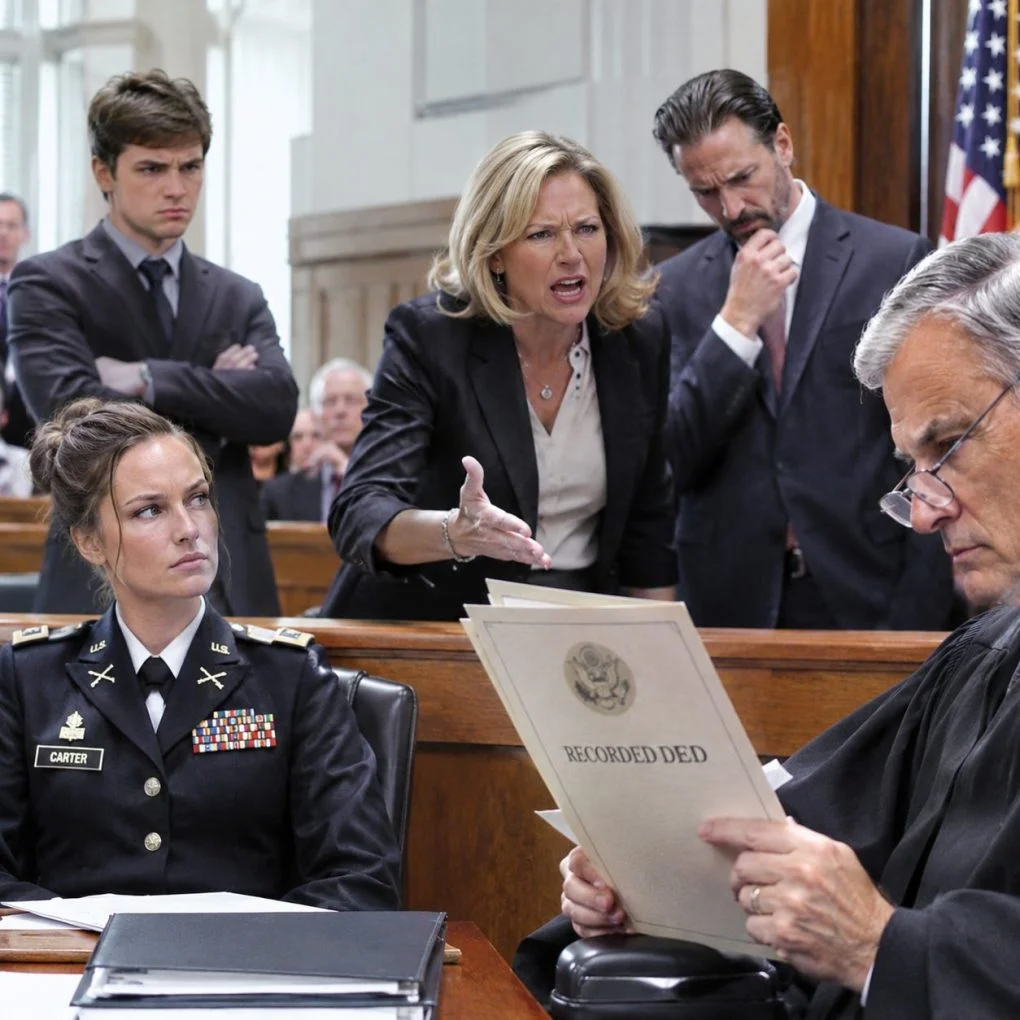
My mother said those words at 10:17 on a Tuesday morning in an Alexandria, Virginia, courtroom, six weeks after we buried my grandfather, retired Major General Samuel Carter. She sat beside her attorney wearing the same pearl necklace she’d worn when she threw me out at seventeen, and she smiled at me as though she’d already won.
I was twenty-nine now, but I still remembered the sound of my suitcase hitting the front porch.
“Give Tyler the college money, Rachel, or find somewhere else to live,” she’d told me twelve years earlier. Grandma had left $42,000 in an education account for me, managed by Grandpa, and Mom wanted it redirected to my younger brother after he lost his scholarship.
I’d refused.
Grandpa arrived forty minutes later in his old pickup truck, still wearing the baseball cap he’d bought after retiring from the Army.
He didn’t shout at Mom or demand an explanation. He simply picked up my suitcase, placed his coat around my shoulders, and said, “Come on, sweetheart. There’s always room for you.”
That night, he made grilled cheese sandwiches because neither of us felt like cooking, and he left a small lamp burning outside my bedroom.
I lived with him through college, my first job, and the years when his knees began hurting too much for him to climb the stairs.
He taught me how to change a tire, balance a checkbook, and stand up for myself without raising my voice.
Now Mom wanted the home where he’d taught me all three.
“Rachel manipulated an elderly man,” she announced, pointing toward me. “My father promised this property would stay in the family.”
I looked at my hands.
Grandpa’s silver watch was resting against my wrist.
My attorney, Daniel Mercer, rose and handed the judge a certified property record together with a sealed envelope Grandpa had kept among his military service papers.
The judge broke the envelope’s seal, examined its contents, and compared them with the recorded deed.
His expression changed.
“Counsel,” he said, looking toward my mother’s attorney, “have you independently verified who owns this property?”
The attorney reached for the document.
Then he stopped smiling.
The deed had been recorded four years earlier.
My name was listed as the owner, subject to Grandpa’s lifetime right to live there.
But that wasn’t what made the attorney turn toward Mom.
Attached to the deed was a second document.
And at the bottom was my mother’s signature, dated three years before Grandpa died.
My mother’s attorney asked for a recess so he could examine the document more carefully, and the judge granted him fifteen minutes. I remained beside Daniel while Mom marched into the hallway, her heels striking the courthouse floor with the same sharp rhythm I’d heard whenever she came upstairs to punish me as a child.
“What exactly did she sign?” I whispered.
Daniel opened our copy of the document.
Four years earlier, Grandpa had transferred the house to me through a properly recorded deed while retaining a life estate, meaning he could continue living there for the rest of his life. The transfer had been handled by an independent attorney, who documented Grandpa’s understanding of the transaction.
Grandpa had also instructed that my mother receive written notice.
She’d attended a meeting with his attorney, accepted a copy of the deed, and signed an acknowledgment confirming that she understood the property would not pass through Grandpa’s estate when he died.
Her signature was right there.
“She knew,” Daniel said quietly.
I stared at the paper.
Mom had spent six weeks accusing me of stealing Grandpa’s house, telling relatives I’d manipulated him during his final illness. She’d even sent me a notice demanding that I vacate within thirty days, although she had no ownership interest or court order authorizing my removal.
And all along, she’d known the house was legally mine.
I remembered the winter Grandpa turned eighty, when he began leaving little notes around the house because his knees hurt too much to climb the stairs looking for things. One note beside the refrigerator said, Rachel likes her coffee before anyone talks to her.
Another, tucked beneath the cookie tin, read, Don’t forget to buy her birthday cake.
He’d never forgotten my birthday.



