Even during his final months, when I helped him button his shirts and carried his dinner upstairs, he’d still ask whether I was eating properly.
“Your grandpa did something else,” Daniel said, interrupting my thoughts.
He showed me a statement Grandpa had signed at the same time as the deed transfer.
It explained that he’d taken me in when I was seventeen, provided a stable home while I finished school, and later watched me contribute to household expenses as an adult. He specifically stated that the property transfer was his independent decision, not a reward for caregiving or something I’d requested.
Then Daniel pointed to the final paragraph.
My daughter believes everything I own should eventually belong to Tyler. I love both my grandchildren, but I will not allow Rachel to lose another home because someone wants to take what belongs to her.
I pressed the paper against my lap.
Grandpa had known Mom might come after me.
He’d prepared for it years before his death.
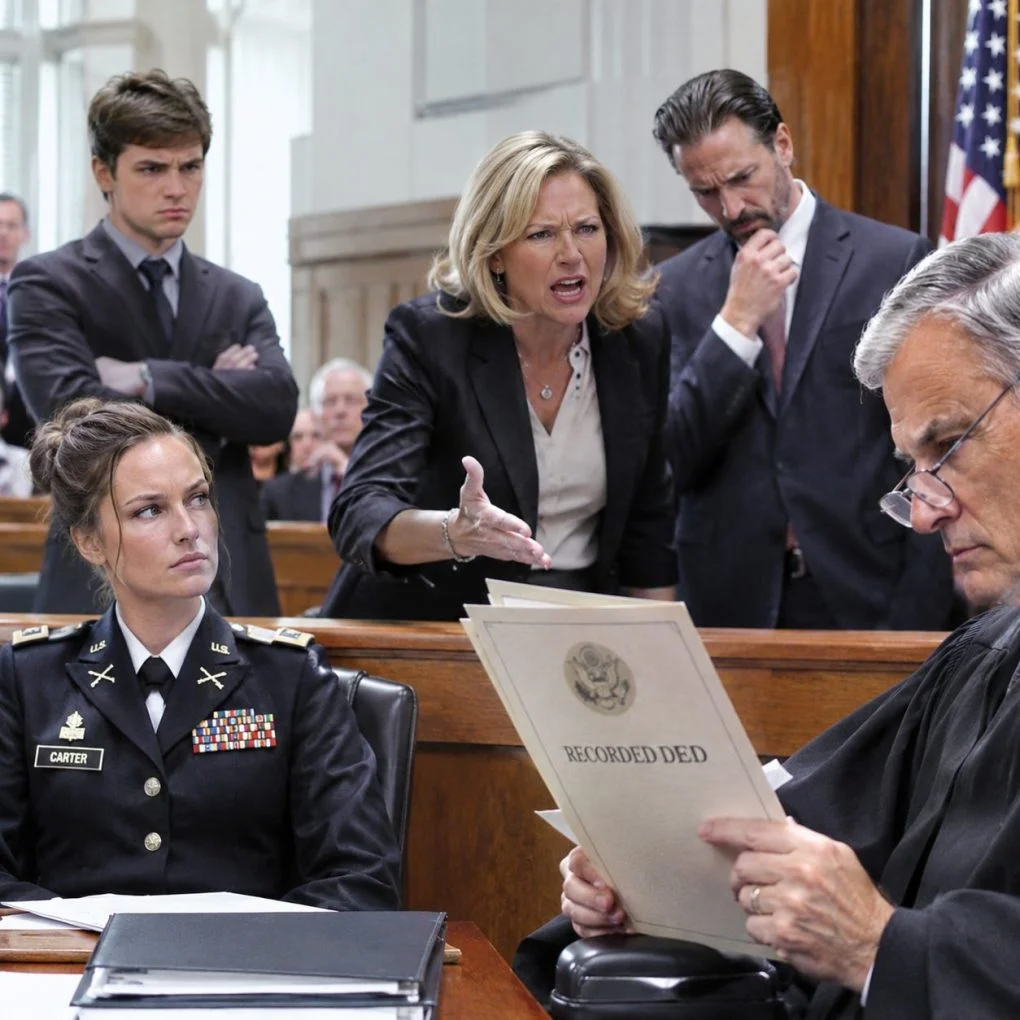
When court resumed, Mom’s attorney explained that his client disputed the transfer and wanted additional time to investigate Grandpa’s mental capacity. The judge scheduled a further evidentiary hearing, warning that allegations of incapacity would need actual evidence rather than family disagreements.
Outside the courthouse, Mom caught my arm.
“You think you’ve won because Grandpa signed some papers?”
I pulled away.
“Mom, you knew he gave me the house.”
Her face tightened.
“Tyler needs somewhere to live. You have a career, and you don’t even have children.”
I stared at her.
Twelve years earlier, she’d used almost those exact words to demand my college fund.
“He’s your brother, Rachel. You should want to help him.”
I looked past her toward the courthouse steps.
“I did help him. I paid his car insurance for two years while I was finishing college.”
She rolled her eyes.
“That was nothing compared to what he needs now.”
Then she said something that made me understand why she’d been so determined to remove me.
“Tyler already borrowed money against the house he’s supposed to inherit. If you don’t cooperate, you’ll ruin him.”
I looked at Daniel.
He immediately asked her what she meant.
Mom stopped speaking.
And that evening, when Tyler finally returned my call, I learned the truth.
My mother had promised him Grandpa’s house as collateral for a $240,000 business loan, even though she knew neither of them owned it.
Tyler admitted that he’d been negotiating with a private lender to expand his struggling home-renovation business. Mom had promised him Grandpa’s property would eventually become his, and he’d signed a financing proposal for $240,000, expecting to offer the house as collateral once the estate was settled.
But no mortgage had been recorded, and the lender hadn’t released the money because Tyler couldn’t produce proof of ownership. My mother had been counting on winning the lawsuit before the lender discovered she’d promised him property she had no right to give.
“Did you know Grandpa transferred the house to me?” I asked.
Tyler hesitated.
“Mom said you tricked him into signing something when he was sick.”
I closed my eyes.
Grandpa had signed the deed four years before his death, while he was still driving, attending veterans’ meetings, and managing his own finances. His attorney had arranged an independent assessment of his decision-making capacity, and two witnesses had observed the signing.
There was no secret military law protecting the property, just an ordinary, properly recorded deed that Grandpa had carefully preserved among his Army papers.
But Mom had turned it into a weapon.
At the next hearing, Daniel presented the original attorney’s records, the capacity assessment, and Mom’s signed acknowledgment. The documents established that Grandpa understood the transfer, had acted voluntarily, and had personally informed his daughter years earlier.
The judge studied the evidence.
Then he looked toward Mom’s attorney.
“Counsel, did your client disclose that she acknowledged this conveyance before filing her petition?”
The attorney slowly removed his glasses.
“No, Your Honor. She did not.”
My mother’s face went white.
The judge turned toward her.
“Mrs. Carter, you received notice that your father transferred this property four years ago. Why did your sworn petition claim you knew of no such transfer?”
Mom opened her mouth, but her attorney gently touched her arm.
For the first time in my life, she had no answer ready.
The court ultimately rejected her challenge to the deed and denied the request to treat Grandpa’s house as part of his probate estate. Without an ownership interest, Mom also had no basis to demand that I vacate the property for Tyler.
When the hearing ended, Tyler approached her in the hallway.
“You knew it wasn’t ours?”
She stared at the floor.
“Tyler, I was trying to help you.”
He stepped backward.
“You promised me that house.”



