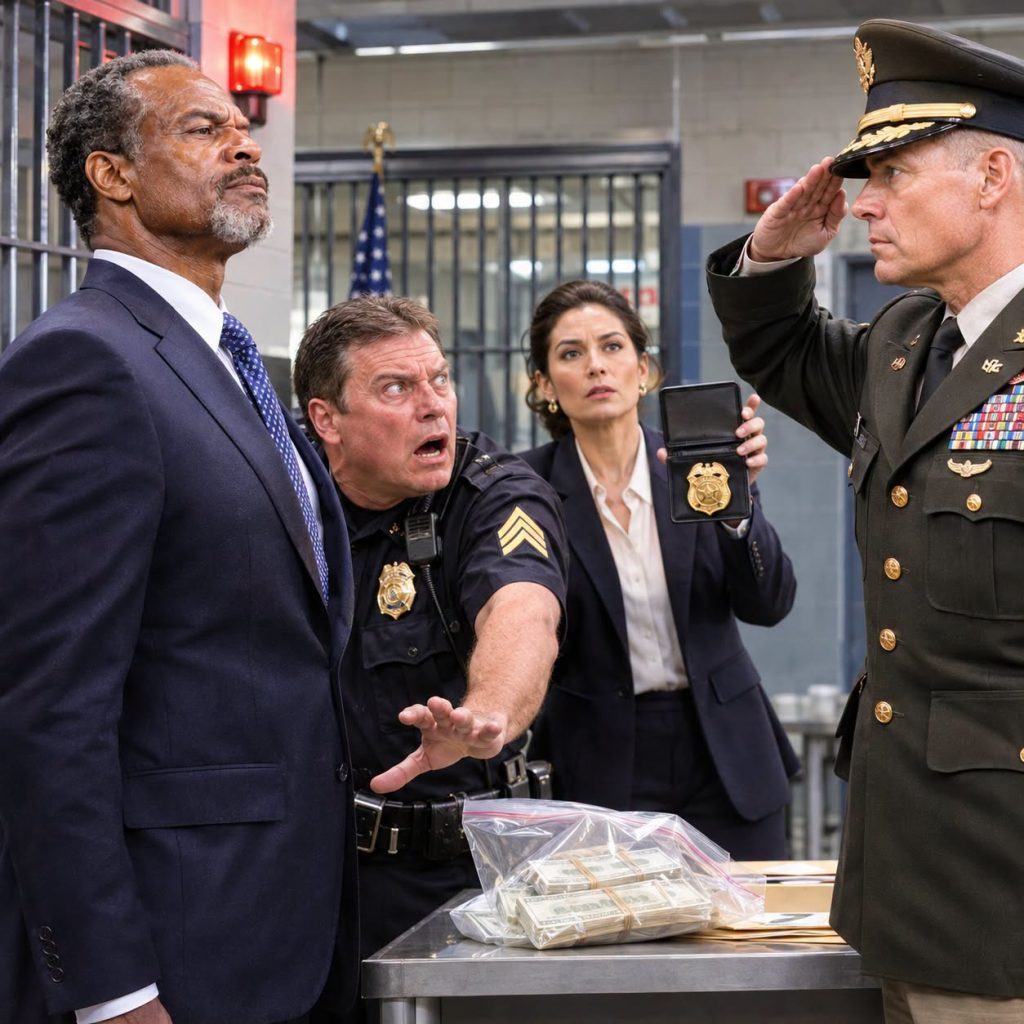
The first thing Sergeant Darren Lane said to me was, “Hands where I can see them,” even though both of mine were already on the steering wheel.
His flashlight hit my eyes through the open window. Another officer stood behind him with one hand near his holster. I had been stopped less than two miles from Camp Ridgeway, on a road where military families had reported losing cash during so-called “consent searches.”
“My name is Russell Knight,” I said. “I’m fifty-eight years old, and I’m asking why I was stopped.”
Lane leaned closer. “You don’t ask the questions.”
What Lane did not know was that I was not a tourist or a retiree passing through Ohio. I was the Deputy Director of National Intelligence, traveling under ordinary credentials as part of a quiet federal inquiry into complaints tied to the Harlow Creek Police Department. My instructions were simple: observe, document, leave.
Lane made leaving impossible.
“Step out.”
“Am I under arrest?”
“You will be if you keep talking.”
I stepped out slowly. His partner, Officer Mason, patted me down while Lane opened my rear door without asking. He searched beneath the seats and inside the console. Then he found the envelope.
It contained four thousand dollars in marked investigative funds.
Lane held it up. “That’s a lot of cash.”
“It’s legal cash.”
“Sure it is.”
I watched him slip the envelope into a clear evidence bag, but he never sealed it. His eyes met Mason’s. Mason looked away.
“Sergeant, I want a receipt for anything you seize.”
“You can ask for one at the station.”
That was when I knew the complaints were real.
Twenty minutes later, I stood in the Harlow Creek booking room with my belt, wallet, watch, and phone on a steel counter. The desk officer, Kelly Price, typed my name into the system while Lane stood behind me.
“No warrants,” she said.
“Run it again.”
She did. “No criminal history.”
“Put him in holding.”
I turned. “On what charge?”
Lane stepped close. “Suspicion of trafficking proceeds.”
“You have no probable cause.”
His face hardened.
He grabbed my arm and marched me toward a side corridor. “Full search.”
Kelly froze. “Sergeant, policy says—”
“I know policy.”
I kept my voice level. “I do not consent to an invasive search.”
Lane opened a gray metal door. “Nobody asked.”
Mason stood behind him, pale now. “Darren, maybe we should wait for the lieutenant.”
Lane turned on him. “You want to join him?”
Mason said nothing.
Inside the search room, Lane ordered me to remove my jacket, shoes, and shirt. I complied only as far as necessary while repeating that I objected and wanted a supervisor. There was no camera in the room. That felt deliberate.
Lane’s confidence grew.
“You people always think somebody important is coming to save you,” he said.
I looked straight at him. “You have no idea who is coming.”
He laughed.
Then the station alarm chirped twice.
Kelly called from the booking desk, “Sergeant Lane?”
He ignored her.
“Sergeant Lane! You need to see this.”
Lane stepped into the doorway. “What?”
“I ran Knight again. The system kicked it upstairs. Federal restricted return.”
Lane stopped moving.
Mason stared at me.
Then the station’s front door slammed open. Heavy boots crossed the lobby. A man’s voice barked, “Where is Russell Knight?”
Lane shoved my shirt toward me. “Get dressed.”
I did not hurry.
Seconds later Colonel Aaron Wallace, commander of Camp Ridgeway, appeared in the corridor with two military police officers. He looked past Lane, saw me beside the search-room door, and went still.
Then he snapped to attention.
Lane looked from him to me.
Colonel Wallace raised his hand in a formal salute.
“Deputy Director Knight,” he said, his voice carrying through the station. “Sir.”
For the first time that night, Darren Lane looked afraid.
Then Kelly whispered from the booking desk, “Sergeant… there’s something else in the system.
The salute changed everything—but the real danger wasn’t over. A missing cash envelope, a locked-down server, and one terrified employee were about to expose something much bigger than one abusive traffic stop. The rest of the story is below 👇
Part 2
“What else?” Lane demanded.
Kelly’s fingers hovered over the keyboard. “A federal preservation notice. It says nobody is to alter, remove, or destroy any record connected to this stop.”
Colonel Wallace lowered his salute and stepped between Lane and me. “Sergeant, return Mr. Knight’s property.”
Lane recovered fast. “Colonel, this is a civilian police matter.”
“No,” I said, buttoning my shirt. “It became a federal matter months ago.”
His face drained.
I had not planned to reveal myself that night. My role was supposed to remain hidden until we had enough evidence to map the entire operation. But Lane had handed us something better than testimony: an active seizure, an unlawful detention, and a station full of witnesses.



