The first pine hit the ground at 7:14 in the morning.
By 7:22, a logging truck was already carrying trees out of my ranch.
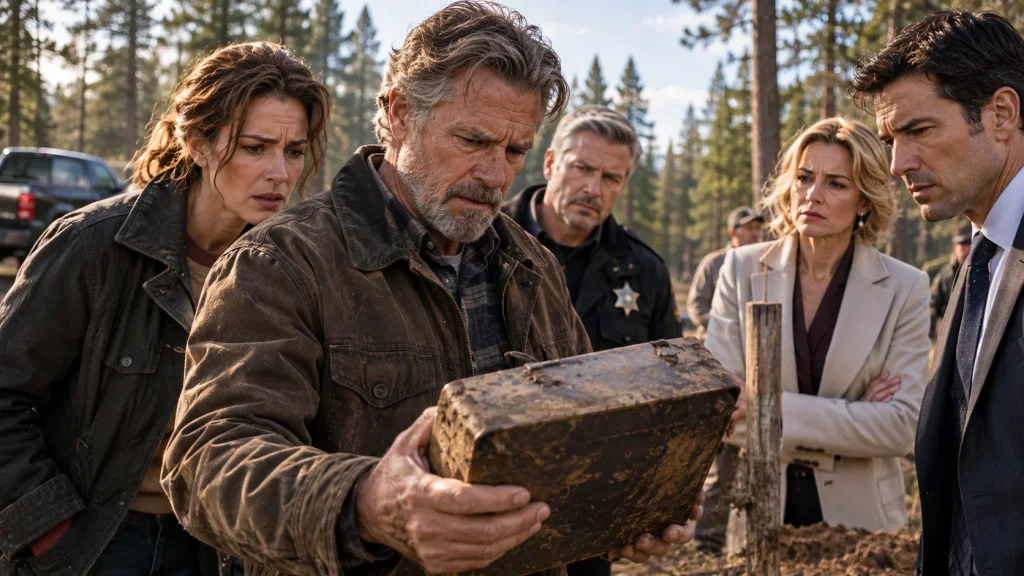
And by 7:31, a Blackstone Timber worker was kneeling beside an old brass marker buried under mud, staring at the words stamped into it.
SULLIVAN RANCH — EAST LINE.
He looked at the marker.
Then at the logging map in his hands.
Then at me.
“Mr. Sullivan,” he said, “who told us this land belonged to Pine Hollow?”
That was the moment every chainsaw stopped.
My name is Wade Sullivan. I’m sixty-two, and Sullivan Ranch covers a little over eleven hundred acres in western Montana. My grandfather started buying the place after World War II. Dad added pasture and forest whenever he could afford another piece.
I inherited cattle, hay fields, a creek, an aging tractor fleet, and more fence than any sane person should own.
But the northern ridge mattered most.
My mother, Martha, died after forty-eight years of marriage to my father. Dad barely spoke for months afterward. Then one spring morning, he came home pulling a trailer loaded with young pines.
Forty-eight of them.
“One for every year she made my life worth having,” he told me.
We planted them along the ridge.
Decades later, they towered above the barn.
Dad made me promise they would stay.
Then Pine Hollow Estates appeared beyond our eastern fence.
Ninety-six expensive homes rose where our old neighbor Harold Price once raised sheep. At first, I had no problem with it. Pine Hollow’s first HOA president, Dennis Cole,
was decent. He asked whether residents could use one old ranch trail to walk toward the creek.
I agreed.
Our attorney, Rebecca Grant, wrote the arrangement carefully. Pine Hollow could organize quiet daytime walks along one marked path. It received no ownership, no logging rights, no building rights, and no permanent easement.
For three years, everything worked.
Then Denise Holloway became HOA president.
Her first request was simple enough.
She wanted twelve pines removed because they blocked mountain views from several new houses.
“They’re healthy trees,” I told her.
“They affect property values.”
“They’re on my ranch.”
She smiled. “We all benefit when the area looks better.”
“My cattle don’t care what Zillow thinks.”
She did not laugh.
Three days later, I received a violation letter ordering me to remove the trees.
My ranch was not even part of Pine Hollow.
Rebecca responded.
The fine disappeared.
The problem did not.
Orange ribbons started appearing deeper in my forest.
Then wooden stakes.
Then blue paint on healthy trees.
A neighborhood newsletter announced a “forest management program” designed to reduce wildfire danger and generate money for clubhouse repairs.
The map attached to it made my stomach tighten.
The shaded harvest zone crossed the recorded Pine Hollow boundary and swallowed a huge section of Sullivan Ranch.
Including the lower edge of Martha’s Hill.
Rebecca contacted Blackstone Timber immediately. Their office acknowledged receiving our notice that Pine Hollow did not own my forest.
I thought that bought us time.
It did not.
At 5:46 the next morning, diesel engines woke me.
Travis Walker, my foreman of twenty-four years,
called before I reached the kitchen.
“Wade, they cut the chain off the logging gate.”
I drove into the eastern woods through morning fog.
Blackstone machines were already working.
A field supervisor named Russell Hayes met me beside the first pile of fresh branches.
“The HOA sold us timber rights across two hundred forty acres,” he said.
“They sold you something they don’t own.”
Russell looked genuinely confused.
Then a pine crashed somewhere uphill.
I turned toward Martha’s Hill.
“How far north did you send your crew?”
Russell checked his map.
His face changed.
The harvest line crossed directly through Dad’s memorial grove.
He grabbed his radio.
“Shut down the northern crew. Now.”
Static.
Then a worker called from farther east.
“Boss, we found a marker.”
Russell listened.
“What does it say?”
“Sullivan Ranch.”
Russell looked at me.
Another message came through.
“We found a second one.”
He ordered every machine stopped.
Then one of his workers came running down the road.
“They’ve already marked the whole grove red.”
I drove over the ridge with Russell beside me.
One memorial pine was lying on the ground.
Forty-seven were still standing.
For a few seconds, I could not speak.
Russell did.
“Nobody touches another tree.”
The crew froze the site exactly as it was.
Sheriff Nathan Brooks arrived. So did Rebecca and licensed surveyor Thomas Reeves.
Thomas found the old brass plates.
Then the metal posts Dad had shown me as a teenager.
Then stone boundary markers dating back decades.
Every historic marker agreed.
Pine Hollow’s map was wrong by hundreds of feet.
Then Russell opened the timber contract.



