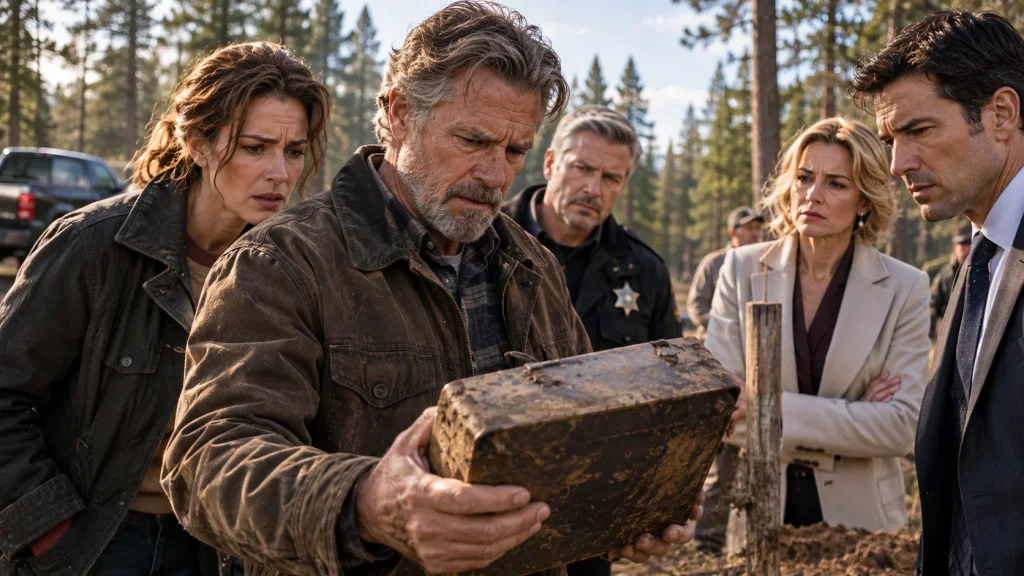
The words PHASE TWO HARVEST changed the scale of everything. Until that moment, I had been trying to understand how Denise could have sold timber rights across 240 acres she did not own. Now we knew she had already begun planning beyond that first area. The second map pushed west across almost four hundred more acres and ended less than two hundred yards from the cemetery where my parents and grandparents were buried.
Susan stood beside me while Sheriff Brooks held the map inside an evidence sleeve. “The cemetery is still there,” she whispered. “The trees are still standing.” I knew what she was doing. She was pulling me back toward what was real instead of letting anger turn a plan into damage that had not yet happened.
Blackstone reviewed its files the next morning. There was no signed Phase Two contract, but Denise had requested a timber-value estimate for the additional acreage. Her email described it as “future HOA-managed forest.” The company had postponed discussion until the first harvest was complete.
Rebecca looked at me across the kitchen table. “Do not invent the ending before investigators finish the middle.”
Susan smiled.
“See? Now Rebecca says it too.”
I had spent most of my life believing patience meant doing nothing. That dispute taught me the opposite. Sometimes patience meant preserving evidence, measuring lines twice, and refusing to make an accusation stronger than what the documents could support.
The HOA’s financial records helped explain why Denise had pushed so hard.
Pine Hollow had problems.
The clubhouse roof leaked.
The swimming pool filtration system needed replacement.
Insurance premiums had climbed.
Residents were angry about a proposed special assessment.
Denise had campaigned on lowering dues and improving amenities. Timber revenue offered an answer that sounded almost too good to be true.
Because it was.
The first harvest could produce far more than Blackstone’s $75,000 advance. Phase Two promised even more. Denise’s projections showed enough money to repair the clubhouse, update the pool, create a fitness room, and build a reserve without asking homeowners for a major assessment.
She was going to solve Pine Hollow’s financial problems with trees belonging to somebody else.
Paul Jennings, the HOA treasurer, brought those records to my house with Dennis Cole and several board members. One woman named Karen Wells began crying while reading them.
“I voted for the forest-management program.”
“You voted based on what you were told.”
“I should have asked more questions.”
“Then ask them next time.”
That was all I wanted from most Pine Hollow residents.
I did not need ninety-six families apologizing for Denise.
They had not driven harvesters onto my land.
They had trusted a president who promised lower bills and safer woods.
Trusting someone is not the same as helping them lie.
The full HOA meeting happened the following week.
Thomas Reeves stood before a packed clubhouse with the final recorded survey displayed behind him. The legal boundary followed every old brass plate, metal post, and stone marker we had found. Martha’s Hill belonged to Sullivan Ranch. So did the creek bend. So did the additional acreage Denise had marked for Phase Two.
The original developer sent its own records manager.
He confirmed what Dad’s buried box had already shown.
Years earlier, the developer tried to buy the 240-acre forest strip.
Dad said no.
The land was removed from later plans.
The old preliminary map remained in project archives because developers kept drafts, but it had never become a deed.
Dennis had known that when he first approached me for walking-trail permission.
That was why Pine Hollow needed permission in the first place.
Then Rebecca displayed the supposed 2017 transfer agreement.
Dad’s name sat at the bottom.
His signature sat beneath it.
The developer had no original.
The county had no record of the transfer.
And Dad had been dead for four years on the date he supposedly signed it.
Nobody needed a speech.
The date did the work.
Denise’s attorney read a statement saying she believed Pine Hollow possessed legitimate rights to the forest and had relied on historical developer records. He disputed any claim that she knowingly attempted to take Sullivan property.
Then Paul presented what the HOA board itself could verify.
Denise signed the timber contract.
She supplied Blackstone with the revised harvest map.
She certified that newly verified markers supported that boundary.
She had been captured on trail cameras entering the disputed area with people carrying stakes.
She proposed Phase Two without showing the full map to the board.
And she continued advancing the harvest after my attorney had raised ownership concerns.
The HOA removed her as president under its governing rules.
There was no cheering.
I was glad.
Pine Hollow still had to live with itself after the meeting ended.



