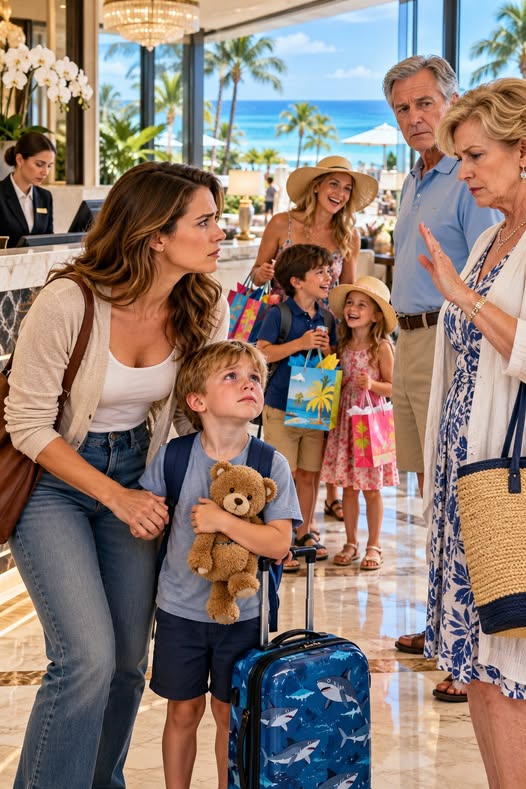
Chapter 1 – The Breaking Point in the Marble Lobby
The air in the grand foyer of the St. Regis Grand Palms smelled of white tea, polished Italian marble, and ozone drifted in from the ocean breeze. It was a scent manufactured for people who never had to check their checking accounts before buying groceries; a scent that spoke of ease, privilege, and deliberate distance from the grinding realities of the world.
Standing in the center of that vast, soaring rotunda, holding my six-year-old son’s trembling hand, the luxury felt like an executioner’s chamber.
“Then let’s make this official,” I said.
My voice didn’t echo, but it cut through the murmuring hum of wealthy vacationers checking in at the mahogany desks. It wasn’t loud. It didn’t need to be. It had the dry, dead snap of an oak branch snapping under too much ice.
My mother, Patricia, blinked. Her hand—manicured in a pale French pink that cost more than Noah’s school shoes—hovered midway to her designer handbag. For three decades, Patricia Bennett had ruled our family through subtle sighs, pointed silences, and an arsenal of manufactured disappointments. She was used to me flinching. She was used to me swallowing the bile in my throat, laughing off the insults, and finding a way to apologize for whatever crime she had decided I committed that week.
“What are you babbling about, Laura?” she snapped, lowering her chin so her designer sunglasses slid down her powdered nose. “Don’t make a scene. People are looking. Honestly, you always have to be so dreadfully dramatic when things don’t go precisely your way.”
Behind her, my younger sister, Ashley, shifted her weight. She wore an ivory linen sundress without a wrinkle, her diamond tennis bracelet catching the afternoon sun through the sixty-foot glass atrium. Her husband, Greg, was staring intensely at his smartphone, tapping away as if he were negotiating an international treaty rather than ignoring his nephew standing in the lobby with tears welling in his eyes.
“Mommy?” Noah whispered again. His small, warm fingers clutched mine so hard his knuckles were white. He was looking at his shoes—the blue canvas sneakers we had bought on clearance at Target three days ago, the ones he had carefully wiped clean with a wet paper towel before we left Charlotte so he would ‘look nice for Grandma.’ “Did I do something bad?”
That whisper did what thirty-three years of emotional neglect could never do. It burned away every scrap of daughterly obligation I possessed. It evaporated every instinct to keep the peace, every lingering childhood hope that if I just worked a little harder, stayed a little quieter, and smiled a little wider, my parents would finally look at me with pride.
I dropped to one knee on the cool, mirror-bright marble. I didn’t care that the hem of my worn denim skirt touched the floor. I ignored my mother’s audible hiss of disgust.
“Noah,” I said, taking his small, round face between both of my hands. I looked straight into those clear, innocent blue eyes that held the entire universe for me. “Look at me, baby.”
He blinked, and two heavy tears spilled over his lower lashes, carving clean tracks through the light dusting of road dust on his cheeks. “Are you mad at me?”
“No,” I choked out, then cleared my throat until my voice was steel. “No, Noah. Listen to me very carefully. You did nothing wrong. You are the kindest, smartest, most wonderful boy in the entire world. Do you hear me? You are good. Every single part of you is good.”
“Then why can’t I have a room?” he asked, his chin quivering uncontrollably. “Why do Oliver and Mia get to swim in the pool, and Grandma told me to sleep in the car? Is our car my room now?”
Around us, the ambient chatter of the lobby began to thin. Two elderly women in expensive resort wear paused near the bellman’s stand, glancing over with horrified expressions. A concierge in a bespoke navy blazer lifted his head from behind his computer terminal.
“Laura, get up off the floor this instant!” Patricia hissed, taking a sharp step forward. Her cheeks flushed an angry, mottled magenta beneath her foundation. “You are deliberately terrifying the child to make us look bad! I never said he was sleeping in the car permanently. I merely suggested—”
“You told me,” I said, standing up slowly, towering over her as I found the full measure of my spine, “to put my six-year-old child in the back seat of a four-door sedan in an unshaded asphalt parking lot in ninety-two-degree coastal Carolina heat. That is what you said, Mother.”



