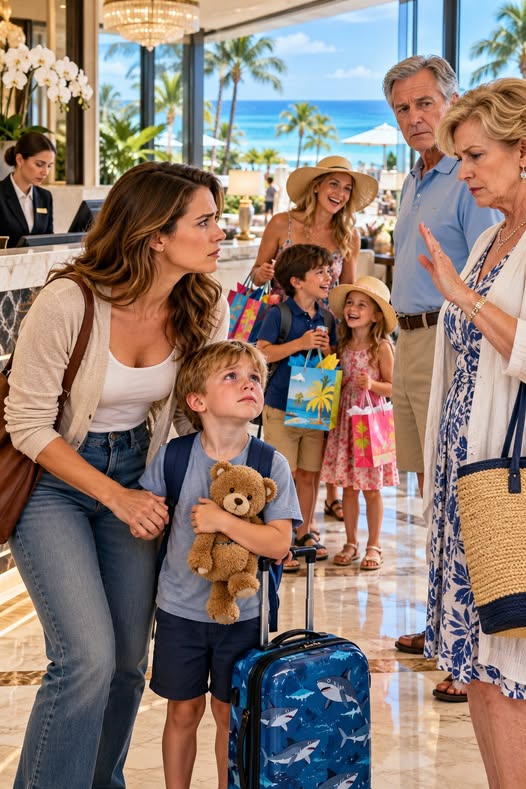
Noah was already sitting up in the middle of the enormous bed, staring out the window with his jaw slack. The morning sun was pouring through the turquoise curtains, painting gold stripes across the white duvet. Through the glass, past a small clearing of sea oats, the ocean stretched out to the horizon—a brilliant, sparkling expanse of aquamarine and sapphire under a cloudless sky.
“Mommy!” Noah shouted, scrambling over the mattress and landing on my stomach with both knees. “The ocean! It’s right there! Look!”
I groaned, laughing as I caught him in a bear hug and rolled him onto his back, tickling his ribs until he was screeching with laughter. For twenty-four hours, I had lived in terror that the poison from the St. Regis lobby would settle into his spirit, that he would carry the stain of his grandparents’ rejection like an invisible bruise. But seeing him now, his cheeks flushed with joy, his blue eyes shining, I knew we had survived the worst of it.
“First,” I said, booping his nose, “we wash our faces. Second, we eat Miss Clara’s blueberry pancakes. Third, we conquer the waves.”
“Can we build a giant castle?” he demanded, hopping off the bed and running into the bathroom. “With a moat? And shells for the windows?”
“We can build an entire city,” I promised.
Breakfast on the covered porch of the Driftwood Inn was something out of an old postcard. Clara brought out a platter of pancakes that were thick, golden, and bursting with fresh coastal berries, accompanied by crisp bacon and a pitcher of warm maple syrup. Noah ate three pancakes, chattering nonstop to Clara about his shark suitcase, his stuffed bear Barnaby, and his master plan to catch a minnow with his bare hands.
Clara sat with us, sipping black coffee, listening to him with the kind of patient, delighted attention that my mother had never once offered.
“You’ve got a good boy here, Laura,” Clara said quietly as Noah bounded over to the edge of the porch to watch a pelican glide over the marsh. “Takes a strong mother to raise a boy that polite on her own.”
“Sometimes I don’t feel very strong,” I confessed, wrapping my fingers around my mug. “Yesterday… yesterday almost broke me.”
Clara smiled, a knowing, ancient expression in her eyes. “A tree doesn’t break when the wind blows hard, honey. It just drops the dead branches it didn’t need anyway. Sounds to me like you dropped about three hundred pounds of dead weight yesterday afternoon.”
We spent the rest of the morning on the sand. The beach behind the Driftwood Inn was practically private, separated from the crowded public accesses by half a mile of protected dunes. Noah ran into the surf, screaming with utter delight as the warm Carolina water splashed against his shins. I held his hands, teaching him how to jump with the incoming swells, watching his face light up with pure, unadulterated triumph every time he conquered a knee-high wave.
We built a castle that took up six square feet of sand. We decorated the parapets with purple clam shells and dried sea whip. Noah stood back, hands on his hips, his little chest puffed out with pride.
“Grandpa was wrong,” he announced suddenly.
I froze, kneeling beside the moat with a plastic shovel in my hand. “What do you mean, sweetheart?”
Noah looked out at the ocean, his expression thoughtful, far older than his six years. “He said the waves were too scary for little boys and only big kids like Oliver could handle them. But they’re not scary at all. They just tickle.”
I swallowed the lump in my throat and pulled him into my side, kissing the salty crown of his head. “That’s right, baby. They just tickle.”
Around two in the afternoon, after a lunch of peanut butter sandwiches on the porch, Noah took a long nap in the air-conditioned room. While he slept, I decided to walk to the small general store adjacent to the inn to buy some sunscreen and bottled water.
As I walked down the crushed shell path, a sleek, dark-blue Mercedes sedan pulled into the driveway, parking near the office. A man stepped out. He was tall, perhaps in his late thirties, wearing a tailored linen shirt, dark chinos, and sunglasses. He had a strong jaw, dark hair dusted with silver at the temples, and an air of quiet, effortless authority.
He held a leather folder under his arm and was looking around the property with an expression that wasn’t hostile, but distinctly analytical.
“Can I help you?” I asked, stopping near the flower beds.
The man paused, removing his sunglasses. His eyes were a startling, intelligent hazel. He looked at me, then at the modest motel rooms, and offered a polite, respectful nod. “Pardon the intrusion. I was looking for the owner. Clara Jenkins?”



