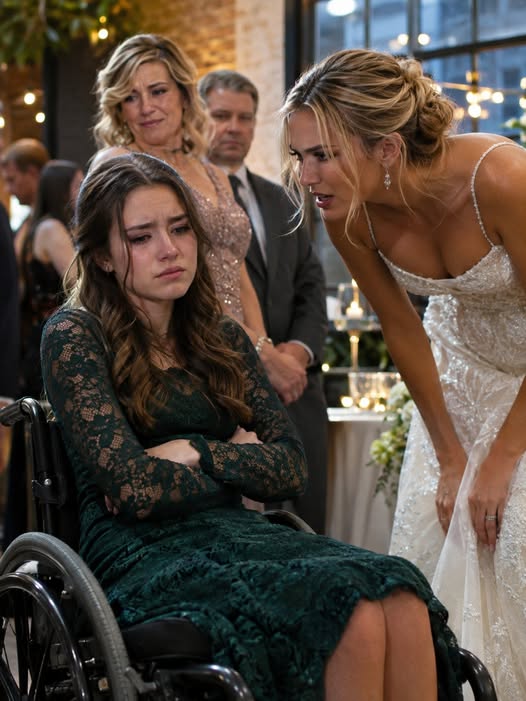
My sister Kalista had a place card waiting for me at her rehearsal dinner. It just didn’t have my name on it.
Instead, somebody had written two words in hurried cursive: Needs assistance.
I was 17 years old, sitting in my wheelchair at a beautifully decorated event space in downtown Seattle, looking at a table where every other guest had been given the courtesy of a name.
Kalista’s card was at the center, beside her fiancé Grant’s. My parents had their places. Brin, who had been helping with the wedding, was seated with the bridal party.
Mine was near the patio exit, away from the family.
I asked my mother, Sable, about it.
“Oh, honey, I’m sure it wasn’t intentional,” she said. “Don’t make this into something it’s not. It’s Kalista’s day. Just go with the flow, okay?”
Then she returned to the dining room.
I looked at that little folded card and wondered how somebody could accidentally forget that I was a person.
The worst part was that I had helped create the beautiful wedding everyone was admiring.
When Kalista first asked me to design her invitations, I was thrilled. Drawing had always been the one place where nobody could decide what I was capable of before giving me a chance.
I spent hours working on color palettes, lettering, floral details, and layouts. I wanted her wedding invitations to feel personal, something she would remember years later.
“You’ve got such an eye,” she’d told me. “It’ll feel more special if it comes from you.”
I believed her.
For once, I thought I wasn’t just the younger sister who needed accommodations. I was contributing something that mattered.
But sitting beside that nameless place card, I began to understand the difference between being useful and being included.
The rehearsal dinner continued around me.
Servers carried appetizers through the room. Guests admired the decorations. Kalista moved between tables in a shimmering dress, smiling and checking arrangements with the wedding planner.
When she saw me, she leaned down for a quick hug.
“Glad you made it.”
Before I could answer, she was already asking somebody about the cake delivery.
I maneuvered my chair behind a structural column, close to the bathroom door. From there, I could see only part of the main table.
A cousin named Jared glanced toward me and asked another guest, “Is she with the catering crew?”
He didn’t seem to realize I could hear him.
I wanted to tell him we were related. Instead, I took a sip of water and watched him turn back to his conversation.
I had spent years learning how to make uncomfortable moments easier for everybody else.
At school, people talked about the extra help I needed before asking what I wanted to do. At church gatherings, adults called me brave when I was doing ordinary things.
At family dinners, I was the quiet, sweet one.
Sometimes I wished somebody would simply introduce me as Leora.
Then Kalista stood to make her toast.
She thanked her bridesmaids, Brin, our parents, and Grant. Everybody laughed when she joked about planning the wedding before he proposed.
I waited for her to mention me.
Not because I needed a speech, but because I had spent so much time helping her.
She finished without saying my name.
A few minutes later, I wheeled toward the bar, hoping to escape my awkward position behind the column.
Kalista was talking to the planner.
“Just make sure that wheelchair girl doesn’t block the aisle tomorrow,” she said.
The planner nodded.
“Understood.”
Then they started discussing napkins.
I was standing—or rather, sitting—less than a yard away.
That wheelchair girl.
Not Leora. Not my sister. Not even somebody with a name.
I went into the bathroom and locked the door.
In the mirror, I saw the hair I’d carefully pinned back and the lip gloss I’d put on because I wanted to look nice for my sister’s celebration.
I had dressed like a member of the family.
Apparently, I was being managed like an obstacle.
Mom drove me home that night. Neither of us spoke.
Once inside, I noticed something missing from the hallway.
When I was 11, I had drawn Kalista and me holding hands beneath the red maple tree in Selene’s backyard. Selene had loved it enough to frame it.
The drawing had hung on our wall for years.
Now it was gone.
I searched the nearby console and found it facedown beneath old mail and greeting cards. The glass had a small crack, but the drawing was intact.
I carried it into my bedroom.
There we were, two sisters holding hands, both smiling.
I couldn’t remember the last time Kalista had looked at me that way.
My phone lit up.
Brin had posted a video of herself and Kalista clinking glasses.



