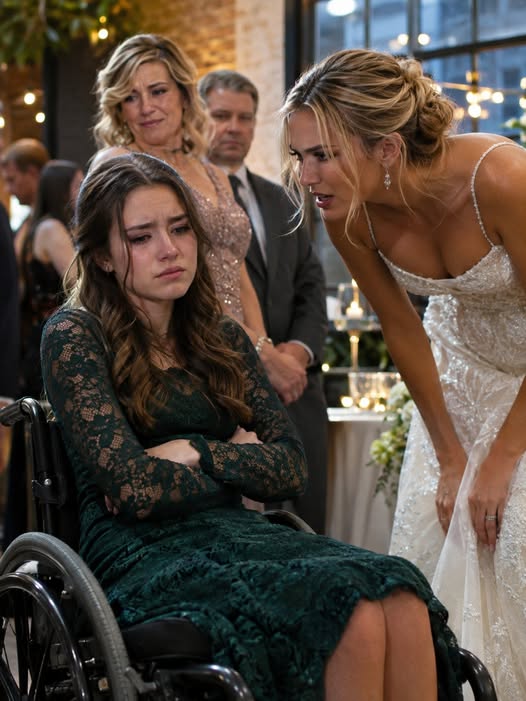
“Hi,” I said in the recording. “You don’t have to watch this, but if you do, just know I’m not here to ruin anything. I’m just here to be remembered.”
For nearly four minutes, I described the parts of the wedding that carried my work and the places where my name had been deliberately left out.
The people gathered around the gift table listened.
Nobody had to take my word for the invitation designs. The dated drafts were right there.
When the video ended, Kalista walked away.
Brin stepped back from the table.
Mom stood nearby without saying anything.
The celebration continued, but the atmosphere had changed.
People began talking about the video. Some watched it again. Others asked questions about the wedding arrangements.
Kalista tried to redirect the attention.
During a reception toast, she said the day was supposed to be about joy.
Then somebody asked where our father was.
Another guest mentioned that he’d been expected to give a speech.
Kalista didn’t answer the question.
She set down the microphone and moved on.
The first dance never happened.
I didn’t see every reaction, and I didn’t need to.
What mattered was that the people who had admired my designs were now learning where they came from.
Later, my phone vibrated.
It was Dad.
“I watched your video. That took strength.”
I read his message twice.
He hadn’t offered an excuse for Kalista or asked me to forgive anybody.
He had simply acknowledged what I’d done.
I turned away from the livestream and opened my sketchbook.
I drew an open window with sunlight falling across the floor. Then I added my wheelchair.
There was nobody else in the picture.
For once, that didn’t feel like an absence.
Two days after the wedding, Selene liked my video.
Mom asked whether I wanted to eat with her. Her voice was ordinary, without the exaggerated cheer she usually used when she wanted to avoid an uncomfortable subject.
I told her I wasn’t hungry.
She nodded and let me return to my room.
It wasn’t an apology, but it was the first time in days that she had accepted my answer without telling me to make things easier.
Brin sent a message, too.
“I didn’t know it was that bad. I’m sorry if I hurt you.”
I read it several times before deleting it.
I didn’t know whether she was sorry for her part in what happened or embarrassed that other people had seen it.
I wasn’t ready to work that out for her.
The family group chat became unusually quiet.
A cousin eventually asked whether dinner was still happening the following week.
Nobody answered.
I stopped checking for messages.
Instead, I drew the wedding as I wished it could have been.
There was a garden, soft lighting, and a dress that suited me.
I drew myself in the center, seated in my wheelchair, surrounded by enough space to move comfortably.
Nobody was cropped out.
I kept that drawing for myself.
A few days later, rain was falling when Selene arrived at our house carrying a paper bag.
Inside was the first dress I’d chosen, before Kalista suggested the structured gown.
“I should have trusted your eye,” Selene said. “Not Kalista’s word.”
We went into the kitchen and made tea.
After a while, she admitted something I hadn’t expected.
“I knew,” she said.
She hadn’t known every detail, but she’d seen enough to understand that I was being pushed aside.
She had told herself it was better not to interfere in family matters.
“I kept thinking silence was neutral,” she said. “I see now it’s not.”
I appreciated that she didn’t pretend she’d been unaware.
She had made a choice, and now she was acknowledging it.
We talked about her garden and ordinary things for a while.
When she was ready to leave, I used my crutches to walk slowly with her toward the front door.
My legs ached, but I wanted to accompany her.
She noticed the childhood drawing hanging in the hallway again.
I’d put it back where it belonged.
She studied it for a moment.
“I never needed a spotlight,” I told her. “Just a seat that was mine.”
Selene squeezed my hand before stepping out into the rain.
That evening, I drew three people together: Dad, Selene, and me.
We weren’t dressed for a wedding or posing for a photograph.
We were simply together.
Three weeks after the wedding, I sat at my desk with my college application open.
My art portfolio contained years of drawings and digital designs, including work that had taken on new meaning since Kalista’s wedding.
The final piece was a collage I called Uninvited, Unfolding.
I signed my name clearly at the bottom and submitted the application.
I didn’t know whether I would be accepted.



