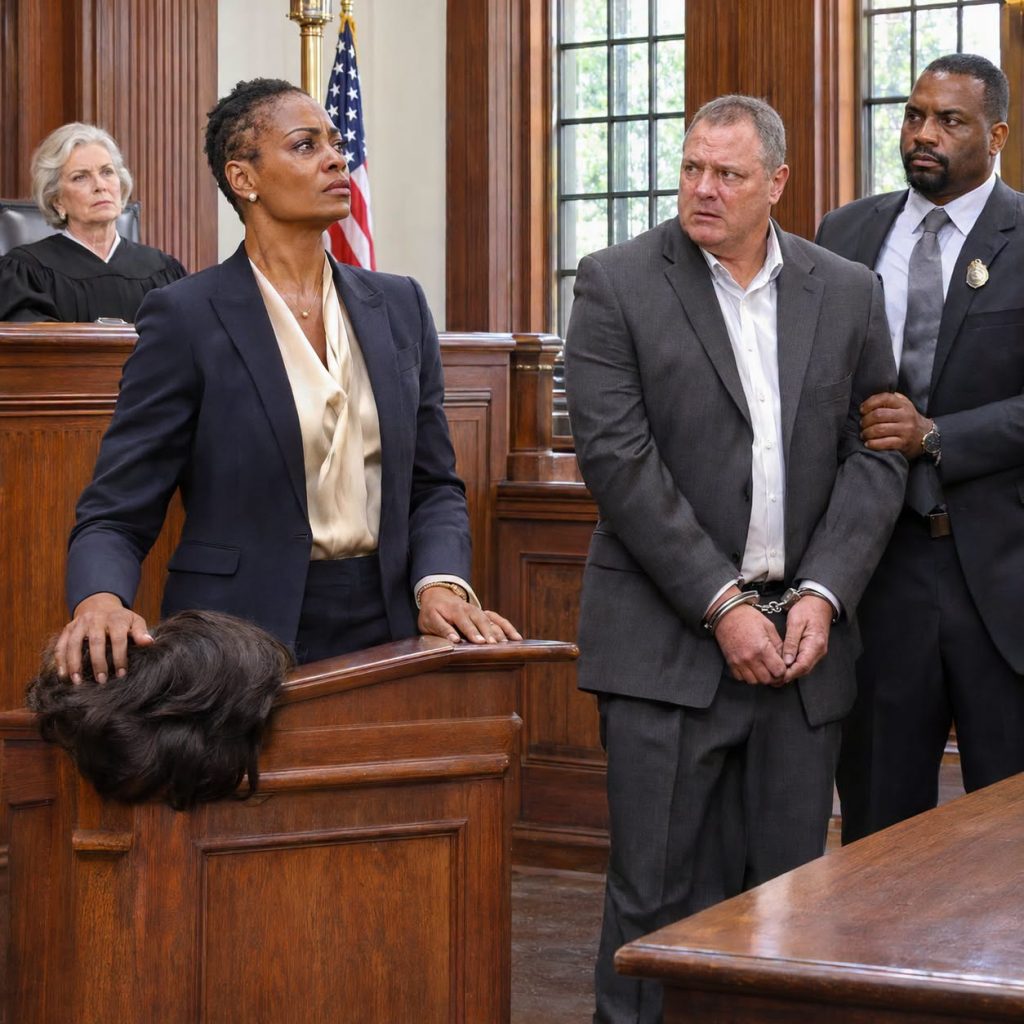
PART 2
“They knew before they stopped me.” My voice sounded unfamiliar. Cruz paused the recording. “Your clerk reported the message after finding your car in the impound database. We were looking for you.” I stared at my bandaged wrist. “Then why pretend they didn’t recognize me?” “Because they wanted you to wonder whether this happened because of your skin, your job, or something you haven’t found yet.”
I requested reassignment of every matter involving the Briar Glen department. My chief judge called personally. “You won’t lose your courtroom over this, Naomi.” “I know. But I won’t use it to decide my own case.” By noon, another judge had the Archer prosecution. By evening, my medical records, clothes, and recorder were in evidence, and two deputy marshals stood outside my sister’s apartment. I thought the danger had finally acquired boundaries.
Then my sister’s doorbell rang. The man outside wore a delivery jacket and held a pharmacy bag. My mother’s name was printed on it. I grabbed my sister before she reached the lock. “Get back.” One marshal stepped between us and the door. The other moved toward the kitchen exit.
The delivery man dropped the bag and ran. Through the window, I saw him shoulder past the second marshal, who hit the railing before catching his sleeve. They crashed onto the steps. A pistol skidded across the concrete. My sister pulled me down behind the couch. Later, Cruz set the recovered bag on the table. Inside was a burner phone. One message waited on its screen.
WITHDRAW YOUR STATEMENT. My sister began crying. I reached for her, but she pulled away. “They know where Mom gets her medicine?” I had no answer that could comfort her. Cruz did. “We’re moving all three of you.”
In a secure interview room that night, she finally explained Archer. Daniel Archer owned towing companies, private parking lots, and a security contractor. Prosecutors alleged that his businesses moved stolen vehicles and paid officers to manufacture stops, seize cars, and bury complaints. Haskett and Brenner claimed they were honest officers who had discovered the operation. Their testimony could steer investigators toward two low-ranking employees and away from Archer himself. “Why target me?” I asked. “Another judge would hear the same evidence.” Cruz slid a statement across the table. A former dispatcher named Renee Wallace had tried to contact my chambers. She believed someone inside the department was identifying witnesses for Archer.
“We think they assumed she had already reached you,” Cruz said. “She hadn’t.” “They didn’t know that.” The next morning, Brenner’s attorney contacted the government. His client wanted protection. I watched his recorded interview from another room, accompanied by my own attorney.
Brenner sat hunched over the table, his uniform replaced by a gray sweatshirt. “I thought Dean wanted to scare her off the case,” he said. Cruz leaned forward. “You held her down.” His mouth trembled. “Yes.” “You saw her credentials.” “Yes.”
“Then say what you did without hiding behind him.” Brenner pressed both palms flat on the table. “I helped assault Judge Mercer.” For several seconds, nobody spoke. Then he looked at the camera. “Dean keeps things. Hair. Pictures. He calls them reminders.”
My attorney reached for my hand. Brenner supplied the location of a storage unit and described a locked metal cabinet. He also identified the man at my sister’s apartment as an employee of Archer’s security company. Then Cruz asked who had told Haskett about Renee Wallace. Brenner shook his head. “Whoever it is,” he whispered, “has access to the witness protection requests.” A phone vibrated beside Cruz.
She read the message and stood. “What happened?” Brenner asked. Cruz was already reaching for the door. In the observation room, my attorney’s phone rang. Renee Wallace’s protection detail had arrived at her house. The front door was open.
She was gone.
PART 3
“Find her,” I said. Cruz was already on the phone. For eleven minutes, I watched people move through the corridor while imagining every terrible thing that could fit inside an empty house. Then a deputy marshal appeared. “She’s alive.” My knees weakened.
Renee had seen an unfamiliar sedan outside her home and climbed through her laundry room window. She was hiding in a neighbor’s basement. The officers at her front door had arrived moments after someone else forced it open. By midnight, she was under federal protection. Her records explained the missing piece. A civilian police records supervisor, Martin Vale, had been forwarding protected addresses to Archer. He had access to local portions of a joint task force database. Renee had copied access logs after recognizing a victim’s address in a message on his unattended screen. Haskett believed she had sent those records to me. Archer wanted me frightened off the case before I could expose his witnesses.



