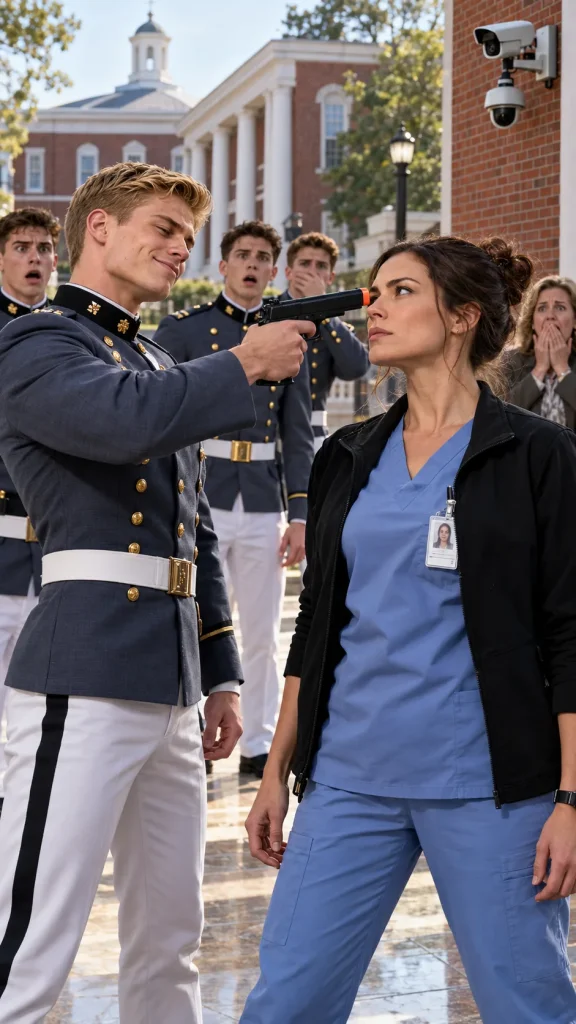
Drew whispered, “My father’s been dead for six years.”
Chapter 6 – A FATHER’S PRICE
Mercer drove away after I photographed his license plate and asked him, loudly, whether he planned to repeat that lie to police. Drew stayed. He cried with his hands over his eyes, ashamed of tears he had earned.
The next morning I met Detective Naomi Hart at the county station. She was direct, sharp-eyed, and unimpressed by the Cole name.
“A training pistol isn’t the same as a loaded firearm,” she said after watching Drew’s video, “but pointing it at someone’s head can still be a crime. We need your full statement. And I want to speak with every witness.”
“There’s more,” I told her. “The academy has a critically injured cadet and conflicting medical times.”
She studied me. “Those are separate allegations. Don’t blur them just because the same people are involved.”
Fair. I’d worked enough investigations to know that a good case needs facts, not rage.
That afternoon Charles Cole’s attorney invited me to a private meeting at the town’s nicest hotel. I brought my own attorney, Dana Brooks, who looked at the contract waiting on the table and laughed once.
“An apology drafted for my client,” Dana said. “And a confidentiality agreement.”
Charles Cole sat in a navy suit with silver hair and a pleasant smile. “Emma, nobody wants a woman’s career damaged over a young man’s foolishness.”
“Then tell Ryan to accept responsibility,” I said.
“He’s applying for a prestigious commission. One false allegation can ruin him.”
“He wasn’t falsely accused.”
Charles slid a second document across the table. It promised a substantial donation to my veterans hospital if I signed.
“My patients need that money,” I said.
“Then surely you’ll consider it.”
Dana pushed the paper back. “We’re done.”
At the door, Charles dropped his smile.
“Ms. Carter,” he said, “you should ask Dr. Price how long she expects to keep her medical license.”
Chapter 7 – THE MISSING TWENTY-FOUR MINUTES
Lena’s office was empty when I returned with Detective Hart and a signed witness-interview request. A maintenance worker said she’d been placed on administrative leave at noon.
We found her across the street, packing a cardboard box into her car.
“They blamed me for a record I wasn’t allowed to amend,” she said. “I wrote an addendum. It vanished.”
Hart asked for details. Lena took a breath and finally spoke like a doctor instead of a frightened employee.
“Iron Gate was a simulated rescue course. A contractor tested new ventilation and monitoring equipment inside an enclosed training building. The heat-warning alarm sounded, and the exercise kept running.”
“Who was in charge?” Hart asked.
“Captain Grant Heller, the training officer. Ryan Cole was the senior cadet assigned to control entry. Ben became disoriented and collapsed after repeatedly asking for water and a break.”
“Who told you that?”
“April Finch, our medical assistant. She heard the emergency radio call. She wrote it down because the wall clock had been reset after a power interruption.”
I remembered Ben’s note: THEY KEEP CHANGING THE CLOCKS.
“Do you have that addendum?” I asked.
“They took my work laptop. But I sent a copy to our outside accreditation reviewer before they locked me out.”
Hart asked for the email address and time. Her expression changed from polite interest to professional focus.
Then Lena showed us a photograph she had taken of Ben’s training wristband. Alongside his name sat a printed identification number and a red inspection mark.
“Every cadet wore these,” she said. “The inspection mark is supposed to mean someone checked the building’s safety system.”
“Who signed the checks?” Hart asked.
Lena gave a bitter laugh. “The same man who sold the system to the academy.”
The paperwork named Cole Tactical Systems. The signature belonged to Charles Cole.
Chapter 8 – THE LOCKER
Drew called me from a laundromat because he believed academy staff were reading his messages. I asked him not to touch Ben’s locker. Evidence taken the wrong way can become a gift to the person who wants a case buried.
“It’s empty anyway,” he said. “Ryan cleared it out.”
“Then tell Hart what you saw.”
“I will. But there’s something else. Before the drill, Ben copied the equipment warning onto a little notebook. He said the test wasn’t safe.”
“Where is it?”
Drew hesitated. “The vending-machine alcove. Behind the loose panel.”
We told Hart, and she arranged for an authorized search with academy cooperation. By evening the alcove was open. The panel concealed dust, a broken pen, and a small black notebook wrapped in plastic.
The first pages held ordinary student things: an English assignment, a grocery list, a reminder to call Mom. Near the back was a diagram of the training building, drawn in Ben’s neat block letters.



