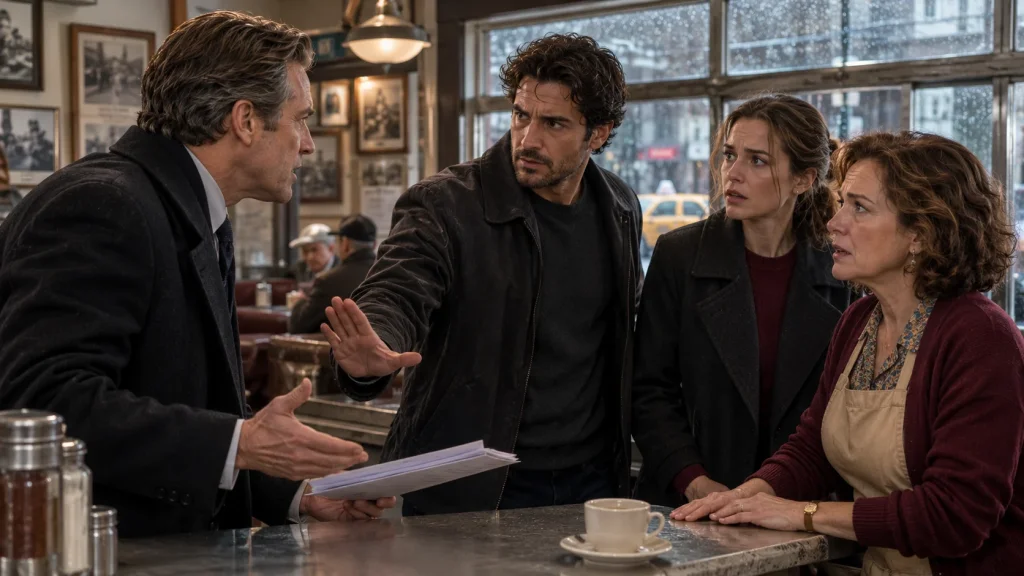
The next morning, I was helping Mom prepare breakfast when I looked through the front window and saw a familiar yellow taxi parked across the street.
Noah stood outside, examining our restaurant sign.
I walked out.
“You again?”
He turned.
“Good morning to you, too.”
“Do you usually spend your mornings outside struggling diners?”
“Only when they serve good coffee.”
“You’ve never had our coffee.”
“I thought I’d take the risk.”
I folded my arms.
“Fine. Come inside. But you’re paying this time.”
“I wouldn’t dream of doing otherwise.”
Inside, Mom was wiping down a table when I introduced him.
“Mom, this is Noah. He’s a taxi driver.”
She smiled warmly.
“Any friend of my daughter’s is welcome here.”
“Nice to meet you, ma’am.”
“Sit down. I’ll make you breakfast.
”
“Coffee is enough, thank you.”
“Nonsense. Nobody leaves my diner hungry.”
That was Mom.
She could be staring at an overdue bill and still worry that a stranger hadn’t eaten.
Noah sat near the front window while I poured his coffee.
Mom returned carrying breakfast.
He looked around the diner, taking in the photographs on the walls, the worn counter, and the booths we’d repaired more times than I could count.
“You must have some wonderful memories here,” he said.
Mom paused.
“My husband built this place with his own hands.”
Her voice softened.
“We’ve always tried to do things right. Paid our bills on time for twenty-three years. Then a new property company bought the building, doubled the rent, and sent us a notice to leave.”
“Who owns the company?” Noah asked.
“Victor Hail,” Mom replied. “He owns half the buildings on this street, or so he claims.”
Something changed in Noah’s expression.
It lasted only a second.
Then he asked, “And what are you planning to do?”
Mom looked toward the kitchen.
“I don’t know yet.”
I hated hearing her say that.
My mother had an answer for nearly everything.
She could repair a broken coffee machine with a screwdriver and patience. She remembered which customers needed extra sugar and which ones were quietly struggling.
But lately, whenever we discussed the restaurant, she sounded like someone trying to solve a problem without enough information.
“We’re trying to find a way to stay,” I said.
Noah nodded.
Mom set his breakfast in front of him.
“A place like ours doesn’t make people rich,
” she said. “But people come here because they know someone will remember their name. That ought to count for something.”
“It does,” Noah replied.
He said it so firmly that Mom looked surprised.
After breakfast, he thanked her and offered to help clear the table.
She waved him away.
“You’re a customer, young man.”
“Then I’ll have to come back often.”
“You’re welcome anytime.”
And he did come back.
Over the following days, Noah became a familiar face at Carter’s Corner.
Sometimes he arrived for breakfast.
Other times he stopped outside after a shift and talked with me for a few minutes.
He didn’t make grand promises about the restaurant.
He didn’t tell me that everything would work out.
Instead, he asked questions.
What did Mom want to do if we couldn’t stay?
Had we kept copies of the lease?
Had the property company explained why the rent had increased?
At first,
I assumed he was simply curious.
But I began noticing that he listened differently when the conversation turned to the building.
He seemed to remember every detail.
One afternoon, I found him standing outside with his phone pressed to his ear.
His voice was calm, but he sounded more serious than usual.
“I want an independent review,” he said. “Every agreement, every increase, every notice.”
He turned when he saw me and ended the call.
“Business trouble?” I asked.
“Something like that.”
I looked at him suspiciously.
“You sound like a man who’s about to buy the entire street.”
He smiled.
“I can barely afford the fuel for this taxi.”
“That’s a terrible lie.”
“Is it?”
“You’re not as good at hiding things as you think.”
He didn’t answer immediately.
Then he asked me something unexpected.
“Can I ask you a personal question?”
“Depends.”
“What matters most to you about keeping this restaurant open?”
I considered it.
“The obvious answer is that it’s how Mom earns a living.”
“And the less obvious answer?”
I looked through the window.
Mom was talking to an elderly customer who came in most mornings.
“After Dad died, there were days when she barely knew how to get out of bed. But she’d come downstairs, turn on the lights, and start making coffee.”
I swallowed.
“People needed her here. And she needed them.”
Noah watched me.
“So it isn’t just about a building.”
“No. It’s the last thing my father left us that still feels alive.”
He nodded slowly.



