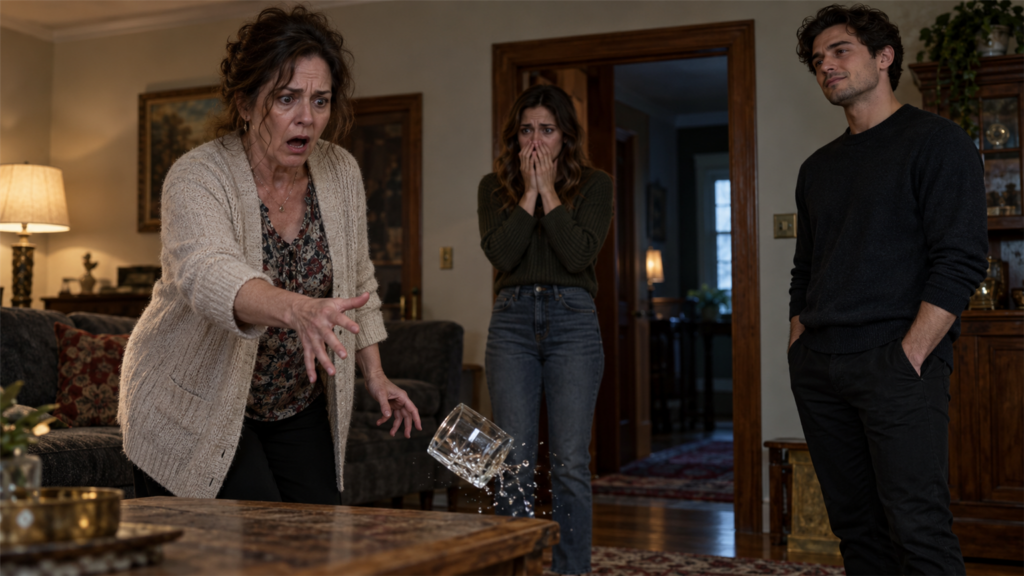
“Stop,” I said.
The foreman turned around. “Who are you?”
“The property owner. Those doors aren’t authorized for removal.”
Madison stepped toward me. “You have some nerve showing up here!”
I showed the foreman the closing confirmation and purchase agreement. He called his supervisor, who had received the attorney’s notice that morning. The crew stopped work and packed their tools.
Madison followed them toward the van.
“You promised you’d take them!”
“We’re not taking property that’s disputed,” the foreman replied.
Then she turned on me.
“Do you know what you’ve done? I already spent that deposit!”
Mom emerged from the hallway, clutching the doorframe.
“Claire, you’re destroying this family over a few old windows!”
I looked past her at the gouges around Grandma’s carefully restored woodwork.
“No. You knew those doors weren’t yours to sell.”
Madison laughed bitterly.
“Grandma never left you anything. You couldn’t stand it, so you bought your way back into her house.”
I reached into my coat pocket and took out the folded letter Grandma had given me during her last winter.
“Actually,” I said, “Grandma left me something you never bothered to ask about.”
Mom recognized the handwriting immediately. And for the first time, she looked frightened instead of furious.
Mom stared at the letter in my hand.
“Where did you get that?”
“Grandma gave it to me in February.”
Madison rolled her eyes. “What, another secret will?”
“No. Just a letter.”
I unfolded the page carefully. Grandma’s handwriting had grown shaky during her final year, but I could still recognize the way she made her capital C.
She had written that she knew the house would probably be sold after her death. She wanted Mom to have the financial security it could provide, but she worried about what would happen to the place where four generations of our family had gathered.
Then came the sentence I’d read so many times the paper had begun to soften along its folds.
Claire, I can’t ask you to carry this house forever. But if it ever becomes yours, promise me you’ll let it be a home again, not just something people fight over.
Grandma hadn’t secretly changed her will. She hadn’t left me millions or hidden ownership documents in a drawer.
She had simply known me.
Mom sat on the porch step. Madison looked away.
“Why didn’t you show us that before?” Mom asked.
“Because it wasn’t a weapon.”
I folded it again.
For years, I’d mistaken being useful for being loved. I repaired the things they broke, paid for what they couldn’t afford, and kept showing up because Grandma had taught me that family looked after one another.
But Grandma had never taught me to let people take advantage of me.
Rebecca handled the dispute over the damaged molding and the occupancy agreement. A restoration specialist documented the damage and provided an estimate. The closing escrow covered the agreed repair cost, with the remaining funds released to Mom after she surrendered possession. There was no dramatic police raid or instant lawsuit that made everyone penniless.
Madison had a harder problem. She had accepted $12,000 from an architectural salvage dealer for items she couldn’t deliver. After the dealer demanded repayment, she returned the money using her savings and part of a loan from Mom. Her planned kitchen renovation had to wait.
Mom still received the proceeds of selling the house, minus the sale expenses and the repair adjustment. The transaction was valid. Her financial security was intact.
What changed was her ability to demand more from me.
She asked whether she could keep a key.
I said no.
She asked if Madison could store furniture in the garage until spring.
Again, no.
Then she said something that stayed with me longer than all the shouting.
“Your grandmother would hate seeing us divided like this.”
I looked at the empty doorway behind her.
“Grandma spent her life keeping us together. You shouldn’t have needed me to keep paying for that after she was gone.”
Mom didn’t answer.
On December twenty-seventh, she moved out as agreed. I collected the keys with my real estate agent and walked through the quiet rooms, photographing the condition before arranging repairs.
The house needed work. The roof had reached the end of its useful life, the furnace was unreliable, and the purchase loan would take years to repay.
I wasn’t rich.
I was a woman with a mortgage, a restoration business, and a house worth saving.
Over the following months, I repaired the dining room trim and restored the stained-glass doors myself. When spring arrived, I opened the house for a small neighborhood gathering to thank the people who had helped Grandma in her final years.
Mrs. Carter brought lemon cake.
Someone put flowers beside the fireplace.



