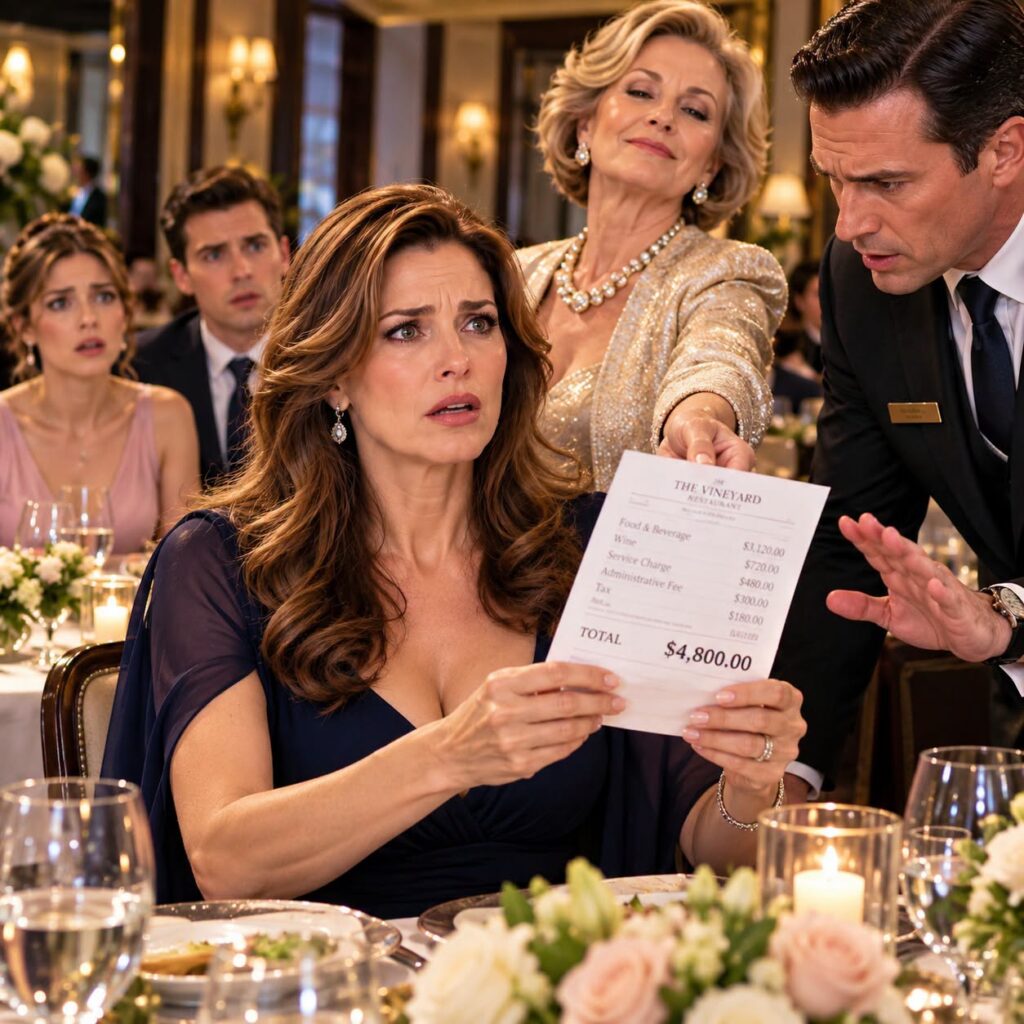
Tyler swallowed. “We needed operating money. Just for a few months.”
“Whose operating money?” I asked.
He didn’t answer.
Celeste leaned forward, furious. “Tyler’s construction business had a temporary shortfall. When the next project closes, everything gets repaid. The wedding expenses are perfectly legitimate.”
“You opened a card in my name to finance his business?” Hannah whispered.
Tyler finally met her eyes. “You gave me your information for the mortgage preapproval. Mom handled the application. I thought you’d understand afterward.”
My daughter flinched as though he’d struck her.
I told Daniel we would need copies of any records the restaurant could lawfully provide and asked him to preserve the rest. He nodded and stepped away to call the owner.
“Show Hannah every application,” I said to Tyler.
He pulled out his phone, hesitated, then opened an email from a commercial lender. Attached were a loan request and a personal-guarantee form. The signature line carried Hannah’s name, though she had never seen the document.
At the top was the requested amount: $62,000.
Underneath, in smaller type, were three words that made my stomach turn.
Funding scheduled Monday.
“Monday?” Hannah said. “You were going to put me $62,000 in debt on Monday?”
Tyler reached for her hand. She moved it away.
“It’s a guarantee,” he said. “Not actual debt unless something goes wrong.”
“Something already went wrong,” I said. “You forged her consent.”
Celeste stood so abruptly her chair toppled backward. “You will destroy my son’s future over paperwork?”
“No,” Hannah answered, her voice suddenly clear. “He did that himself.”
For the first time all evening, I saw my daughter look at Tyler without searching his face for permission.
I asked her to photograph the loan documents and send copies to her own email. Tyler didn’t protest. His phone lay on the table between us, the evidence of what he’d done brighter than any diamond in the room.
Then I turned to Daniel. “Please retain the payment record, the banquet agreement, and your surveillance footage. We’ll make formal requests.”
“The reservation is in Mrs. Whitmore’s name,” he said. “She signed the contract. We’ll cooperate with the card issuer if the payment is disputed.”
Celeste opened her mouth, then closed it.
We left before dessert. In the parking lot, Hannah pulled off her engagement ring. I didn’t tell her what to do with it. She placed it in its box and handed it to Tyler when he followed us outside.
“You knew exactly what you were doing,” she said. “I trusted you with my future. You used it as collateral.”
He stared at the ring. Neither of us waited for his answer.
That night, Hannah contacted the credit-card issuer through its official fraud number, reported an account she had never opened, and froze her credit with all three major bureaus. We filed an identity-theft report with the Federal Trade Commission and began documenting everything for the police.
On Sunday, I helped her send an urgent fraud notice to the commercial lender, including the forged guarantee and her sworn statement that she had never authorized it. My attorney followed up first thing Monday morning.
The lender suspended the proposed disbursement before the money went out.
Then the investigation uncovered what Celeste had tried to bury under talk of wedding expenses. The credit card had paid charges to Caldwell Event Services, a company Tyler helped create. Some proceeds had gone toward overdue bills at his construction business. The restaurant dinner was another unauthorized charge. Celeste had still tried to collect a second $4,800 from me.
The card issuer removed the fraudulent charges after its investigation. The restaurant pursued Celeste under her signed banquet agreement. The lender rejected the guarantee, and Hannah’s credit files were corrected.
Months later, Tyler and Celeste faced criminal charges. Both entered guilty pleas under agreements requiring restitution and supervised probation. The documentation—and Daniel’s preserved records—made it impossible to dismiss everything as a family misunderstanding.
Hannah moved into her own apartment. She kept her nursing job, her savings, and her name. I gave her the $8,000 check I had carried to dinner, without conditions or speeches.
She hugged me in the doorway and finally cried.
That night, I learned the difference between family and ownership: people who love you protect your future; people who want to own you put their price on it.



