She hadn’t.
Mom had created an independent nonprofit board and a restricted scholarship fund. Dad was its paid executive director, not its owner. The bylaws prohibited payments to relatives without independent board approval.
The invoices in my name did exactly what that rule forbade.
Worse, the tutoring payments were routed to a consulting company registered at Dad’s home address. I’d found its name in the nonprofit’s accounting export. A state business filing listed Dad as its organizer.
I had given every document to the county’s grant administrator and the Ohio Attorney General’s charitable-law investigators. They were already reviewing the allegations.
Dad must have learned about the referral.
The confession was his escape route. If I signed it, he’d get the story he needed. If I refused, he’d circulate the forged version and call me a criminal.
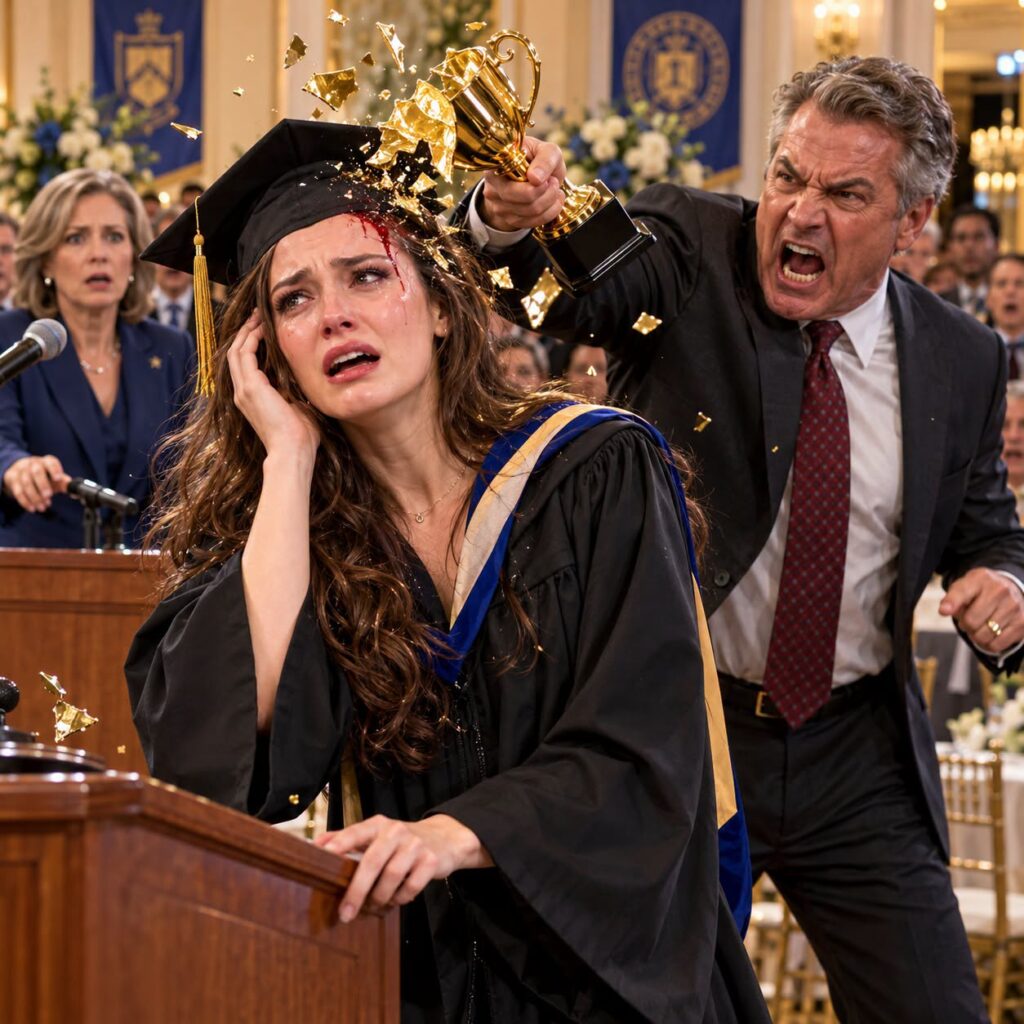
Paramedics lifted me onto a stretcher. Dad stepped toward me, lowering his voice so only I could hear.
“You don’t understand what you’ve started.”
“I understand you used my name.”
His eyes narrowed.
“Then understand this,” he whispered. “I sent that confession to the school board an hour ago. By Monday, you won’t be allowed near a classroom.”
And for the first time that night, I was more afraid of what he had done before the ceremony than of what he’d done onstage.
I grabbed Dr. Lawson’s wrist before the paramedics wheeled me out.
“Please tell the district what happened,” I said. “Before they read his email.”
“I already have,” she replied.
She turned her phone toward me. At 6:14 p.m., after Dad had tried to force the confession on her, she’d forwarded it to the district’s legal counsel with a warning that I disputed its authenticity. She had preserved his original email, including the attachment and timestamp.
My father had spent years counting on my silence. He hadn’t counted on a paper trail.
At the hospital, I needed six stitches for my scalp and treatment for a concussion. An officer photographed my injury, took my statement, and collected the broken trophy from the venue. Kayla gave police her video of the attack.
I didn’t sleep much that night. Not because of the stitches.
I kept thinking about Mom.
She used to say a child who couldn’t read a bus schedule or a medicine label deserved somebody willing to sit beside them until the words made sense. She’d started the reading project for children whose families couldn’t afford tutors.
Dad had turned her work into a way to steal money—and then tried to make me carry the blame.
On Monday, with my attorney beside me, I met district officials. We brought payroll records showing I was teaching at Roosevelt during the dates on the invoices, copies of the forged tutoring logs, the nonprofit’s bylaws, and the police incident number. I submitted a written denial of the confession and asked the district to preserve Dad’s message.
The district kept me in the classroom. It referred his allegations to counsel instead of treating them as fact.
Then I did something Dad never expected.
I contacted the two surviving independent board members and the retired chair. My attorney shared the records I’d lawfully collected. The board hired an outside forensic accountant, suspended Dad’s access to the nonprofit’s accounts, and removed him as executive director under its bylaws.
The review uncovered payments to his consulting company and nonexistent tutoring hours. Investigators obtained bank records through the proper legal process. The forged treasurer signature and my fabricated confession became part of their case.
Nine months later, Dad pleaded guilty to theft and forgery charges arising from the nonprofit scheme. The judge ordered restitution and eighteen months in prison. In a separate case, he pleaded guilty to assault for striking me at the reception.
I testified at his sentencing.
He wouldn’t look at me until I said, “You were right about one thing. I couldn’t have protected Mom’s work by staying the daughter you wanted.”
He looked smaller than I remembered.
The nonprofit reopened its tutoring program under independent oversight. I volunteered at its first Saturday reading session, sitting beside a little girl who sounded out every syllable of the word courage.
After the case closed, police returned the trophy. I kept its broken handle, but stopped hiding my graduation photograph.
The scar near my hairline remained.
So did my degree.
My father tried to turn the proudest night of my life into proof that I was nothing, but all he really broke was the power he had over me.



