I’d seen the receiving account information because Grandpa had authorized Daniel to obtain it. Every deposit led to an account controlled by Brooke.
“Those were advances,” she said, too quickly. “Dad told me Grandpa approved.”
“You registered the company,” I answered. “You signed the invoices.”
Brooke looked at our mother. Mom stared at her plate.
Then Grandpa laid two letters on the table. One supposedly from me, saying I never wanted to see him again. The other supposedly from him, telling me to stay away.
I had received that second letter four months earlier. I’d cried over it in my kitchen, convinced the man who raised me had stopped loving me.
“Neither of us wrote these,” Grandpa said.
Dad’s mouth opened, but nothing came out.
I finally understood the point of the lies. They hadn’t only stolen his money. They’d kept us apart so neither of us would question the missing funds.
Daniel slid out one final document: a purchase agreement for Grandpa’s paid-off house, a home worth more than $400,000. Dad had signed as his agent before the power of attorney was revoked.
The listed price was $165,000.
I studied the buyer’s name. Then I looked at my sister.
The buyer was a company Brooke owned.
And the closing was scheduled for nine the next morning.
Brooke snatched the purchase agreement from my hand.
“It’s an investment,” she said. “The house stays in the family.”
Grandpa’s knuckles whitened around his cane. “It’s my home. You didn’t ask me.”
Dad finally found his voice. “I’ve handled his finances for a year. I know what’s best.”
I stood. “You used his savings to fund Brooke’s company. Then you tried to have that company buy his house for less than half its value.”
“Prove it,” Brooke hissed.
“I intend to.”
Daniel photographed the agreement and stepped into the hall to contact the title company. I sent him the recorded business registration showing Brooke as the company’s organizer, along with our evidence of the forged invoices.
Mom caught my sleeve. “Nora, please. Families make mistakes.”
“A mistake is forgetting a birthday,” I said. “Who wrote those letters?”
She swallowed. “Your father said it would keep things peaceful.”
Grandpa closed his eyes. The silence hurt more than her confession.
Dad pointed at me. “You’ve always wanted to turn him against us.”
“No. I wanted him to know I never abandoned him.”
Grandpa reached for my hand. This time, I let myself cry.
The restaurant manager appeared beside our table. I had spoken with her before dinner because I suspected my family would spring another bill on me. Now she opened the reservation agreement.
“Ms. Brooke Whitfield signed the private-event guarantee,” she said. “Ms. Nora Whitfield is not responsible for this balance.”
Brooke’s jaw fell open.
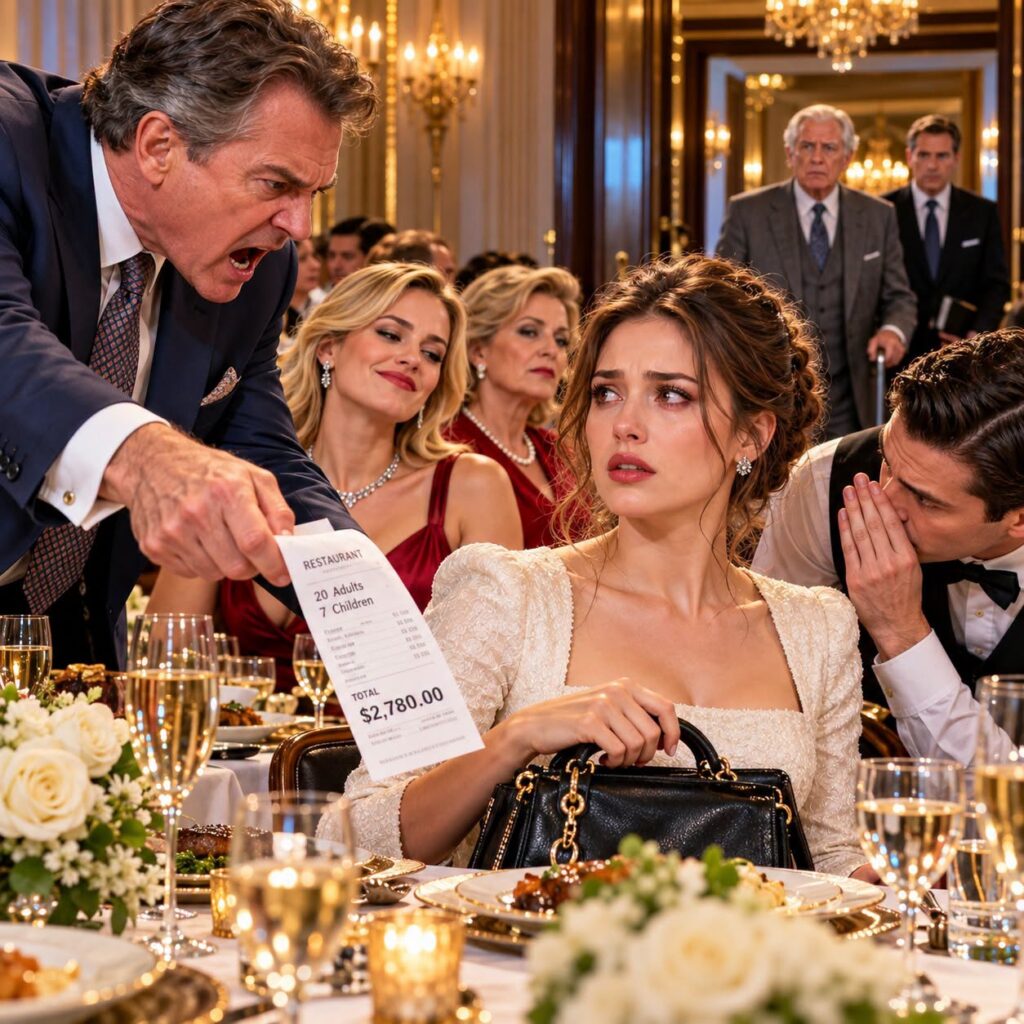
The cousins began asking for separate checks. Dad stared at the $2,780 total as though it were an insult. I left enough cash for my own meal and a generous tip, then walked Grandpa to the car.
At 8:17 the next morning, the title company confirmed it would not proceed with closing while Grandpa’s authority and the conflicted transaction were disputed. Daniel filed a civil action seeking to protect the property and recover the missing funds.
We also reported the transactions to the bank, Adult Protective Services, and law enforcement. I submitted an identity-theft report to challenge the fraudulent business and its tax notices.
The investigation took months. It wasn’t the instant punishment people imagine. There were interviews, subpoenas, handwriting comparisons, and ugly hearings.
Dad eventually pleaded guilty to theft involving Grandpa’s money and received a prison sentence. Brooke pleaded guilty to forgery-related charges. Restitution orders followed; some money was recovered through seized funds and asset sales, while the remainder became an enforceable debt.
Mom admitted preparing the false letters during sworn testimony. Grandpa refused further contact with her.
He kept his house.
By spring, he was living there again, with a caregiver he had personally hired. Every Sunday, I brought groceries, and we made dinner together in the kitchen where he once taught me to bake biscuits.
One evening, he set two plates on the table and said, “You never had to earn a place here, Nora.”
I finally believed him.
The night my family demanded I pay for my seat, I learned that love was the one thing I should never have had to buy.



