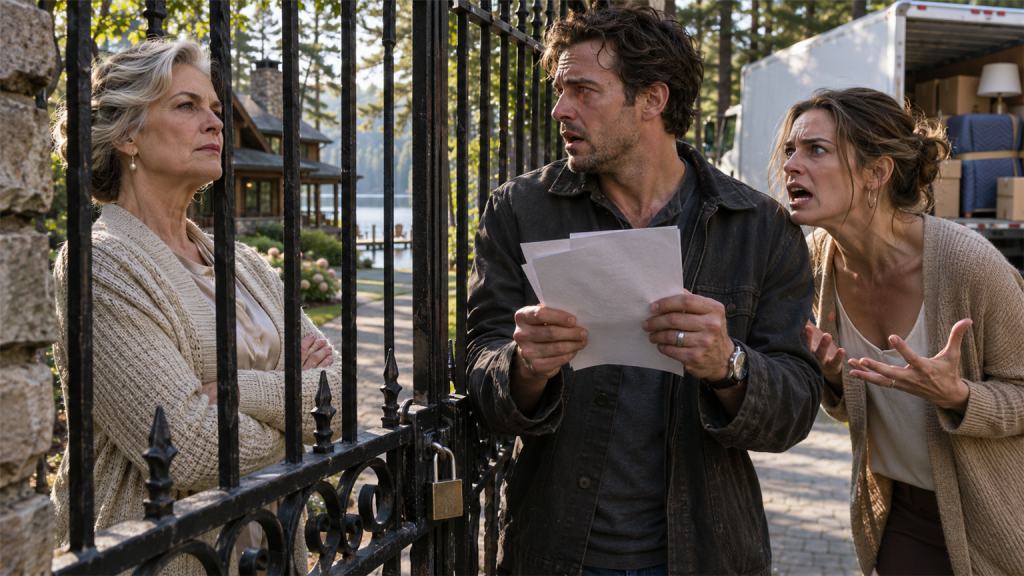
Aunt Jean called to ask whether I was ill. I stood at the sink looking at Frank’s mug and heard myself say, “I’m retired, Jean. That’s not the same as helpless.”
Tuesday brought a worse surprise: a message from Kelly’s mother accusing me of taking Brooke’s savings and threatening to report me for elder financial abuse. I sent her Linda’s number, but the words stayed with me through a whole sleepless night.
On Thursday Brooke came alone. She sat on the dock, twisting a receipt between her fingers, and admitted she’d been told the six thousand dollars was going into my account; her bank record showed it had gone straight to Kelly’s personal account instead.
“She said you’d complain for a week, then let me stay because you hate conflict,” Brooke whispered. “I thought she knew you better than I did.”
I told her to save everything, even the messages that made her embarrassed. Then she showed me one Kelly had sent the night before the move, and the sentence at the bottom made both of us go quiet.
Once my sister is in, Evelyn won’t dare call the police. Matthew will back me up like he always does.
But Matthew hadn’t backed her up. And when Linda summoned us to her office the following Monday, she said Brooke had one more piece of evidence that could change the entire case.
It was a voice message Kelly had sent Brooke after I refused the lease. She sounded amused: “I copied Evelyn’s signature from the payoff packet. Everybody signs things online now. She won’t notice, and Matthew won’t argue.”
Brooke kept it because the laughter unsettled her. Linda listened once, saved a copy with Brooke’s permission, and explained that it supported the evidence without deciding the case.
Kelly arrived at the meeting fifteen minutes late with a coffee in one hand and her mother’s arm in the other. She glanced at Brooke, then at me, and said, “I assume we’re finally agreeing to be reasonable.”
“No,” Matthew said from the seat beside mine. “We’re finally telling the truth.”
Linda laid the deed, my refusal texts, the alleged lease, and the transfer receipt on the table. She played the voice message, and I watched Kelly’s mother slowly let go of her daughter’s arm. Kelly reached for the phone, but Brooke held it firmly against the table.
“That money was for Evelyn?” her mother asked.
Brooke nodded. “It was my savings. I trusted Kelly to give it to her.”
Kelly pushed back her chair. “It was supposed to be temporary. Evelyn barely uses that house!”
“Then why did you need my signature?” I asked.
For once she had no reply. Matthew moved the lease toward her, careful not to touch my hands, and said, “You told me Mom agreed. You made me treat her like a problem instead of asking her what she wanted.”
Kelly’s mother turned to Brooke. “Come stay with me until you find somewhere.” Brooke covered her face with her sleeve, her shoulders shaking.
Linda told Kelly that unless the money was repaid, Brooke could pursue recovery and report the false lease and payment to police. Brooke chose to report it, and I provided investigators my signature samples and correspondence; proving a lie didn’t mean an immediate arrest.
Kelly repaid Brooke in installments under a written settlement and covered the movers’ cancellation charge. The police investigation continued separately, and months later she pleaded guilty to forgery and received probation; the court considered her repayment.
Matthew and Kelly separated that winter. He moved into a small apartment and began counseling, and when he asked to visit the lake, I told him he could come for coffee but not bring a key or expect the old gate code.
“I should have defended you at Sunday lunch,” he said on his first visit.
“You should have believed I knew what I wanted,” I answered. We sat together while a fishing boat crossed the water, and for the first time he didn’t ask me to make his life easier by forgiving someone else.
In April, I repaired the loose step Frank had been meaning to replace. I used the money I’d once set aside for emergencies, not a dollar from Matthew, and afterward I put his blue mug on the porch rail beside mine.
One afternoon Brooke mailed a postcard from her new apartment. She thanked me for not blaming her for believing a lie, and tucked in a photograph of the little balcony she’d filled with herbs; I pinned it to the refrigerator, where I could see the green leaves every morning.
The gate still needed a code, and I still kept it locked at night. But the house was quiet again, and when I sat beside the lake with my coffee, the silence didn’t feel like someone had forgotten me.



