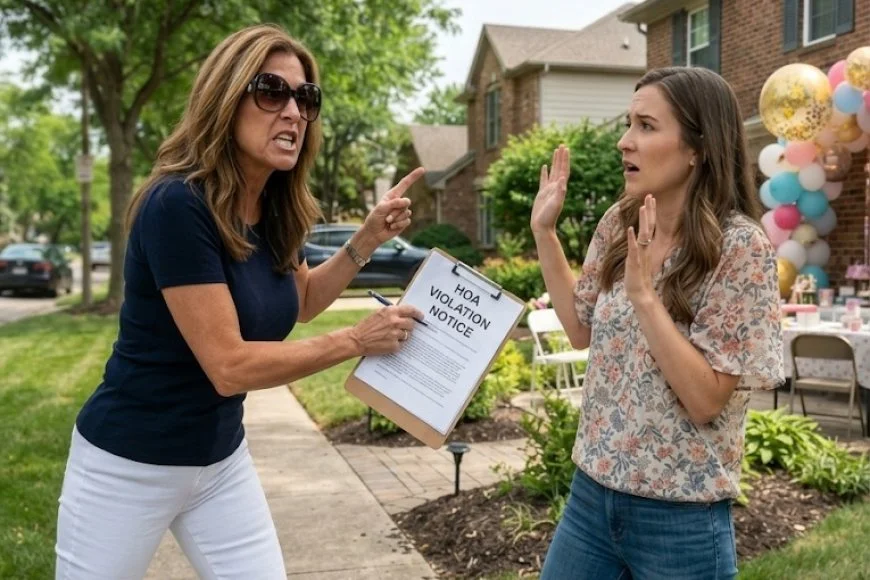
For most of my life, Dad had been the person who fixed things. That afternoon, he did something harder.
He stepped aside.
The HOA board called its attorney and arranged an emergency meeting for that evening. The bank froze the association card pending confirmation from authorized officers. Nobody declared Denise guilty on my lawn. Nobody needed to. The paperwork had become more interesting than the argument.
The party vendors packed up.
The taco-truck driver refunded what he could and told me he had been assured the homeowner had approved everything. The bounce-house crew had never even unloaded the inflatable. The DJ left after giving Alvarez a copy of the order showing the HOA billing information Denise had supplied.
By three o’clock, my yard was quiet again.
Except for Tyler.
He sat on the bottom porch step staring at his phone.
“Where are your friends?”
“I told them the party was canceled.”
“You okay?”
He shrugged.
“That’s not an answer.”
He looked toward his house.
“She’s going to hate me.”
“Because you told the truth?”
“Because I told it in front of everybody.”
I understood more than I wanted to.
For almost a year after Mom died, I had avoided telling people when I was angry, lonely, overwhelmed, or simply tired of being told how lucky I was to inherit a house.
The house did not feel lucky.
It felt full of ghosts.
Boxes I could not open.
Clothes I could not donate.
A garden I was terrified I would kill because Mom had always known exactly when everything needed water.
But Tyler was sixteen.
He should not have been responsible for protecting his mother from consequences created by adults.
“You did the right thing,” I said.
He gave me a skeptical look.
“Adults always say that when doing the right thing is about to ruin your life.”
“That is annoyingly accurate.”
For the first time all day, he smiled.
The HOA meeting began at seven.
I almost did not go.
Then Mr. Peterson asked me to attend because Denise’s attempted use of my property was part of the record.
The clubhouse had never been that crowded.
People stood along the walls. Several residents brought printed bank statements. Others had copies of violation letters Denise had issued during her presidency.
Denise sat at the front beside an attorney.
She looked composed again.
Hair perfect.
Blouse pressed.
No sunglasses.
If you had not seen her screaming on my lawn six hours earlier, you might have believed she had walked into the meeting to discuss landscaping.
The vice president, Elaine Harper, opened the meeting.
“We are not conducting a criminal trial tonight,” she said. “We are determining what actions this association needs to take immediately.”
That was the smartest sentence anyone spoke.
Mr. Peterson presented the financial records.
Over eleven months, approximately $11,600 in HOA funds had been charged or transferred through transactions the board could not immediately reconcile with approved association expenses.
Not all of it was necessarily missing.
Some charges might have supported legitimate events.
Some could have proper documentation sitting in an email account nobody had reviewed yet.
But several payments had gone to Whitmore Community Solutions.
Denise owned it.
The board had not knowingly approved that conflict.
Then came Tyler’s birthday expenses.
$850 for the DJ.
$1,200 for catering deposits.
$475 for the inflatable rental.
Decorations.
Tables.
A photographer.
All entered as community-programming costs.
Elaine turned toward Denise.
“Was tomorrow’s event an HOA event?”
Denise’s lawyer leaned toward her.
Denise finally answered.
“It was intended to strengthen neighborhood relationships.”
Someone laughed.
Elaine raised her hand.
“Was it your son’s birthday party?”
“Yes.”
“Were residents invited as part of an official association program?”
“It was still community-oriented.”
“Did Claire Brennan consent to host it?”
Denise looked at me.
“I believed she would.”
My doorbell footage played on the clubhouse television.
My answer is no.
The room went quiet.
Then:
You’ll regret this, sweetheart.
Denise stopped looking at me.
A homeowner near the aisle stood.
“My dues paid for her kid’s taco truck?”
Elaine asked everyone to stay calm.
Another resident raised a hand.
“Then what exactly is Whitmore Community Solutions?”
Denise said the company performed legitimate administrative and event-planning work for the neighborhood.
Mr. Peterson asked why the contract had never appeared in the board minutes.
She replied that executive authority allowed her to approve small operational expenses.
“That might explain one payment,” he said. “It doesn’t explain why the vendor was your own company and the board wasn’t told.”
That was the moment Denise’s confidence finally cracked.
Not dramatically.
She simply stopped answering quickly.
The board voted to suspend her authority immediately while an independent accountant reviewed the books.
Then Elaine proposed removing her as president under the association’s governing procedures.
The vote passed overwhelmingly.
Denise remained a homeowner.



