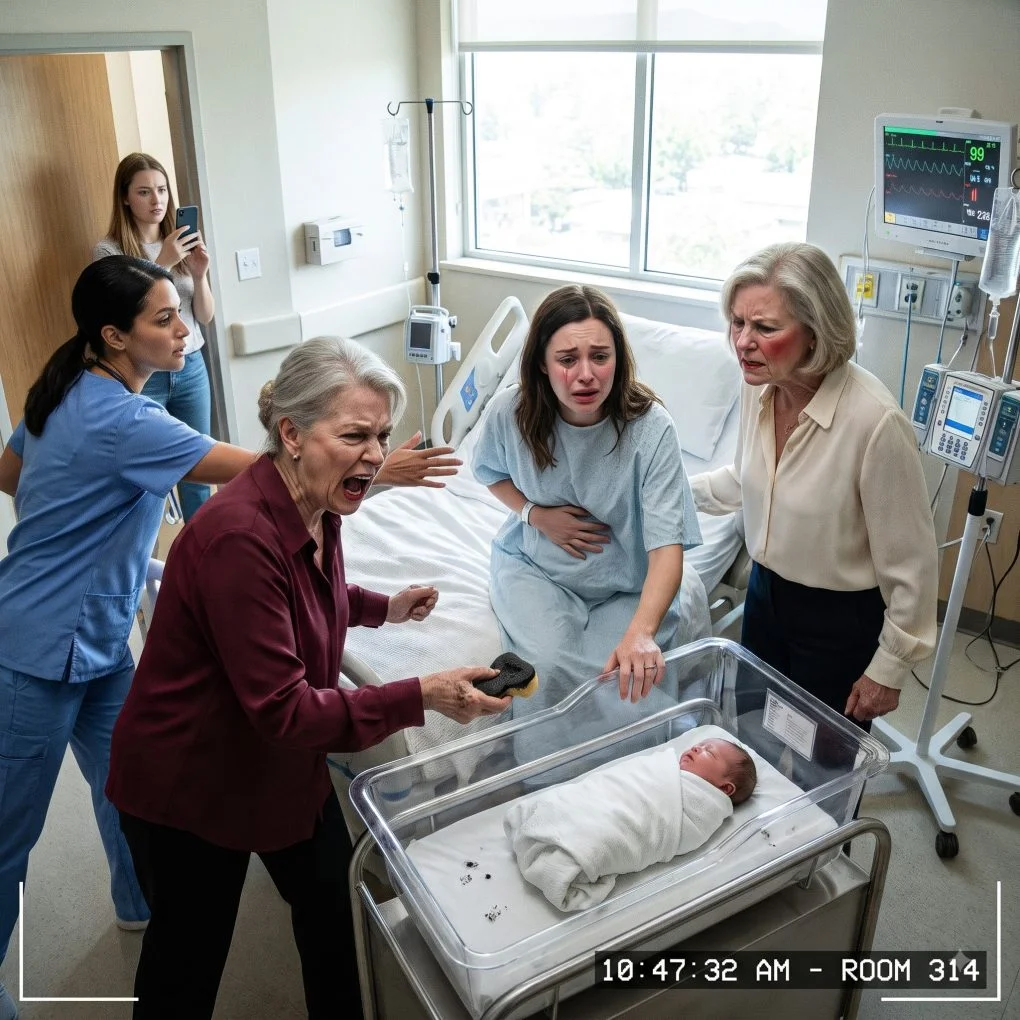
Then Daniel’s cousin Mia called. She was twenty-two and had come to film the family meeting Oliver for the first time, so she had her phone up when Patricia began shouting. She’d been too frightened to speak, but her recording showed Patricia tucking a dark makeup sponge into her purse and my mother slapping me while I lay against the pillows.
“I’m sorry I didn’t stop her,” Mia said.
“You’re helping now,” I told her. My voice sounded unfamiliar even to me.
Daniel watched the clip beside my bed, then opened the messages his mother had sent him during the final weeks of my pregnancy. I’d never seen them. He had told me he’d stopped answering her accusations.
One message read, “If the baby doesn’t look like you, I’ll make sure the whole family sees before she can invent an explanation.”
Daniel had replied, “Stop talking like that, Mom.”
He’d never warned me, and he’d never taken Patricia off the approved visitor list we’d made before delivery.
“Why didn’t you tell the nurses?” I asked.
He stared at the floor. “I thought she’d calm down once she saw him.”
I watched Oliver move his lips in his sleep.
My husband had known his mother was planning to humiliate me at the hospital. He just hadn’t believed she would use our baby to do it.
The pediatrician cleared Oliver after several hours of observation. The makeup had irritated his skin, but the redness faded, and there was no sign of a more serious reaction. When Rebecca finally placed him against my chest, I held him carefully around the IV tubing and cried into the edge of his clean blanket.
He smelled like soap instead of that awful chemical sweetness. His fingers opened around mine, and for the first time since surgery I could hear him breathing without someone accusing him of being the wrong child.
We filed police reports before leaving the hospital. Rebecca’s notes, the photographs taken for the medical record, the visitor log, and Mia’s original video established what happened; the hallway cameras confirmed when Patricia and my mother arrived, not what took place inside my private room. Our attorney preserved everything and asked relatives not to circulate the photograph of Oliver.
Daniel sent a message to the same family group Patricia had used to shame me. He wrote that his mother had deliberately applied makeup to a newborn, that the hospital had removed both grandmothers, and that nobody had permission to share pictures or speculate about our son’s parentage. Mia agreed to provide her recording directly to the investigators, and Daniel told the family it existed.
Patricia replied, “You’re choosing your wife over your mother.”
He read it aloud, then set his phone down.
“I’m choosing my son,” he said. “I should have done it sooner.”
I loved him, but those words didn’t make the earlier silence disappear. We started counseling after I recovered, and Daniel acknowledged that trying to keep the peace with his mother had left me unprotected when I was most vulnerable. He canceled her access to our home and made sure she could not be listed as an emergency contact or childcare pickup.
My mother asked to visit a week later. She brought the knitted yellow cardigan she’d made during my pregnancy and kept saying she hadn’t known about the makeup. I met her on our porch without Oliver.
“You believed her instead of looking at me,” I said. “And then you hit me.”
She tried to hand over the cardigan. I couldn’t take it.
Months passed before the legal cases ended. Patricia pleaded guilty to a misdemeanor child-endangering charge and received probation with a no-contact condition protecting Oliver; my mother pleaded guilty to misdemeanor assault and was ordered to complete community service and stay away from me under the court’s conditions. Neither had access to our child. The consequences were not immediate or easy, but the records made it impossible for them to call the incident a misunderstanding.
Patricia’s social circle learned the truth because the people she’d contacted that day received Daniel’s correction. She had wanted a roomful of witnesses to condemn me; instead, those witnesses became the reason she couldn’t hide what she’d done. My mother eventually mailed an apology without excuses. I kept the letter, but I didn’t reopen the door.
On Oliver’s first birthday, Daniel baked a crooked vanilla cake and covered it with too much frosting. I sat at our kitchen table watching our son slap his palm into the icing, his cheeks pink from laughing.
A year earlier, I hadn’t been strong enough to lift myself from a hospital bed when someone tried to make my child a weapon against me.
Now Oliver reached for me without fear, and I scooped him into my arms.



