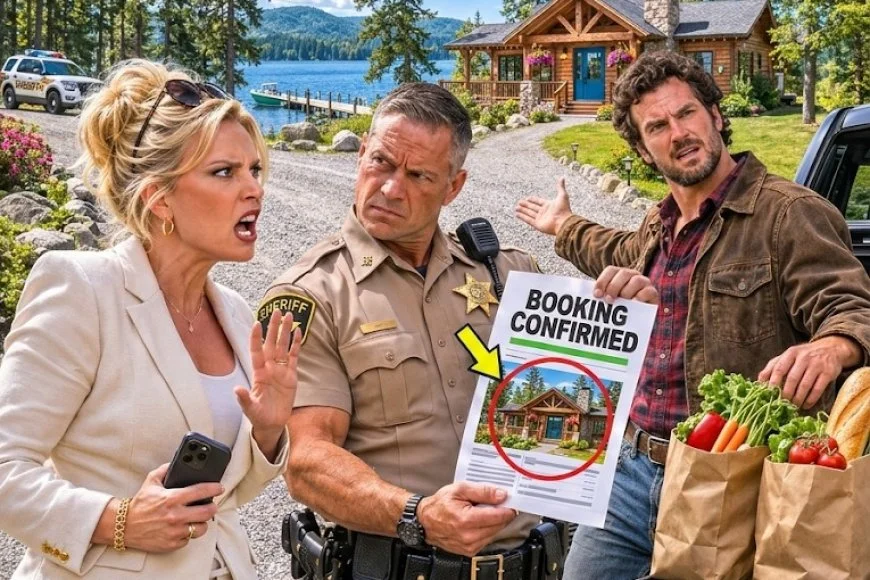
Amelia Grant called 911 while I stood on my own porch holding a bag of groceries.
Ten feet away, a family with two suitcases watched her point at my blue front door and tell the dispatcher I was forcing my way into an occupied rental.
The woman beside the suitcases stared at Amelia, then at me.
“This is his house?”
Amelia ignored her.
“My name is Warren Ellis,” I told the deputy when he arrived. “I live here.”
Amelia spoke over me. “He has no right to be here this weekend.”
That was when the woman stepped forward and handed the deputy her phone.
“You need to see what she sent us.”
The booking showed my address, my kitchen, my dock, and the porch my late wife Joan and I had painted blue.
Under HOST was Amelia Grant.
I had never rented my cabin to anyone.
The deputy scrolled through the messages.
Then he stopped.
A note sent that morning warned the family that an older man might appear and claim the property was his.
DO NOT LET HIM INSIDE. CONTACT ME IMMEDIATELY.
I looked at Amelia.
She hadn’t been surprised to see me.
She had planned for me.
Eight days earlier, I had found a black lockbox attached to my porch railing beside a wooden fish my grandson had painted at summer camp.
I was sixty-six, a retired refrigeration mechanic, and I had learned not to touch unfamiliar equipment before figuring out why it was there.
So I photographed the box first.
Then I called Amelia, president of Lake Briar HOA.
“It’s for the gutter program,” she said.
I had agreed to an exterior gutter inspection.
“I didn’t give anybody a key.”
“It doesn’t hold a key. It identifies participating properties.”
I emailed the gutter contractor.
His reply came that evening.
We do not use lockboxes and have not accessed your property.
I forwarded it to Amelia.
“Administrative mix-up,” she wrote.
The box vanished the next day.
I should have kept digging.
Instead, I told myself she had made another mistake.
Two days later, a cleaning van stopped outside.
A woman named Nicole climbed my steps carrying a mop bucket.
“Are you almost finished checking out?”
“I live here.”
Her face changed.
She showed me her work order.
TURNOVER CLEAN — CABIN 14.
My address.
Amelia’s phone number.
I called Amelia immediately.
She said the cleaner had been sent to the HOA guest cottage by mistake.
The two buildings were on different roads.
“Have you rented my cabin?”
“No.”
“Have you taken money for anyone to stay here?”
“Of course not.”
I asked her to put that in writing.
Her email arrived fifteen minutes later.
YOUR PROPERTY IS NOT ENROLLED IN ANY RENTAL PROGRAM.
I printed it.
Then I remembered the spare key.
Years earlier, Joan and I had left one with the HOA for genuine emergencies.
At the clubhouse, Ruth, the office assistant, opened the key cabinet.
My envelope was there.
Empty.
The log beside it showed Amelia had signed my key out the previous week for “contractor access.”
I canceled the HOA’s permission to hold any key and paid $260 to have both exterior locks changed that afternoon.
When I told Amelia, she went silent.
“You changed them?”
“It’s my house.”
She ended the call.
Two days later, I left to help my daughter.
I returned Saturday afternoon with groceries and found the family beside my porch.
Megan, her husband Paul, and their son Luke had paid $1,140 for three nights.
They thought I was the problem.
Until Deputy Ross read Amelia’s messages.
Then Megan opened another part of the reservation.
“There’s more.”
Attached was a service order for a locksmith.
INSTALL GUEST KEYPAD.
REMOVE EXISTING DEADBOLT.
The appointment was for four o’clock that afternoon.
I looked at my watch.
3:48.
Amelia had discovered I changed the locks and had ordered someone to remove them.
A white service van pulled into the driveway twelve minutes later.
The locksmith listened to the deputy, looked at my identification, and refused the job.
Then Ross asked Amelia for the agreement giving her authority to rent my cabin.
She marched to the clubhouse and returned with a blue folder.
Inside was a document carrying my signature.
Then I read the heading.
EMERGENCY PROPERTY ACCESS AUTHORIZATION.
It was the form Joan and I had signed years ago for frozen pipes and emergencies.
Amelia pointed at my signature.
“That authorizes the association to manage access.”
Deputy Ross read the page.
“This says emergency access.”
She produced a second form—the HOA’s voluntary rental program.
At the bottom was a space for the homeowner’s approval.
Mine was blank.
Ross looked at her.
“Where is Mr. Ellis’s signed enrollment?”
Amelia said the records were incomplete.
I stared at the folder.
They were complete enough to take $1,140 from a family.



