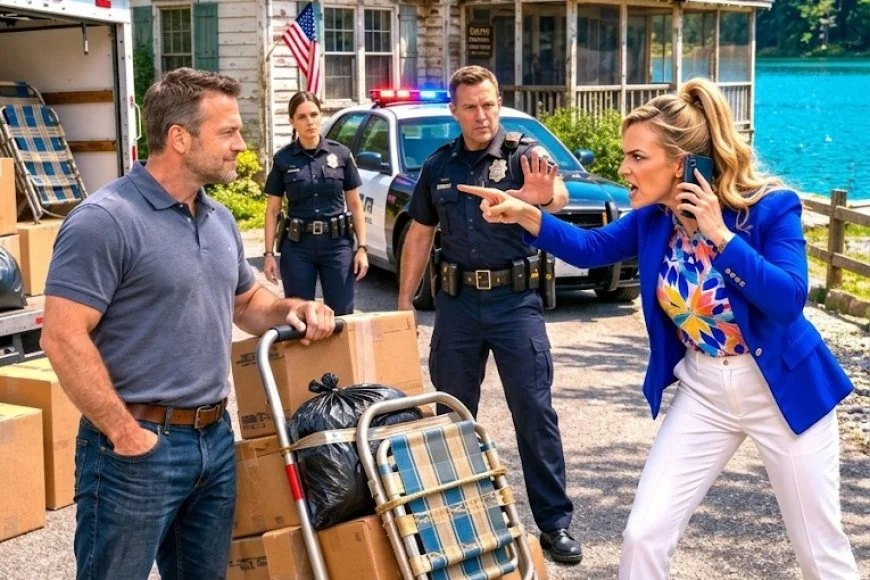
Then carried a sixty-pound toilet nearly four hundred yards in August heat.
That night, Brenda emailed all sixty-two homeowners.
For everyone’s safety, lakefront road access has been restricted to authorized HOA residents.
The next morning, I walked back into Doris’s office.
“One question.”
She smiled.
“What now?”
“Who owns the road?”
She pulled the parcel map.
Then turned the monitor toward me.
A highlighted strip ran straight through the block.
Parcel Six.
Owner: Colton Irwin.
Doris looked at me over her glasses.
“Well.”
“How long has my family owned it?”
“Since 1994.”
I almost laughed.
Instead, I took photographs of the barriers, the sign, and Brenda’s SUV sitting on my pavement.
Then I drove forty minutes to see Glenn Hutton.
Glenn was a semi-retired real-estate attorney who had handled several of Earl’s property deals.
He wore suspenders and kept paper files in cabinets older than I was.
He spread everything across his desk.
“She blocked your private road?”
“Yes.”
“She fined property outside her HOA?”
“Yes.”
“Have you paid anything?”
“No.”
“Good.”
Then I asked the question that mattered.
“If I legally closed that road, what happens?”
Glenn studied the map.
“That road is currently the subdivision’s only practical connection to the county highway.”
“How many homes?”
“Sixty-two.”
“So if I close it—”
“Sixty-two families have a serious access problem.”
I stared at the survey.
Brenda thought she controlled my property.
In reality, her entire subdivision depended on property Earl had owned for thirty years.
“I’m not closing it.”
Glenn nodded.
“Good.”
“Not unless I have to.”
That afternoon, Wade Prescott found me at the general store.
He was seventy-one and had lived beside Lakeview Shores since before the HOA existed.
“You’re Earl’s nephew.”
“That obvious?”
“You sit like him.”
I wasn’t sure what that meant.
Then he said:
“Brenda’s done this before.”
“How many?”
“Enough.”
A week later, Wade arrived at my porch carrying an old manila folder.
Inside were six years of HOA budgets, meeting minutes, and financial reports.
“Why do you have these?”
“Because nobody else kept copies.”
The HOA collected roughly $185,000 a year.
Reported expenses looked normal at first.
Roads.
Landscaping.
Pool maintenance.
Insurance.
Then one line caught my eye.
ROAD MAINTENANCE — $22,000 ANNUALLY.
“What road?”
Wade looked toward mine.
“That one.”
My road.
The HOA had been charging homeowners twenty-two thousand dollars a year to maintain property it did not own.
And according to Wade, very little maintenance had actually happened.
Then he showed me contractor invoices.
Companies nobody remembered seeing.
Administrative fees.
Repeated payments without detailed scopes.
Across several years, the unexplained difference approached hundreds of thousands of dollars.
I called Glenn.
“I think we found another problem.”
“How big?”
“Potentially four hundred thousand dollars.”
He was silent.
Then:
“Bring me everything.”
Two days later, Glenn called me back to his office.
His desk was covered with county filings.
At the center sat a petition.
PETITION TO ANNEX SOUTH LAKEFRONT BLOCK INTO LAKEVIEW SHORES ASSOCIATION.
Date:
May 2020.
At the bottom:
Earl T. Irwin.
My uncle’s signature.
Except it wasn’t.
I knew immediately.
Glenn wasn’t convinced.
“It’s close.”
He placed Earl’s older deeds beside it.
Same looping E.
Same slope.
Same tail on the last name.
Whoever wrote it had practiced.
Then Glenn showed me the medical timeline.
Earl suffered a stroke in March 2020.
His right hand was partially paralyzed afterward.
Bank records from the remaining year of his life showed shaky left-handed signatures.
The annexation petition was dated two months after his stroke.
Its signature was smooth.
Right-handed.
Nearly identical to Earl’s pre-stroke handwriting.
Then Doris found the mistake that made Glenn stop arguing about coincidence.
The notary information didn’t match the petition’s timeline.
The notarization record referenced a commission detail that did not align with the date the petition supposedly had been executed.
Glenn looked at me.
“This needs investigation.”
I stared at Earl’s name.
For four years, I had thought probate was the hardest part of inheriting his land.
Now I understood that while Earl had been recovering from a stroke, someone had filed paperwork claiming he voluntarily placed everything he owned under Brenda Saxton’s HOA.
And those same papers were the foundation beneath every fine she had sent me.
Glenn slid the petition into a clear evidence sleeve.
“Do not confront her.”
“What do we do?”
“We stop arguing about fines.”
He closed the file.
“And start asking who created the authority she’s been using.”
Glenn sent a formal demand to all five HOA directors requesting the annexation records, financial books, road-maintenance contracts, and immediate suspension of every fine against my property. Brenda ignored it.
Then Wade introduced me to Lorraine Buckley, the HOA’s former treasurer.
She carried six years of bank records on a flash drive.
“I got removed from the board for asking why our numbers didn’t match,” she said.



