I searched the contractor license printed on the invoices.
Valid.
Owner: Peter Kowalski.
At eight the next morning, I called him.
“Mr. Kowalski, did your company replace the roof at Desert Oasis?”
Silence.
Then:
“Where?”
“Desert Oasis HOA in Scottsdale.”
“I have never worked there.”
My pulse quickened.
“I have four invoices with your company name totaling one hundred twenty thousand dollars.”
The background noise disappeared.
“Give me your address.”
Forty-two minutes later, a battered F-250 stopped in my driveway.
Pete Kowalski stepped out.
Steel-toed boots.
Faded shirt.
Hands like concrete blocks.
I showed him the invoices.
His face changed immediately.
“That is not my letterhead.”
He pointed at the license number.
“That is my license.”
Then the company address.
“Not mine.”
He looked at me.
“Somebody stole my business identity.”
We walked to the clubhouse.
Pete examined the roof for less than five minutes.
He squeezed exposed wood beneath the gutter.
It crumbled in his hand.
“No roof replacement.”
He pointed toward the foundation.
“No sealing.”
Then he looked up at the sagging tile line.
“No serious structural work at all.”
“So the invoices are fake.”
“All four.”
He turned toward me.
“Where did the money go?”
I looked down at the spreadsheet on my phone.
“That’s the next thing I’m going to find.”
Back home, I opened the cleared-check images.
On the back of each was deposit routing information.
I began tracing the account.
The destination was not Peter Kowalski’s company.
Not even close.
It was an LLC using a private mailing address.
I pulled the Arizona business record.
The registered owner appeared on my screen.
I read the name twice.
Richard Sterling.
The same man trying to foreclose on my house had approved $120,000 in fake HOA construction payments and routed the money into a company he controlled.
Then I noticed the date of the next annual HOA meeting.
Tuesday.
Richard’s budget presentation was the main event.
And my foreclosure was item number one.
Pete and I took everything to Detective Sarah Higgins with Scottsdale financial crimes. At first, she treated it like another angry HOA dispute—until Pete placed his contractor logs beside the forged invoices and proved his crews had been working forty miles away on every date Richard claimed they were repairing our clubhouse.
Then I showed her the cleared checks.
The money had left the HOA reserve fund under Pete’s stolen business identity and entered an LLC registered to Richard.
Sarah’s expression changed.
“This isn’t bad bookkeeping.”
“No.”
“This is a fraud case.”
She began the process of obtaining bank records, but she wanted one more thing before moving publicly.
Intent.
A defense attorney could claim Richard had made an accounting mistake, used the wrong vendor information, or believed the work had actually been performed.
We needed him to verify the lie himself.
I knew exactly where he would do it.
The next evening was the annual HOA meeting.
Richard was required to present the reserve-fund expenditures to more than two hundred homeowners.
He had also placed my supposed foreclosure first on the agenda because he wanted everyone to watch what happened to residents who challenged him.
Sarah agreed to stay nearby while Pete and I attended.
The plan was simple.
First, I would destroy the foreclosure argument using the state statute.
Then I would ask Richard about the $120,000 clubhouse project.
If he admitted the invoices were false, the neighborhood would hear it.
If he insisted they were real, Pete would identify himself.
And if Richard publicly confirmed that the ghost work had been completed and paid exactly as recorded, Sarah would have the statement she wanted.
Richard thought Tuesday night was going to be my public execution.
By seven o’clock, every chair in the clubhouse was full.
Then he projected my foreclosure notice onto a ten-foot screen.
Richard stood behind the podium and displayed my name on the screen beneath the words “FORECLOSURE ACTION PENDING.” He announced that my unpaid trash-can fine had been converted into an assessment and warned residents that the HOA would take my home.
I stood and read the state statute aloud. Penalty fines and their attached fees did not become foreclosable merely because the board renamed them.
When residents began asking whether the board could do the same to them, I opened the financial records Richard had dumped on my porch.
Over fourteen months, Desert Oasis had paid $120,000 to Kowalski Prime Builds for a roof replacement and waterproofing. Richard publicly confirmed that he had approved the invoices and insisted the work had been completed.
Then Pete walked down the aisle carrying his contractor’s ledger.
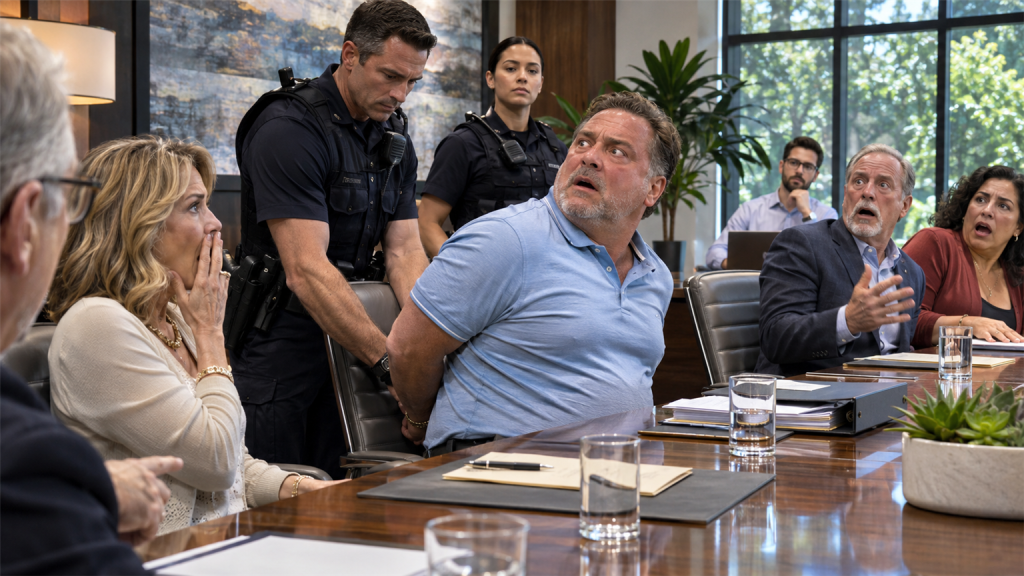
“My name is Peter Kowalski,” he said. “I own Kowalski Prime Builds, and I have never worked for Desert Oasis.”



