The judge considered his response.
Then she granted the emergency injunction.
Our joint assets, including the house and business, would be frozen pending further proceedings. Unauthorized transfers, refinancing, or liquidation could result in contempt proceedings.
She also referred the forgery allegations to the district attorney for review.
Under the table, Tanya squeezed my hand.
“That’s the freeze,” she whispered.
I looked at Daniel.
He wasn’t arguing anymore.
For months, I had been trying to find out where our money had gone. Now a court had ordered that he could not simply move the remaining assets without approval.
Two weeks later, Detective Nair called while I was folding laundry in Rachel’s guest room.
The district attorney’s office had reviewed the evidence.
Daniel was being charged with forgery of a financial instrument and felony theft by deception involving diverted company funds.
Natalie was also facing a charge of conspiracy to commit theft by deception.
Her role as owner of the receiving entities had become part of the criminal case.
I sat on the edge of the guest bed with a towel in my hands.
“What happens now?” I asked.
“Now it goes through the system,” Detective Nair said.
There would be an arraignment and further court proceedings. Negotiated pleas were possible, but no particular outcome was guaranteed.
The criminal case would proceed separately from the divorce.
Three weeks after the arraignment, a local business journal published an article about the fraud charges.
The article discussed money routed through shell entities and a forged signature on a home-equity application.
It didn’t name me.
People who knew our family understood the connection anyway.
Eleanor called again after the article appeared.
Her message was different this time.
“Claire, I didn’t know about the money. I want you to know that. I knew about Natalie, but I didn’t know about the rest.”
I believed that she probably hadn’t known about the financial transactions.
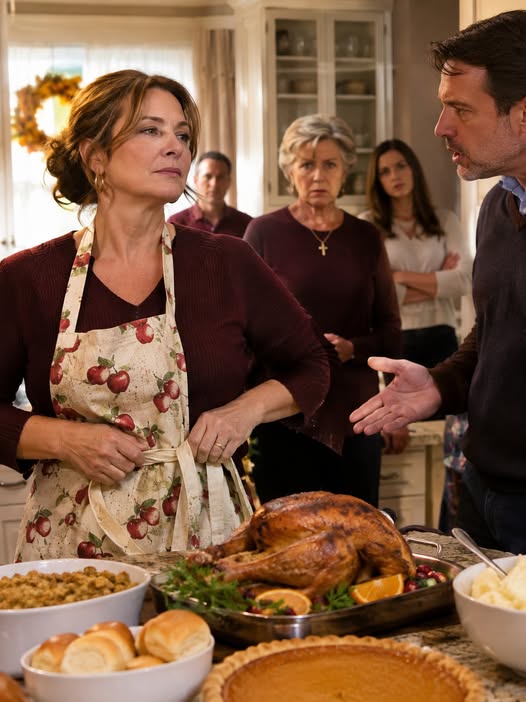
But I remembered her standing in my kitchen while Daniel told me he wanted a divorce, expecting me to finish preparing Thanksgiving dinner.
She had known enough to understand what he was doing to me that afternoon.
I didn’t call her back.
The financial scandal eventually made it impossible for Daniel’s company to continue operating.
The business partners Marcus had interviewed dissolved the company rather than let the fraud proceedings destroy whatever remained of its reputation.
Daniel lost the business that had occupied so much of our marriage.
Natalie’s professional consulting license was suspended pending the outcome of her case.
Months later, I looked at her social media once.
The photographs of ribbon cuttings, business events, and expensive trips had stopped appearing.
I closed the page and didn’t return.
The divorce settlement eventually awarded me sole ownership of the remaining business assets.
I was able to sell those assets and recover part of the money Marcus had traced, though not all of the $340,000 came back.
Some of it had already been spent.
Tanya explained that there was no practical way to recover every dollar.
I had to accept that financial restitution could not make twelve years of work, trust, and marriage reappear.
But I kept the house free and clear.
The place where I’d raised my children would no longer be threatened by a refinancing application I had never authorized.
In the spring, Daniel accepted a plea agreement.
He received an eighteen-month suspended sentence, probation, and a restitution obligation. His cooperation and lack of a prior criminal record were factors in the outcome.
Natalie accepted a similar agreement with a smaller restitution obligation reflecting her secondary role.
Neither outcome restored my marriage or brought back every dollar.
But their conduct was now formally documented, and both faced consequences beyond simply ending a relationship.
Almost a year after that Thanksgiving, I encountered Eleanor in a grocery-store parking lot across town.
She looked tired and much smaller than I remembered.
“Claire,” she said.
“Eleanor.”
We stood there for a moment, neither of us moving closer.
Then she got into her car, and I got into mine.
That was our entire conversation.
I didn’t feel a need to argue with her. There was nothing left I wanted her to admit.
By then, I had stopped waiting for Daniel’s family to acknowledge what had happened to me.
The people who had supported me had already shown where they stood.
Rachel had given me a place to live while I sorted through the divorce. Tanya had helped protect my legal interests. Marcus had traced the money. And my children still had a mother who could give them a home and a Thanksgiving dinner without pretending everything was fine.
The following Thanksgiving, almost exactly a year after Daniel announced he was leaving me, I cooked for a much smaller gathering.
Rachel came with her husband. My two children were home from college.



